
Why Novus ordo and not just vernacular

  • Thread starter Thread starter Jragzz123
  • Start date Start date
Status
Not open for further replies.
Why was a whole new mass written instead of just translating the Latin mass to English?
Because the actual aim of the Novus Ordo wasn’t the use of vernacular language. Latin was meant to be retained, unfortunately the ambiguous language allowed for the use of vernacular language to spread to the entire celebration of the Mass.

I don’t buy the argument that the NO is more authentic to the ancient form. There’s no historical proofs to back that argument and you can’t use a time period where in the early Church was forced to celebrate in secret and in hiding and say that we need to adopt those same practices.
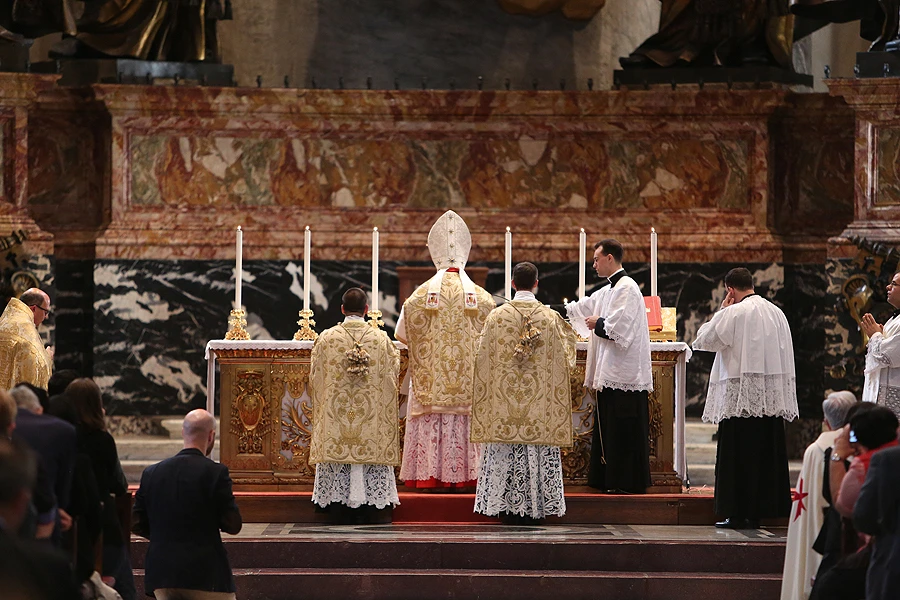
 
Fancy dress worn by the Priest during the Mass
Surely you jest. A few pics from the EF Mass:

(Please Note: This uploaded content is no longer available.)


I don’t think I’ve ever seen as much lace in a Victoria’s Secrets catalogue!!!
 
Because the actual aim of the Novus Ordo wasn’t the use of vernacular language. Latin was meant to be retained, unfortunately the ambiguous language allowed for the use of vernacular language to spread to the entire celebration of the Mass.

I don’t buy the argument that the NO is more authentic to the ancient form. There’s no historical proofs to back that argument and you can’t use a time period where in the early Church was forced to celebrate in secret and in hiding and say that we need to adopt those same practices.
I hear these two arguments all the time, and I wonder about them. These arguments assume two things.

First, that the 5,000 or so bishops of the Church completely misunderstood the liturgical reform, and maintained that misunderstanding for 50 years. Does that seem reasonable? That thousands of bishops simply misunderstood what was supposed to happen with the Mass? Or is it more likely that the bishops are faithfully following through with the reform of the liturgy, with a small minority disagreeing?

Second, that the Church does not understand its own history and its own liturgy, which is better understood by those that prefer the extraordinary form. Again, that requires either believing that the thousands of dedicated (and consecrated) professionals that have worked on this over the last 50 (or 75) years got it completely wrong, or that the Church is deliberately misleading the faithful for some reason.

I am not saying the bishops are always right, or that no mistakes have been made. The Church even implicitly admits that, by making some adjustments along the way. But the idea that the reform was accidentally misinterpreted is just not credible; and the idea that it was a deliberate fraud is not supported by any evidence I have seen.
 
there’s nothing to suggest that if the EF were made normative again, the same people doing injury to the OF liturgy wouldn’t be doing injury to the EF liturgy.
True, and the kind of priests who offer both the EF and OF have a very reverent OF.

But still a vernacular EF should be available. There ** are** elements on the EF that are subdued in the OF even when offered reverently and many people likely miss them. But these elements, including Ad Orientem, do not require Latin.
 
why are the liturgical norms of the NO so little respected, and why has the TLM never had this problem?
I can recall my father talking about serving early morning Mass in the 1950’s.
Frequently the priest was tired; so the entire Mass would be said in under 10 minutes.

I somehow doubt all of the liturgical norms could be practiced with such a timeframe.

I don’t think the TLM was immune to abuse. It is more likely a difference in attitude. People feel more comfortable discussing what they observe as wrong under the Novus Ordo.
 
The liturgical water will seek its own level. For our part, we are called to be patient, i.e. to suffer without complaint.

A tall order.
 
As Pope Benedict wrote in the Spirit of the Liturgy, what’s more old fashioned? To go back 2000 years or to go back 500? Not sure why the EF is such a controversial topic on these forums nowadays. Didn’t used to be that way.
 
Last edited:
If you are feeling that way, perhaps others in your area are too. Get a few together and form an Anglican group for evening prayer. Once recognized you could bring a Priest in to celebrate Mass.
 
Last edited:
Well do you think treating even the tiniest parcel of the Eucharist reverently is essential? I do.

The church can and has been in the wrong in the past
Well, according to you, the Church is just flat lying right now. Still waiting for an explanation of that serious allegation.
 
Typical. Ignore the question.
You are the one ignoring the question. Your claim is that the Church is lying about the liturgy. That was your statement. Its a pretty serious thing. I just want to know why you think that. I think its a fair question.
 
I very much agree with this and have stated as much on this forum in the past. While I greatly appreciate the EF Mass… I rarely attend as I have access to reverent, well celebrated OF Masses. The OF Mass, chanted and with generous use of incense, can be just as beautiful as the EF Mass.
 
I don’t think it’s a lie… and I think the OF Mass is beautiful when properly and reverently celebrated. …but it is my understanding that more recent scholarship has challenged some of the “party line” of the 1970s. For example, people were told that the priest “faced the people” until well into the Middle Ages. We now know that Ad Orientem is indeed an ancient practice, even if there has been variation in various times and places. (Of course the OF Mass can be celebrated Ad Orientem as well).
 
First, that the 5,000 or so bishops of the Church completely misunderstood the liturgical reform, and maintained that misunderstanding for 50 years. Does that seem reasonable? That thousands of bishops simply misunderstood what was supposed to happen with the Mass? Or is it more likely that the bishops are faithfully following through with the reform of the liturgy, with a small minority disagreeing?
The problem is that many of the liturgical reforms that ultimately took place, weren’t even discussed at the council. Which is why men like Marcel Lefebvre signed those documents. The changes were subsequently implemented in the years after the council closed. The outcry came after the changes were shown to be far more than what was originally thought.
 
In all respect, you should probably reread that exchange.
You said that the assertion that the reform of the liturgy was based on ancient forms of the liturgy is a lie. It is the Church making that assertion. What am I misreading?
 
The problem is that many of the liturgical reforms that ultimately took place, weren’t even discussed at the council. Which is why men like Marcel Lefebvre signed those documents. The changes were subsequently implemented in the years after the council closed. The outcry came after the changes were shown to be far more than what was originally thought.
And those changes were implemented by those same thousands of bishops. So did the bishops vote for one thing, then go home and immediately forget what they decided to do? How did it get so out of whack? Did none of the bishops notice? Or is it more likely that the changes were implemented in the manner intended, by the same people who agreed to those changes, but a few disgruntled people now claim otherwise?
 
Status
Not open for further replies.
Back
Top