Will there be EC in America in 40 years?

  • Thread starter Thread starter Madaglan
  • Start date Start date
Status
Not open for further replies.
He emigrated in 1905, under polish citizenship, via Krakow, then returned and brought the family over in 1908. I know from the photos that they did not live in Krakow; one of them is from the trip to Krakow.

I am told he avoided discussing the old country.
He was probably a Rusin like Pope John Paul II’s mother.

Galicia was part of the Austrian kingdom at that time. My grandparents came from the region of Tarnow, closer to Krakow than any other big city. They were definitely Polish though.

Galicia was once inhabited by Celts, but they were either adsorbed or expelled by the White Croats, a Slavic people who are likely the ancestors of all the Poles and Ukrainians in Galicia, from east of L’viv to west of Krakow.

The people of “Little Poland” were originally evangelized when the area was part of the Moravian kingdom, into the Byzantine rite. Later the newly evangelized kingdom of Poland expanded to include the area and suppressed the Byzantine rite in southern Poland (and anywhere else it had spread by then) but the Rusyn were border people and probably were able to escape the consolidation.
 
Galicia was once inhabited by Celts, but they were either adsorbed or expelled by the White Croats, a Slavic people who are likely the ancestors of all the Poles and Ukrainians in Galicia, from east of L’viv to west of Krakow.
Actually, if you look at Paul Magocsi’s Atlases of Ukraine and Eastern Europe you will see that the original homeland of All Slavs - Eastern, Western, Southern - in the middle of the first millennium A.D. was actually in Galicia, Eastern Poland, and Central/Western Ukraine. If you take a horizontal line from Cracow through Halych (capital of Galicia) to Ukraine’s capital Kyiv and you add some hundreds of kilometers either side, this is the original homeland of the Slavs before their migrations set in with some going south to the Balkans (the South Slavs), some further west, and some to the North. So in effect this area provides the ancestors not just for all Poles and Ukrainians, but all Slavs for that matter, from Russian to Croat. Magocsi: “…all do agree that the original Slavic homeland was located in present-day northwestern Ukraine, southwestern Belarus, and eastern Poland”.

By the 7th Century A.D. you find separate Slavic tribe differentiation, the Mazovians (west Slavs) in Poland, the Poliany, Derevliany, Bili Horvaty, (East Slavs) in Ukraine, and so forth.

But I just thought I’d point out that the area you referenced is more than just the homeland of Poles and Ukrainians in Galicia; it is part of the original homeland of all Slavs, which was situated here and not in the Balkans, or in Russia. The Slavs would arrive in those areas later. 🙂

But the Horvaty (translated Croats) were one of the East Slavic tribes (along with the Duleby) for this area of western Ukraine, eastern Poland.
 
Michael, on the Celts, there was one Celtic tribe that inhabited parts of the Dnister valley around the Carpathians/western Ukraine, and the Danube delta. The tribe was called Basternae and they appeared around 230 BC in southern Ukraine and the lower Danube where they raided Greek colonies. In AD 279 Roman Emperor Probus transplanted about 100,000 Bastarnae to Thracia, south of the Danube, after which their name disappeared from history.

They left a settlement in Mukachiv as well. The original homeland of the Slavs and their sedentary population experienced the onslaught of many nomadic tribes as well; heck, the Goths went through the Slavic homeland from the north in the early centuries A.D. to get to the Greek colonies in Crimea.

One group of Slavs, known as the Antes, are considered by some scholars to have formed the first Slavic state in what is modern day Ukraine in the middle of the first millennium A.D.

Anyway, I am taking this thread way off topic now.
 
Hi Vico:

I was looking at your map. It never even dawned on me that Austrians and Germans were Catholic and Orthodox. My husband has family from Greece, Germany, Austria, and Scottland. I always presumed the Greek part was Greek Orthodox but I never thought about the other countries. Do you happen to know the predominant religons in Germany, Austria in around 1881-1910? I’m just curious. He is a Methodist convert to the Catholic faith and his family has no idea of their religious background so it would be interesting to know what the people of his country of origin originally were.

Thanks and Many blessings.
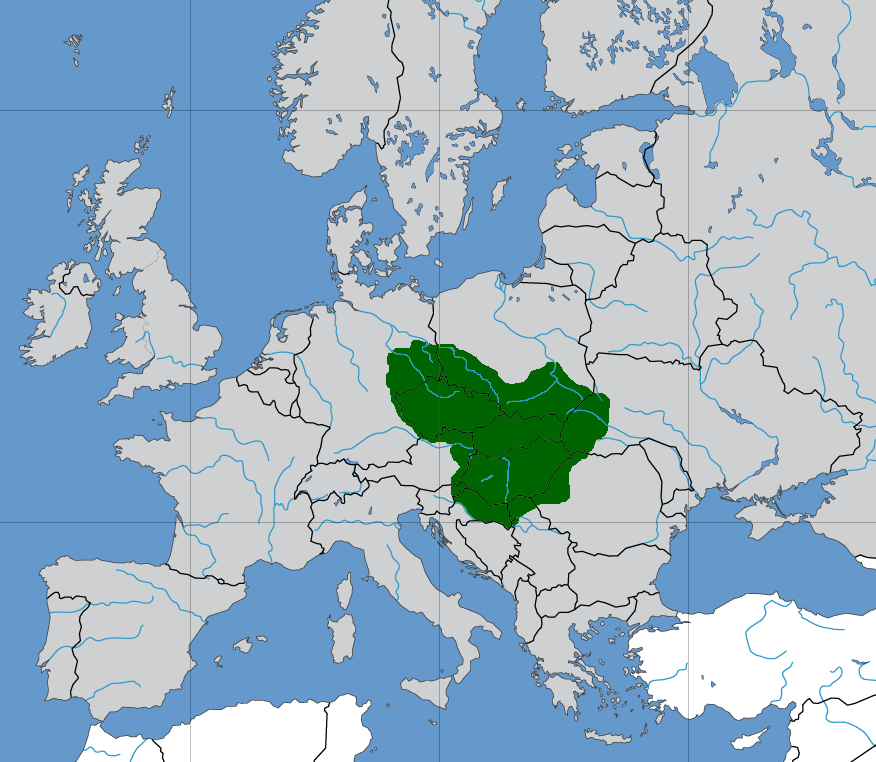
I believe that the Germans which moved into areas where Orthodoxy were predominant were of Catholic or Reformation churches. Some may have converted to Orthodoxy in those areas, but I do not know of any statistics on this (I looked). The Slavic areas that Constantine (St. Cyril) and St. Methodius brought Christianity to are defined (with controvery) as the area in green on the map below, with the current countries boundaries shown. It includes part of today’s Poland in the south, Czech Republic, Slovakia, portions of Ukraine, and Hungary, etc. The Union of Brest and Union (1595) of Uzhorod (1646) brought some Greek Catholics from Greek Orthodoxy.

(The ancient Roman rulers had partitioned into west and east along the vertical section of the Danube which is through the middle of Hungary, and did not venture into the barbarian territories north of the Danube or Rhine. So the barbarian territories received Christianity later.)

 
The Slavic areas that Constantine (St. Cyril) and St. Methodius brought Christianity to are defined (with controvery) as the area in green on the map below, with the current countries boundaries shown. It includes part of today’s Poland in the south, Czech Republic, Slovakia, portions of Ukraine, and Hungary, etc. The Union of Brest and Union (1595) of Uzhorod (1646) brought some Greek Catholics from Greek Orthodoxy.
Quite so.

So far as Poland is concerned, the pagan Prince at Gniezno (Mieszko) converted to Latin Christtianity under the unfluence of the Holy Roman (Frankish-Germn) empire in 966AD. This was about 100 (more or less) years after Byzantine Catholicism had been introduced into that portion of Great Moravia which was to become southern Poland (with the annexation of Krakow). One might suppose the Byzantine rite came to symbolically represent the old regime of Krakow. It seeems to me the the Holy Roman empire was intractibly hostile to the eastern rite, so it is also possible the king might have banned the rite in order to not give them an excuse to attack.

A short story which goes a little way toward explaing how the southern Poles eventually became entirely absorbed into the Latin rite is here. The Rusyn in the mountains must have been largely out of reach of the king’s enforcers at that time, for they never gave up their dialect nor their religious practices and bishops.

I think that this earlier presence of the Byzantine - Methodian rite goes a long way to explaining how some of the minor customs of the Catholic church in Poland parallel the Orthodox practices of their neighbors.

One custom I can think of is the reception of the bishop with bread and salt ( a relic custom still practiced by the PNCC as a “traditional Polish” trait). The second I can think of is the blessing of Easter Baskets in Holy Saturday.
 
I think that this earlier presence of the Byzantine - Methodian rite goes a long way to explaining how some of the minor customs of the Catholic church in Poland parallel the Orthodox practices of their neighbors.

One custom I can think of is the reception of the bishop with bread and salt ( a relic custom still practiced by the PNCC as a “traditional Polish” trait). The second I can think of is the blessing of Easter Baskets in Holy Saturday.
The idea that these practices are a legacy of the early, common Byzantine Christianity is a very curious theory. I think that it is commonly understood that the practices stem from ancient practices of pagans - Slavs, or perhaps beyond Slavs. Svjatyj vecher too Dousing on Eastern Monday? I have heard that is a “Latinization”.
 
I think the ability of Eastern Catholicism not only to stick around, but flourish in North America will depend oh her ability to inculturate. If they become more enticing for other ethnic groups, the faster they can grow their congregation in North America. The healthier the Church here will be.
 
I think the ability of Eastern Catholicism not only to stick around, but flourish in North America will depend oh her ability to inculturate. If they become more enticing for other ethnic groups, the faster they can grow their congregation in North America. The healthier the Church here will be.
Byzantine Catholics MUST disappear if we are to live out our vocation…we must become Orthodox.
 
Byzantine Catholics MUST disappear if we are to live out our vocation…we must become Orthodox.
Its the Orthodox who must become Eastern Catholics in union with the heir of Peter 😉
 
Its the Orthodox who must become Eastern Catholics in union with the heir of Peter 😉
I thought that the Eastern Orthodox rejected the Uniate model for reunion. I don;t see the EO accepting the infallibility or the universal supremacy of the Roman Pope.
 
I thought that the Eastern Orthodox rejected the Uniate model for reunion. I don;t see the EO accepting the infallibility or the universal supremacy of the Roman Pope.
Compare the words I used with yours. I never used the words you did. I think we’re talking about different things.
 
I’ve seen fallen away Roman Catholics come back to the church after being away, ten, twenty, thirty, and even forty years. There’s no reason they can’t come back to EC churches as well. A couple things I remember being told at EC Churches over the years which convince of that are 1. The large numbers that only turn up at Easter and Christmas. 2. The claims I’ve heard from parishoners, that in many cases, the fallen away live closer than some of the regular attendees.
 
I’ve seen fallen away Roman Catholics come back to the church after being away, ten, twenty, thirty, and even forty years. There’s no reason they can’t come back to EC churches as well. A couple things I remember being told at EC Churches over the years which convince of that are 1. The large numbers that only turn up at Easter and Christmas. 2. The claims I’ve heard from parishoners, that in many cases, the fallen away live closer than some of the regular attendees.
I don’t disagree with you.

It does happen, but in most of those cases the children/grandchildren have been raised in another tradition. If they are also fallen-away, they have left another tradition. This is important when discussing the future of the EC.
 
Then how does your proposal differ from what Sid has posted?
I just said communion. I never said it had to be a uniate. They will have to accept the Pope, but it doesn’t necessarily have to be the current definition.
 
Status
Not open for further replies.
Back
Top