Dear Lynn and Leaf: Too much tail chasing here. Let’s stop going in circles and deal with something simple. Answer this. What percentage of all the greenhouse gases are caused by mankind?
I’m guessing nearly 30% of the CO2 in the atmosphere is human-caused (see below).
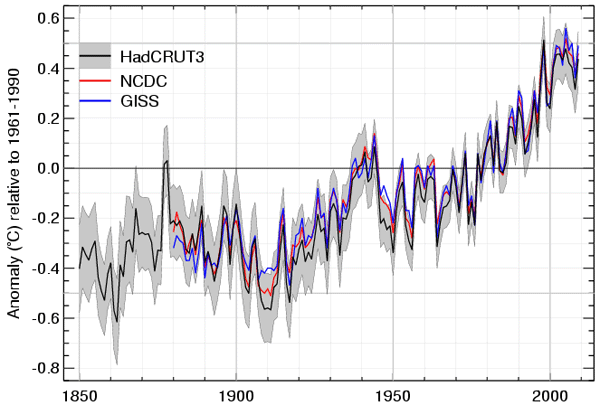
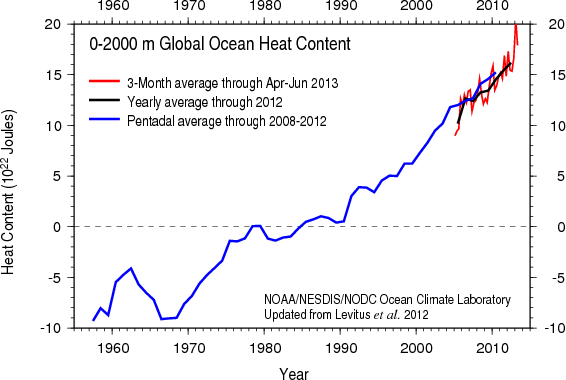
Another answer to the Q of what percentage of all the GHGs are caused by humans: Enough to be the main cause for the current level of warming (about 0.8C, which may reach 2.4C once equilibrium is reached – see below). Other GHGs (at this point*****) are in a natural back and forth flux. Plants take in CO2 (during photosynthesis), animals (and plants at night) breath them out.
The natural GH effect keeps the earth warm enough for life to exist. That is surely the most abundant level of GHGs, because it keeps the earth warmed about 33C more than it would be without those gases. (However, note that the function of CO2 causing warming is a log function, not a straight line, so that initial amount of 280 ppm has the biggest warming effect…of about 33C.)
The important “forcing” GHG is CO2, since it is more abundant and has a longer residence in the atmosphere than CH4 (partly from natural gas leakage, livestock, and paddy fields, etc) and NOx (partly from auto emissions, synthetic fertilizers, etc). The other GHGs, human-produced chemicals, tho quite potent GHGs, are not in such a vast quantity as CO2. H2O is a potent GHG and is more abundant than other GHGs, esp with the warming, but it is a “feedback” to these forcing GHGs – more of it goes into the atmosphere due to the warming, so in effect a portion of that water vapor in the atmosphere was put there by the warming which humans caused. That portion is to be figured in GHGs “caused by humans.”
CO2 in the atmosphere has gone from about 280 ppm in pre-industrial times to currently 400 ppm (see
co2now.org/Current-CO2/CO2-Now/ ) – that’s about 120 ppm more – which would come out to about
30% of the present 400 ppm is mainly from human emissions.
From what I have read, the current amount of CO2e (including the other GHGs) would cause the earth to warm (high-end projection) about to about 2.4C above pre-industrial levels once it all plays out (there is a lag time between emissions and warming), assuming there are no further GHG emissions, which is a wrong assumption.
*****Once the climate reaches 2 or 3C warmer, this will cause vast releases of CH4 stored in hydrates and permafrost (it’s already happening to some extent) – and tho CH4 has a shorter residence in the atmosphere, about 10 years, it degrades into CO2+ – after which temps will continue to rise along with increasing emissions from “nature” until we get to 6C warmer in 100 to 200 years, and perhaps even 10C warmer thereafter in centuries and millennia to come. This would most certainly kill off much of life on earth, including humans. Such warming and its knock-on effects during the end-Permian 251 mya killed off about 95% of life (tho life then was less resilient than today).
The ideal ppm of CO2 top climate scientists tell us to avoid this nightmarish scenario is 350 ppm. This means we need to reduce our GHG emission enough to allow nature to absorb more CO2 than is being emitted, until we can get it down to 350 ppm or less. It’s getting to be more and more difficult for that to happen, however, with all the wildfires, droughts, floods, and ocean acidification (increased by AGW) reducing plant-life on earth, it seems faster than CO2 fertilization can help plants grow more.
So I guess eventually as nature releases vast gigatonnes (perhaps teratonnes) of carbon (CH4, CO2) as a response to the increasing warming, skeptics can rest assured that the portion of directly human-caused GHGs in the atmosphere will not be very great compared to the GHGs under the natural GH effect plus those added from melting hydrates and permafrost.