
You are using an out of date browser. It may not display this or other websites correctly.
You should upgrade or use an alternative browser.
You should upgrade or use an alternative browser.
- Status
- Not open for further replies.

A
A_Augustinus
Guest
Wow. I was following this thread a few days ago when it was at about 14 pages of replies. Now it’s up to 21. I haven’t read every post, but I think this debate largely confirms something I’ve noticed for a while now.
This entire debate about the science is just a proxy war. The real underlying fight is between conflicting policy ideas. And that is true for both sides of the debate. People who want to see major government intervention to reduce CO2 emissions think that if they could just educate people about the science, they would support government action. At the same time, those who don’t want the government to curtail CO2 emissions strive mightily to refute their opponents’ scientific arguments.
Why has the science become the battle ground? Why not argue about the proposed policies and leave the science in peace? The only answer I can come up with is that both sides implicitly accept this premise: If anthropogenic global warming (AGW) is real, we must act to stop it. So the people who want to stop it spend their time trying to convince everyone that AGW is real. And the people who don’t want the government to get involved spend their time arguing that AGW is not real (or that it’s not certain).
I don’t think that underlying premise is true. The fact is, policy decisions ought to be based on more than just climate science. Even if AGW is real, it may be costlier to try to stop it than to adapt to it (at least in the short term). That’s a very legitimate economic consideration. So the policy debate is much broader and encompasses more disciplines. Fighting over minute details of climate science will not resolve the policy debate.
This entire debate about the science is just a proxy war. The real underlying fight is between conflicting policy ideas. And that is true for both sides of the debate. People who want to see major government intervention to reduce CO2 emissions think that if they could just educate people about the science, they would support government action. At the same time, those who don’t want the government to curtail CO2 emissions strive mightily to refute their opponents’ scientific arguments.
Why has the science become the battle ground? Why not argue about the proposed policies and leave the science in peace? The only answer I can come up with is that both sides implicitly accept this premise: If anthropogenic global warming (AGW) is real, we must act to stop it. So the people who want to stop it spend their time trying to convince everyone that AGW is real. And the people who don’t want the government to get involved spend their time arguing that AGW is not real (or that it’s not certain).
I don’t think that underlying premise is true. The fact is, policy decisions ought to be based on more than just climate science. Even if AGW is real, it may be costlier to try to stop it than to adapt to it (at least in the short term). That’s a very legitimate economic consideration. So the policy debate is much broader and encompasses more disciplines. Fighting over minute details of climate science will not resolve the policy debate.
S
sps49
Guest
The permutations easily exceeds N=2. While there are no doubt ideological biases at work, I have heard dialog from both sides (for the most part) expressing a desire to know the underlying details of the physical processes at work. Endless graphs of time series data do nothing to advance the argument. The only way we understand processes in nature is by observation, hypothesis, and test. In my opinion, scientists should not be subjected to a political process that reduces them and their work to a type of directed technocracy.Wow. I was following this thread a few days ago when it was at about 14 pages of replies. Now it’s up to 21. I haven’t read every post, but I think this debate largely confirms something I’ve noticed for a while now.
This entire debate about the science is just a proxy war. The real underlying fight is between conflicting policy ideas. And that is true for both sides of the debate. People who want to see major government intervention to reduce CO2 emissions think that if they could just educate people about the science, they would support government action. At the same time, those who don’t want the government to curtail CO2 emissions strive mightily to refute their opponents’ scientific arguments.
Why has the science become the battle ground? Why not argue about the proposed policies and leave the science in peace? The only answer I can come up with is that both sides implicitly accept this premise: If anthropogenic global warming (AGW) is real, we must act to stop it. So the people who want to stop it spend their time trying to convince everyone that AGW is real. And the people who don’t want the government to get involved spend their time arguing that AGW is not real (or that it’s not certain).
I don’t think that underlying premise is true. The fact is, policy decisions ought to be based on more than just climate science. Even if AGW is real, it may be costlier to try to stop it than to adapt to it (at least in the short term). That’s a very legitimate economic consideration. So the policy debate is much broader and encompasses more disciplines. Fighting over minute details of climate science will not resolve the policy debate.
A
A_Augustinus
Guest
You’re definitely right. The situation isn’t as clear-cut and simple as I described, but in debates I’ve observed, the continuing argument seems to be driven onward by the basic opposing viewpoints I described. I’ve discussed climate science with a variety of people, and it frustrates me when I perceive (quite often) that a person is completely unwilling to consider scientific evidence. To me, that strongly indicates an underlying ideological bias. I think it’s unfortunate and quite frankly annoying that scientific questions have become an ideological battleground. The science should inform the policy debate. It shouldn’t become a proxy battleground for policy fights.The permutations easily exceeds N=2. While there are no doubt ideological biases at work, I have heard dialog from both sides (for the most part) expressing a desire to know the underlying details of the physical processes at work. Endless graphs of time series data do nothing to advance the argument. The only way we understand processes in nature is by observation, hypothesis, and test. In my opinion, scientists should not be subjected to a political process that reduces them and their work to a type of directed technocracy.
W
weller2
Guest
W
weller2
Guest
Ah, yes the gool old times when the Catholic Church realized the practical necessity of population controlThe population of Europe went from about 30 million to nearly 90 million just before the Black plague. The towns and cities were teeming with poor people, so much so that some scholars think the ‘Children’s Crusade’ was merely an effort to get rid of excess population.

Here’s the deal though. The medieval Europe was running on solar power – plants use solar energy to grow, so people would grow wheat, and either eat it or feed it to horses which would then produce power. So their energy flows were:
sun → wheat → food
sun → wheat → horse → power
sun → wheat → transport
Of course energy budget of the entire civilization depended directly on the solar output. Since solar output happens to fluctuate, they were facing a food deficit roughly every 11 years, during which the excess population would die off, but things would rebound pretty quickly after the solar mininum ended.
Fast forward to 1900. The wonderful discovery of fossil fuels allowed its use for transportation and power, eliminating horses. Someone also discovered a fertilizer, which allows plants to grow faster (more food!) by supplementing them with energy in chemical form. Since fertilizer is chemical energy, you must invest energy to make it – but no problem, you have plenty of fossil carbon. So our energy flow is like:
oil/coal + sun → wheat → food
coal → power plant → power
oil → transport
So here’s the deal. The reason we are now able to support 7 billion people (and arguably up to 15-20 billion people) is by converting a non-renewable resource (carbon) into food and power (and producing permanent pollution in the process).
If you remove all fossil carbon energy (name removed by moderator)uts into agriculture you can maybe feed 0.5 billion people.
So – what will happen when carbon runs out before a suitable alternative method of energy generation is found?
Fine, build me a thorium power reactor in your garage. The design is out there since 1950s.But not all innovation and invention require expensive hardware and personnel.
W
weller2
Guest
Short term being the operative word here. Because the climatic response to CO2 forcing is delayed, the adaptiation will actually have to be done by your grandchildren. Yes, short term, you are getting all the profit from burning carbon, and long term your grandchildren are getting all the cost. Wonderful deal, isn’t it?Even if AGW is real, it may be costlier to try to stop it than to adapt to it (at least in the short term).
Besides, there are limits to adaptation. Here, have a map:
http://i.imwx.com/images/maps/climatology/map_avghitmp_jul_4namus_enus_600x405.jpg
Assume that the climate warms by 5C, which is roughly 10F. The climate in Texas is now like in today’s Death Valley (a.k.a. desert, so no more ranching). Climate in the US bread basket around the Kansas City is now like today’s southern states, so Kansas City becomes a major hub of cotton production. Wheat production has to be moved to Canada… oh wat, it can’t, because the Canadian land has been irreleversibly polluted by strip mining for tar sands.
L
lynnvinc
Guest
Sorry I missed your post. I have a day & night job.Can you explain or counter the point made in the following video that CO2 levels from ice core data frequently rise after increases in temperature and decline after decreases in temperature, so that a causal relationship between C02 levels and temperature change is not clearly demonstrated?
youtube.com/watch?v=Hm6cEgEghwg
You brought up one of the most alarming and terrifying aspects of AGW, and that is that CO2 is both a forcing and a feedback. That is, and you are absolutely correct, CO2 causes warming and warming causing CO2 release – by melting ice, releasing CH4 (which degrades into CO2 within about 10 years) and CO2 trapped in the ocean hydrate and permafrost ice, causing more warming, causing more melting & carbon release, causing more warming, causing more melting and carbon release…spiraling out of control until it gets very very hot, killing off a huge portion of life on earth.
Now there are several other factors that can cause that initial warming and have done so in the past, such as irregular orbital patterns, but once some initial warming happens do to those causes, say about 2C, then that triggers the “methane shotgun,” causing much greater warming.
Added to the point of the video is that both CO2 levels and temperature are constantly in a correlated flux, but not inexorably rising or falling.
You are right that plants absorb CO2, and right now in our temperate zones both the longer summers and CO2 fertilization are causing more plant growth (and better crop yields), taking up CO2. However, when the warming rises to a higher level, which they project by mid-century, they are projecting a sharp decrease in plant and crop productivity. Too much warming is actually bad for plants. At that point and given the methane shotgun release becoming much greater (it is already starting), the warming will likely start going into climate hysteresis, a great warming period that could last up to 100,000 years, killing off both plant and animal life on earth, a great extinction event.Clearly, when temperatures rise AND more CO2 is available, that would inevitably lead to plant flourishing and the fixing of more CO2 into carbohydrates, thereby depleting the amount of CO2 in the air.
For one thing warmer air holds more water vapor – it sucks it out of water bodies, soil, and plants, harming crops and creating vast dry fuel for wildfires. This is beginning to happen now and then – crop harms from extreme heat waves (as happened a couple of years ago in the US Midwest), and greater, more intense wildfires, as we see in the US West (and other parts of the world). This is sporadic now in the temperate zones, tho more common in poor African and Asian nations (who really can’t afford to lose crop productivity), but is projected to become more common in the future.
Also, when we think of AGW enhancing wildfires, floods, droughts, heat waves, storms, etc., we should keep in mind that it is that last intensification that causes the most damage – the last few inches of flood water breeching the levee, hurricane intensity knocking down buildings, wind speeds and dryness causing wildfires to consume many more plants and houses, degrees in a heat waves causing vast amounts of death, as in the 2003 European heat wave when over 60,000 people died.
I just saw a report yesterday about the increasing AGW portion of wild fire damage and costs at policyintegrity.org/publications/detail/httpbit.ly1m7ZjTI/ :
“Climate change is expected to make wildfires more frequent and intense, with new areas facing wildfire risk. This could take a serious toll on the U.S. economy by expanding the area that wildfires burn 50 percent by 2050—and raising projected damages by tens of billions of dollars a year. This report surveys the scientific and economic literature on wildfires and climate change, and provides the first estimate of the future economic costs of wildfires that will be magnified by climate change. Currently these costs are omitted from the government’s social cost of carbon estimate. Flammable Planet lays the groundwork for the future inclusion of wildfire costs in the models that underlie the social cost of carbon.”
L
lynnvinc
Guest
Another thing I learned from someone who lives up in the arctic area of Canada is that the soil is way too poor for agriculture.…Assume that the climate warms by 5C, which is roughly 10F. The climate in Texas is now like in today’s Death Valley (a.k.a. desert, so no more ranching). Climate in the US bread basket around the Kansas City is now like today’s southern states, so Kansas City becomes a major hub of cotton production. Wheat production has to be moved to Canada… oh wat, it can’t, because the Canadian land has been irreleversibly polluted by strip mining for tar sands.
I guess “easy come, easy go” is the mantra for some. After all, this is just land we robbed from other people a few centuries ago by committing genocide against them. I guess we anglos could all move back to Europe. Oh, wait, since it’s “global” warming, Europeans are also are having problems and don’t want us back.

The mantra of the Climate March today, aside from “We Want Climate Justice,” is "There is no Planet B."
Those of you participating in the NYC march or marches elsewhere, let me know how it went. And please continue to pray that it doesn’t rain today from 4 to 7 pm in McAllen, Texas.
L
lynnvinc
Guest
This is ridiculous, at least the claim that those concerned about AGW expect major gov interventions will somehow magically reduce CO2 emissions.This entire debate about the science is just a proxy war. The real underlying fight is between conflicting policy ideas. And that is true for both sides of the debate. People who want to see major government intervention to reduce CO2 emissions think that if they could just educate people about the science, they would support government action. At the same time, those who don’t want the government to curtail CO2 emissions strive mightily to refute their opponents’ scientific arguments.
Those truly concerned about AGW will have been mitigating it on the individual and household levels for 10, 20 or 30 years and would know that mitigation saves money, $1000s, and would also know that the ONLY solution to this problem is if nearly everyone around the world, mainly the rich and profligate like us Americans, in their personal lives, work, school, churches, etc. reduces their GHG emissions.
If the gov imposes some fee on burning fossil fuels, that will do absolutely nothing to reduce GHG emissions, if people just pay it and burn the same amount or more…which I think is basically what a lot of people are planning…just keep on the same path and suck up the rising prices as we do with rising prices in other areas.
However, there is something the government (at all levels, local to federal) can do, and that is reduce its own GHG emissions thru energy/resource efficiency/conservation and going on alt energy, thereby saving taxpayers a lot of taxes. When Al Gore was VP, he made it a point to start doing just that, which has been saving us tax-payers billions. But I think most of that went not back into our pockets, but into the Middle Eastern wars. And we know what the people did with whatever money did remain or get back into our pockets – speculate in real estate (rather than buy homes they could afford), and the rest is history…
It’s not really a policy debate at all, it is a moral debate. If we are to face AGW squarely, then we have to look at ourselves and realize we are doing wrong, and then strive to do right, and that is very difficult both psychologically and logistically. Very difficult.
Luckily for us Christians there is forgiveness and redemption in the blood of Christ, and prayer can help beyond our wildest expectations.
Amen, brothers and sisters.
S
sps49
Guest
This thread and others like it on this board can easily look like that. The participants who are most passionate are also more vocal. What I try to do is parse out the non-repeating arguments to reveal more points of view. I am fortunate that I have a lot of contacts in the science and technical community, a lot of which are of the pro AGW persuasion and in a climate science field (large lab east of San Francisco) , but not all. We manage to agree to disagree in most cases, and in all cases we admit that there is a huge amount of uncertainty still swirling around the attribution discussion. It is only in these public forums that I encounter the strange phenomena of “uncontested certainty.”You’re definitely right. The situation isn’t as clear-cut and simple as I described, but in debates I’ve observed, the continuing argument seems to be driven onward by the basic opposing viewpoints I described. I’ve discussed climate science with a variety of people, and it frustrates me when I perceive (quite often) that a person is completely unwilling to consider scientific evidence. To me, that strongly indicates an underlying ideological bias. I think it’s unfortunate and quite frankly annoying that scientific questions have become an ideological battleground. The science should inform the policy debate. It shouldn’t become a proxy battleground for policy fights.
The proxy battle ground is difficult to deal with. To unfold the science from the “social justice” or “environmental stewardship” discussions is difficult due to this being a Catholic board. Never the less, they probably should have their own board entries. The problem of the “ideological battle ground” was set fast by the decision of professional researchers to engage in political activism, supported by their employers.
AGW receives more attention via the media, government and communities than abortion, poverty, or civil rights, perhaps combined. I think that the pro AGW movement is hampered by multiple competing ideologies and interest groups. The only way they can “win” is by the largest and strongest ideology effectively silencing competing ideologies. But this may result in the directed technocracy I mentioned earlier. My question today is, do any of the players want to win by “the ends justify the means” method? This represents a threat to open research, as well as a moral hazard. The debate needs to look less like a George Pal movie, and more like a civil discussion.
E
Ender
Guest
One has to go a long way north even in Canada to reach the Arctic Circle. Given that Canada is one of the largest agricultural producers and exporters in the world it is not immediately obvious how a modest warming of her climate could do anything other than lengthen her growing seasons and allow for even greater production. A reasonable (sounding) argument could be made that the Sahara region would become less productive if global temperatures increased, but no reasonable argument can be made that Canada (and Russia) wouldn’t benefit.Another thing I learned from someone who lives up in the arctic area of Canada is that the soil is way too poor for agriculture.
Ender
R
RGCheek
Guest
Carbon is renewable; that is just hype to say it is not. We already have engineered bacteria that can convert biomass into oil.So – what will happen when carbon runs out before a suitable alternative method of energy generation is found?
It’s just more expensive.
Within 10 years almost everyone will have their own nano-nuclear reactor in their own homes.Fine, build me a thorium power reactor in your garage. The design is out there since 1950s.
W
weller2
Guest
And the reason it is more expensive is that we use fossil carbon to make biomass.Carbon is renewable; that is just hype to say it is not. We already have engineered bacteria that can convert biomass into oil.
It’s just more expensive.
This is exactly why biodiesel is a fraud – we’re using fossil oil to produce biomass which we then turn into oil. It’s only viable because the state taxes/subsidizes biofuels differently than fossil fuels.
I would want to be that optimistic. Particularly given the amount of bureaucratic red tape the developers have to put up with.Within 10 years almost everyone will have their own nano-nuclear reactor in their own homes.
I know a few Canadian farmers that would disagree.Another thing I learned from someone who lives up in the arctic area of Canada is that the soil is way too poor for agriculture.
But then, they likely live hundreds of miles away from whoever your witness is.
Which I guess would speak poorly for your contention that Canada has poor soil for farming.
Canada is a big place. Sweeping assessments such as yours say more about the person then they do Canada.
W
weller2
Guest

Sure, Canada has some prairie, but most of it is boreal forest or tundra – which makes for a very poor land.
agr.gc.ca/eng/about-us/publications/we-grow-a-lot-more-than-you-may-think/?id=1251899760841
Do a little research before making such sweeping claims about a country that is larger then the contiguous 48.
Do a little research before making such sweeping claims about a country that is larger then the contiguous 48.
T
Theo520
Guest
This is a LIE.That’s easy. Global average temps (GAT) would have to go back down to what they were prior to 1970 and stay there for over 30 years. No problem there. I think that’s actually what the skeptics had predicted and they are WAY WRONG compared to climate scientists, who slightly overestimated what the GAT would be in 2013.
The ‘skeptics’ haven’t proposed a model that predicts, they argue the evidence supports natural variation and more research is required for us to correctly forecast climate change. The best predictive model I’ve seen is a harmonics model using expertise from modeling planetary systems.
Hansen committed scientific fraud with his data manipulation.BTW, in his 1981 projection Hansen actually underestimated what GAT would be in 2000. Eyeball the mid-point of his projection on pg 4 (about .6 C) of pubs.giss.nasa.gov/docs/1981/1981_Hansen_etal_1.pdf.
Blue - raw data
Red - Hansen’s manipulation
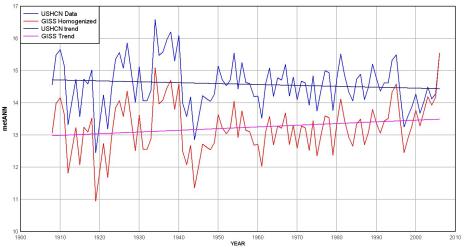
He also did not predict the ocean’s were cycling between heat absorption and release, as several Pause excuses now postulate.
On the bright side, it’s encouraging to see you use the term ‘false negative’ which by definition acknowledges the models are in error. A false negative indicates the test or predictive model has failed the scientific method and must be revised to include new and correct feedback mechanisms.We people concerned about life on earth, OTOH, should be striving to avoid the false negative of failing to address true, serious life-threatening problems like AGW. You’d think.
S
sps49
Guest
WSJ article
Climate Science Is Not Settled- We are very far from the knowledge needed to make good climate policy, writes leading scientist Steven E. Koonin
online.wsj.com/articles/climate-science-is-not-settled-1411143565
Climate Science Is Not Settled- We are very far from the knowledge needed to make good climate policy, writes leading scientist Steven E. Koonin
online.wsj.com/articles/climate-science-is-not-settled-1411143565
L
lynnvinc
Guest
My friend lives up in Nunavut Territory – the tundra area on the map above – I think on Ellesmere Island or some place close to that (I’ve lost contact with him). I believe what he said about the arctic area in which he lives, but he could be wrong, I suppose.I know a few Canadian farmers that would disagree.
But then, they likely live hundreds of miles away from whoever your witness is.
Which I guess would speak poorly for your contention that Canada has poor soil for farming.
Canada is a big place. Sweeping assessments such as yours say more about the person then they do Canada.
I know another poster here also disagrees with me as well, and says even if the soil is not good for agriculture, we can make it good for such when the time comes. Though I imagine would be a lot of work and (name removed by moderator)ut. By that time (in a few centuries if the warming continues and is increased by the “methane shotgun”) it could be that hydrogen sulfide will be outgassing and killing off life and making survival difficult.
- Status
- Not open for further replies.