Ask A Buddhist

  • Thread starter Thread starter Bakmoon
  • Start date Start date
Status
Not open for further replies.
Finally, there is the Atirātra Agnicayana, the ‘overnight piling of Agni (fire[place])’, a grand-scale ritual which takes twelve days to perform and which involves a huge bird-shaped altar, the uttaravedi (northern altar) made out of 10,800 bricks and animal sacrifice (a goat). The original purpose of the ritual is unclear, but immediate practical purpose of the Agnicayana is apparently to build up for the sacrificer an immortal body that is permanently beyond the reach of the transitoriness, suffering, and death. Performance of the Agnicayana was abandoned in most circles after the post-Vedic period (6th century BC); although there have been attempts at revival, the ritual was widely held to have been extinct by the 11th century.

Then in 1975, Indologist Frits Staal happened to come upon an Agnicayana conducted performed by Nambudiri Brahmins following the Śrauta tradition (a minority Hindu tradition which places more emphasis on the performance of rituals rather than having a set of beliefs, and thus continues to hold the Vedic rituals of old) at Kerala, who kept the tradition alive for 3000 years. The Nambudiris were concerned that the ritual was threatened by extinction (the last performance was in 1956), so in exchange for a financial participation of the scholars towards the cost of the ritual, they agreed that the performance should be filmed and recorded for posterity. This became the documentary Altar of Fire (a preview from Youtube available in the link). In the preview you can see the preparations for the ritual proper: the construction of utensils (altars, pots, mud bricks, frames for the bricks, etc.) as well as a temporary ritual enclosure which represents the sacrificer’s house. Apparently the efforts to bring it to public attention were successful: since 1975, there have been several more performances, the most recent of which apparently occurred this year (according to Wiki, at least). I should note that since slaughter of animals is now frowned upon by most Hindus and is a punishable offence in modern India, the goat sacrifice in modern Agnicayanas is symbolically performed using an effigy.
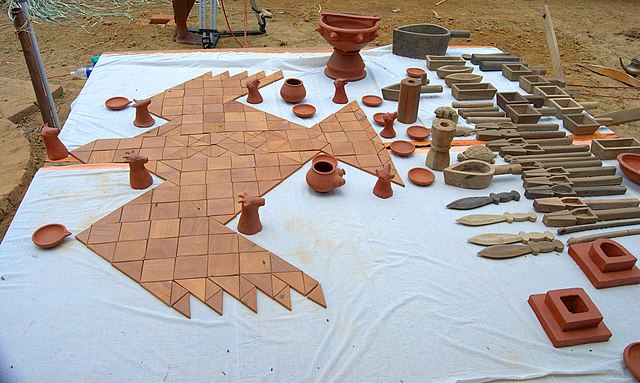

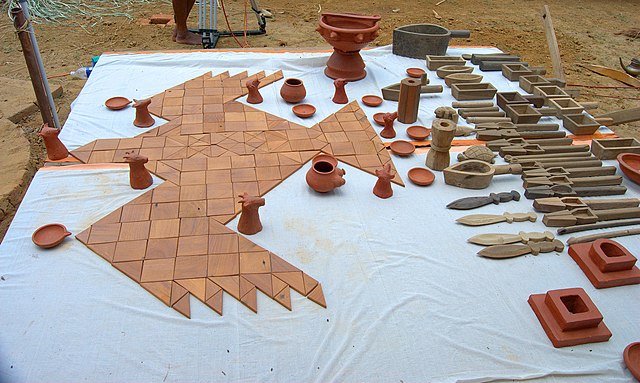
A replica of the altar (uttaravedi) and utensils used during the Agnicayana.


An uttaravedi inside the sacrificial enclosure.


The enclosure being destroyed by fire at the conclusion of the ritual.
So who offers a yajña? Early on, there was the presiding hotṛ, who recited invocations and litanies (which are preserved in the Ṛgveda, from ṛca ‘verse’), and his assistant, the adhvaryu, who performed the physical aspects of the sacrifice like building the altar, kindling the sacrificial fire and preparing the necessary implements and oblations. Each action was accompanied by supplicative or benedictive formulas (yajus, hence the Yajurveda). They were soon joined by the udgātṛ, who chanted hymns (sāman, hence the Samaveda) during the duration of the ritual. A brahman meanwhile supervised the whole thing: should there be any mistake during the performance he ‘corrected’ it by means of supplementary invocations.

Since there was a huge stress on performing the ritual accurately, it soon became the case that only professional priests could perform a yajña adequately. So whereas in the earliest times, the true sacrificer or the intended beneficiary of the rite directly participated, in Vedic times he was only a sponsor, the yajamāna, with the hotṛ or brahman taking his stead in the ritual. The position of purohita (literally, “one who is placed in front”), a term originally designating a domestic chaplain, especially of a prince, became important because of this. It was not unusual for a purohita to serve as the hotṛ or brahman at a sacrifice for his master, besides conducting other more domestic (gṛhya) rituals for him also. It was because of this that the very first hymn in the Ṛgveda opens with the words:

I laud Agni, the chosen Priest (purohitaṃ), God, minister of sacrifice,
The hotar (hotāraṃ), lavishest of wealth.
Worthy is Agni to be praised by living as by ancient seers.
He shall bring hitherward the Gods.

Eventually, with the disappearance of Vedic ritual practice, purohita has become a generic term for ‘priest’ (cf. the modern surname Purohit) and a synonym for pandit (a scholar who has memorized a substantial portion of the Vedas) or pujari (a ‘performer of puja’).
 
Patrick457,

Fire and fire imagery seemed to play an important role in Vedic rituals and texts. Can you talk a bit about this?

Fire imagery is common in Buddhist texts as well. “Mind like a fire unbound” is a metaphor for nibbana. Here is a snip from the Aggi-Vacchagotta Sutta: To Vacchagotta on Fire
accesstoinsight.org/tipitaka/mn/mn.072.than.html
…“Of course you’re befuddled, Vaccha. Of course you’re confused. Deep, Vaccha, is this phenomenon, hard to see, hard to realize, tranquil, refined, beyond the scope of conjecture, subtle, to-be-experienced by the wise. For those with other views, other practices, other satisfactions, other aims, other teachers, it is difficult to know. That being the case, I will now put some questions to you. Answer as you see fit. What do you think, Vaccha: If a fire were burning in front of you, would you know that, ‘This fire is burning in front of me’?”

“…yes…”

“And suppose someone were to ask you, Vaccha, ‘This fire burning in front of you, dependent on what is it burning?’ Thus asked, how would you reply?”

“…I would reply, ‘This fire burning in front of me is burning dependent on grass & timber as its sustenance.’”

“If the fire burning in front of you were to go out, would you know that, ‘This fire burning in front of me has gone out’?”

“…yes…”

“And suppose someone were to ask you, ‘This fire that has gone out in front of you, in which direction from here has it gone? East? West? North? Or south?’ Thus asked, how would you reply?”

“That doesn’t apply, Master Gotama. Any fire burning dependent on a sustenance of grass and timber, being unnourished — from having consumed that sustenance and not being offered any other — is classified simply as ‘out’ (unbound).”

"Even so, Vaccha, any physical form by which one describing the Tathagata would describe him: That the Tathagata has abandoned, its root destroyed, made like a palmyra stump, deprived of the conditions of development, not destined for future arising. Freed from the classification of form, Vaccha, the Tathagata is deep, boundless, hard to fathom, like the sea. ‘Reappears’ doesn’t apply. ‘Does not reappear’ doesn’t apply. ‘Both does & does not reappear’ doesn’t apply. ‘Neither reappears nor does not reappear’ doesn’t apply…
 
The above sutta not only references nibbana, but also uses fire and fuel in reference to Dependent Origination, a core concept of Buddhist teaching. The Buddha didn’t have much use for rituals. He often spoke of them as being useless. Here is a sutta where he describes the “highest protection” vs. the protection rituals used by the Vedics.

accesstoinsight.org/tipitaka/kn/snp/snp.2.04.than.html
I have heard that at one time the Blessed One was staying in Savatthi at Jeta’s Grove, Anathapindika’s monastery. Then a certain deva, in the far extreme of the night, her extreme radiance lighting up the entirety of Jeta’s Grove, approached the Blessed One. On approaching, having bowed down to the Blessed One, she stood to one side. As she stood to one side, she addressed him with a verse.
[The Deva] Many devas and human beings give thought to protection, desiring well-being. Tell, then, the highest protection.
[The Buddha:]
Not consorting with fools,
consorting with the wise,
paying homage to those worthy of homage:
This is the highest protection.
Living in a civilized land,
having made merit in the past,
directing oneself rightly:
This is the highest protection.
Broad knowledge, skill,
well-mastered discipline,
well-spoken words:
This is the highest protection.
Support for one’s parents,
assistance to one’s wife and children,
consistency in one’s work:
This is the highest protection.
Giving, living in rectitude,
assistance to one’s relatives,
deeds that are blameless:
This is the highest protection.
Avoiding, abstaining from evil;
refraining from intoxicants,
being heedful of the qualities of the mind:
This is the highest protection.
Respect, humility,
contentment, gratitude,
hearing the Dhamma on timely occasions:
This is the highest protection.
Patience, compliance,
seeing contemplatives,
discussing the Dhamma on timely occasions:
This is the highest protection.
Austerity, celibacy,
seeing the Noble Truths,
realizing Unbinding:
This is the highest protection.
A mind that, when touched
by the ways of the world,
is unshaken, sorrowless, dustless, secure:
This is the highest protection.
Everywhere undefeated
when acting in this way,
people go everywhere in well-being:
This is their highest protection.
 
Patrick457,

Fire and fire imagery seemed to play an important role in Vedic rituals and texts. Can you talk a bit about this?
I think it has something to do with humans in general having this fascination with fire (it was, after all the control of fire which introduced a dramatic change in the habits of early humans and in one sense, changed the course of history), and the fact that many cultures (not just the Vedic people) seeing it as this very special element.

The role which fire assumes in Vedic India, while sharing some similarities with other peoples, has its unique differences. For example, in other religions fire is treated as a symbol of divine epiphany (for example, Yhwh appears to Moses from the burning bush and later, comes down to Mount Sinai “in fire”) or simply a divine element which had to be either given or smuggled to the human world (cf. Prometheus stealing the gods’ fire) or even something dangerous (cf. the Japanese Kagutsuchi, who burned his mother Izanami to death as he came out of the womb; his father Izanagi then beheaded him in grief and chopped his body to pieces). In any case, fire had to be kept under the surveillance of a particular deity: for example, Hestia/Vesta (Greco-Roman), Kōjin (Japanese), and Zao Jun (Chinese) are all gods of the hearth, while Svarog (Slavic), Gibil (Sumerian), Kagutsuchi and Hephaistos/Vulcan are smiths or are connected with metallurgy. In many many mythologies, the god of fire, who is not identified with the element but is only related to it, is only partly connected with sacrifice, and at most is connected with either the ‘controlled’ use of fire (such as the hearth and various trades such as metallurgy) or its ‘destructive’ aspect. Still, its sacrificial importance is not as culturally determinant as it is in India.

For the Vedic people however, Agni, besides bearing a name which puts him in direct relationship with the element of fire in itself is directly connected with sacrifice, and his place on earth is more the altar than the domestic hearth. Agni is the mediator between gods and men, not so much because he is the ‘medium’ between men (with whom he dwells in the flame) and gods (to whom he belongs by nature) but also because he is the ‘medium’ by which sacrifice is accomplished. His sacrificial function is precisely that of carrying the human oblation to the divine realm and to see that it is accepted. Inversely, the gods themselves descend down to earth through him to enjoy that same offering.

The sacrificial altar is central to Vedism. Before the temples of Hinduism even existed, the altar in the Vedic tradition acquired an importance in itself and can be erected anywhere since it is related to no kind of cultic building. It is even provisional since it is erected from time to time as the need arises, and is abandoned or destroyed as soon as a sacrifice is completed (cf. the Agnicayana, where the whole sacrificial compound is set on fire). There are three main altars where ‘Agni’ rests: in the east is the square-shaped offertorial pit or āhavaniya, which receives the holocaust; the round gārhapatya or ‘householder’s fire’ in the west is reserved for the equally important function of cooking the offerings. The fire in the āhavaniya is kindled using the flaming pieces of firewood from the gārhapatya. Occasionally a third fire pit in the shape of a half-moon is added for the cooking (usually of grain offerings) at the south or south-east of the gārhapatya which is called anvāhāryapacana or dākṣiṇāgni (‘southern fire’). (Again note the falcon-shaped altar used in the Agnicayana being placed in the only other available space: the north.)

At first sight this seems to be strange and redundant - why cook something that is going to be burned anyway? - but here lies the distinction. Whereas in other cultures sacrifices are offered raw to the gods (with man receiving his portion cooked) and much emphasis is laid on a communal meal between the human and the divine, in India the consumption of the offerings on the part of man is spoken of only secondarily; the act of cooking was deemed to be important so as to demand a separate rite. In fact, the act which mattered above all in a sacrifice is the havana, the pouring of the offering into the fire with extended hand, palm upwards, and fingers pointed downwards. If the priest and the sacrificer consume a part of the offering (which is notably called a ‘remnant’, ucchiṣṭa, and not a ‘portion’), this act remains marginal with respect to the very essence of sacrifice, which precisely consists of offering the victim in almost its entirety. So whereas the sacrificial banquet and the convivial meal became a core ritual in other lands, it never became so in India, where a meal is seen above all as an alm or an act of hospitality offered to others. A host might offer a meal to guests as a form of service, but he does not care to strengthen his alliance with them by joining himself as their table companion. Apparently the same goes for sacrifices. The sacrificer waits for his guests, the gods to ‘eat’ first before partaking of their leftovers: this is where the modern Hindu idea of distributing prasād (a material substance, usually food, that is first offered to a deity or a guru or any other holy personage and then consumed) comes from.

In other words, fire was important because sacrifice was important.

Uma Marina Vesci’s Heat and Sacrifice in the Vedas goes into more detail than I could here.
 
BTW, just to put things in context a bit more: I found a 29-minute video showing highlights from the 2011 performance of the Agnicayana, and a 13-minute documentary in English. Yes, apparently this is pretty much how Vedic sacrifices were performed: especially if you watch the documentary you can notice the almost-scrupulous attention to detail in the making of implements.
 
Do you deny that natural happiness (as distinguished from supernatural happiness) can be increased through self efforts which are not centered on God? This is demonstrably false, as there are non-believers who have natural happiness which they gain through worldly means such as relationships and living virtuously.

Also, St. Thomas Aquinas disagrees with you here if you hold that position. In the Summa Theologica, First part of the Second Part, question 5, article 5 He writes:

To translate his terminology into the terms of our discussion, imperfect happiness= natural happiness and perfect happiness= supernatural happiness.

And if you do not deny that natural happiness (as distinguished from supernatural happiness) can be increased by self-effort, then why is it that Anapanasati cannot increase natural happiness?
You seem to refuse to see my point, or you continue to miss it. I told you NO, I do not agree with you.

Not one quote did you give that say’s that ANY happiness does not come from God. You continue to say that people who do not believe in God can have natural happiness. I never denied that. I never said people who do not accept God can feel happiness.

Let me state my point once more and maybe this time you can get it.

ALL happiness comes from God. Rather you want to accept this belief or not. It does not change truth.

Where is there one thing that you stated that proves that natural happiness or (name removed by moderator)erfect happiness that a person can feel is still not a gift from God and his grace.

Show me where the Saints said that you can acquire ANY happiness on your own without the grace and assistance from God the Almighty.

And where did I ever state that wordly happiness can not come from material thing’s? I never once stated that. The only difference those things are short lived.

They say any material thing’s last the most about 5 or 6 months. But where is it said that while this is not a perfect happiness, like Love and the things that God teaches us that last forever, that the short term happiness still do not come from God and his grace.

Show me that. All good thing’s come from God; Happiness that is an emotion or feeling still comes from God.

Even sadness which is an emotion still comes from God. He made us human, and being human HE GAVE us human feelings and emotions. And reasons for this.

Its like me saying People who have material things in their life that can give them joy and happiness have to deny God or something. That is not true either.

God loves to see us have material things and see us enjoy them also. Right now for example my husband and I bought a horrible house last year. The last 5 months especially we have worked every weekend day and night and every single evening on this house.

We had to gut and practically build a new house from top to bottom. We now are at the finishing touches of this house. We are having GREAT JOY in seeing what God through his grace helped us accomplish.

How, simple his grace. By his grace my husband used his hands and mind to measure, put up dry wall, wire, put in doors windows, insulation, siding etc.

Did our joy come from something Material, you bet your life, when we sell or rent we will get the reward. But did it come from us alone or God alone and his grace. Well let me tell you without his grace alone it was not possible.

But by using his grace we accomplished our goal. By his grace we even had a goal. And by his grace giving us the knowledge do this we together accomplished great things.

We did the same thing when we got married. It was not a house we build, it was a house that build us. Into a family, blood sweat and tears, But they became a house that we could be proud of, and house that glorify’s Christ at all times.

You are saying you can acquire natural happiness on your own without the assistance of the Grace of God. I am saying no you cannot.

You are asking me to prove it comes from God and not yourself. I cannot prove that the same as you cannot prove it does not come from God.

I have quotes from the bible I can give you. It states ALL GOOD things come from God. You deny them, The word of God tells us nothing is IMPOSSIBLE with GOd and all things are POSSIBLE with him. But again you deny this.

You can stand here right now and watch it rain with your own two eyes and still sit here and deny this. But denial does not change the truth. Rather you want to accept it or not.

THe breath you are talking at this moment comes from God and his grace, If he chooses he can take that breath from you, And he will someday. He told us I am leaving but I will come back and prepare a place for you. Again you deny that he exists. People testified that he did indeed die on that cross and come again.

And once again your denial does not make the testimony false.🤷
 
To make my point you use the word CENTERED. Where was it said people can acquire happiness on their own NOT CENTERED on Christ but People can acquire happiness on their own WITHOUT God and his grace.

You take the words of the Saints and you try to twist them and make them say what YOU want them to say.

The Saint’s never said happiness comes from the efforts of someone WITHOUT the assistance of God. You seem to again miss the point.

To make your statement true and explain it proper what the saints are saying is while People do not realize and CENTER CHRIST in thier efforts it is still by his Grace that happiness, and peace is acquired. Show me one quote where any saint ever said it was by efforts ALONE.

And show me where one Saint ever stated with your own effort you can acquire happiness without the assistance of God. ANY happiness, show me.😉 That you do not still NEED the GRACE of God. Show me.
 
If you read the relevant sections in the Summa, you will find the question isn’t whether or not the fetus is alive, but rather what kind of soul there is (nutritive, sensitive, or intellectual.) and I don’t see how scientific advancement would inform us about the nature of the type of soul in an embryo at any given point in time (i.e. whether or not the early embryo has a sensitive soul as opposed to a nutritive soul).

The question doesn’t really matter from a Catholic point of view however, because early embryo abortion is a mortal sin either way, either as homicide or as contraception.
This is true. In the teaching of the Church the moment of conception a soul is produced and it becomes a person. A human living soul.

So truthfully we do not need science to prove anything there. Once human life begins to take from the soul is alive and soul exists.
 
… Agni is the mediator between gods and men, not so much because he is the ‘medium’ between men (with whom he dwells in the flame) and gods (to whom he belongs by nature) but also because he is the ‘medium’ by which sacrifice is accomplished…

…In fact, the act which mattered above all in a sacrifice is the havana, the pouring of the offering into the fire with extended hand, palm upwards, and fingers pointed downwards. If the priest and the sacrificer consume a part of the offering (which is notably called a ‘remnant’, ucchiṣṭa, and not a ‘portion’), this act remains marginal with respect to the very essence of sacrifice, which precisely consists of offering the victim in almost its entirety…
… Apparently the same goes for sacrifices. The sacrificer waits for his guests, the gods to ‘eat’ first before partaking of their leftovers: this is where the modern Hindu idea of distributing prasād (a material substance, usually food, that is first offered to a deity or a guru or any other holy personage and then consumed) comes from.

In other words, fire was important because sacrifice was important.
This ritual is similar to Jesus as the sacrifice and the God to whom the sacrifice is offered; the remnant, ucchista, as a communion host; the ritual as a Mass.
 
This ritual is similar to Jesus as the sacrifice and the God to whom the sacrifice is offered; the remnant, ucchista, as a communion host; the ritual as a Mass.
Actually I would say more that the Mass is (obviously) has closer affinity to the Semitic concept of a sacrifice plus a meal, rather than the Indian idea of ‘sacred cooking’.
 
Actually I would say more that the Mass is (obviously) has closer affinity to the Semitic concept of a sacrifice plus a meal, rather than the Indian idea of ‘sacred cooking’.
I wasn’t thinking of the process of cooking. I was more interested in a divine being being sacrificed and the use of the remainder by the priest. But I posted in the middle of the night and I have a bad case of insomnia, so everything is a bit on end.

You have a impressive knowledge of the Hindu/Vedic belief system. What made you so interested?
 
I wasn’t thinking of the process of cooking. I was more interested in a divine being being sacrificed and the use of the remainder by the priest. But I posted in the middle of the night and I have a bad case of insomnia, so everything is a bit on end.
Again, it isn’t so much a divine being being sacrificed but the sacrificial offering being conveyed to the gods by fire (who is a god himself). If you’re looking for a sacrificed divine being in Vedism, the ‘sacrifice’ of the primeval man Puruṣa is closer, but it still isn’t a 100% exact fit to the Christian idea: in the story the gods ritually slaughtered Puruṣa, out of whose body parts came forth the universe and everything in it, including humans and their castes. In other words, one of the different Vedic creation myths - in this particular case, the world is literally created by and out of a yajña, which incidentally is the very same thing which maintains it according to Vedic thought.

A thousand heads hath Puruṣa, a thousand eyes, a thousand feet.
On every side pervading earth he fills a space ten fingers wide.
This Puruṣa is all that yet hath been and all that is to be;
The Lord of Immortality which waxes greater still by food.
So mighty is his greatness; yea, greater than this is Puruṣa.
All creatures are one-fourth of him, three-fourths eternal life in heaven.
With three-fourths Puruṣa went up: one-fourth of him again was here.
Thence he strode out to every side over what eats not and what eats.
From him Virāj was born; again Puruṣa from Virāj was born.
As soon as he was born he spread eastward and westward o’er the earth.
When Gods prepared the sacrifice with Puruṣa as their offering,
Its oil was spring, the holy gift was autumn; summer was the wood.
They balmed as victim on the grass Puruṣa born in earliest time.
With him the Deities and all Sādhyas and Ṛṣis sacrificed.
From that great general sacrifice the dripping fat was gathered up.
He formed the creatures of-the air, and animals both wild and tame.
From that great general sacrifice Ṛcas and Sāma-hymns were born:
Therefrom were spells and charms produced; the Yajus had its birth from it.
From it were horses born, from it all cattle with two rows of teeth:
From it were generated kine, from it the goats and sheep were born.
When they divided Puruṣa how many portions did they make?
What do they call his mouth, his arms? What do they call his thighs and feet?
The Brahman was his mouth, of both his arms was the Rājanya made.
His thighs became the Vaiśya, from his feet the Śūdra was produced.
The Moon was gendered from his mind, and from his eye the Sun had birth;
Indra and Agni from his mouth were born, and Vāyu from his breath.
Forth from his navel came mid-air; the sky was fashioned from his head;
Earth from his feet, and from his ear the regions. Thus they formed the worlds.
Seven fencing-sticks had he, thrice seven layers of fuel were prepared,
When the Gods, offering sacrifice, bound, as their victim, Puruṣa.
Gods, sacrificing, sacrificed the victim: these were the earliest holy ordinances.
The Mighty Ones attained the height of heaven, there where the Sādhyas, Gods of old, are dwelling.
  • Rigveda, 10.90
 
You have a impressive knowledge of the Hindu/Vedic belief system. What made you so interested?
Four of my main interests are history, religions/philosophies, and literature. That’s pretty much the main reason really. 😛 And those Indian mythological films and TV series, and the great epics like Mahabharata and the Ramayana.

BTW, here’s another (late) hymn from the Rigveda which has more of a skeptical tone to it (10.129):

Then was not non-existent nor existent: there was no realm of air, no sky beyond it.
What covered in, and where? and what gave shelter? Was water there, unfathomed depth of water?
Death was not then, nor was there aught immortal: no sign was there, the day’s and night’s divider.
That One Thing, breathless, breathed by its own nature: apart from it was nothing whatsoever.
Darkness there was: at first concealed in darkness this All was indiscriminated chaos.
All that existed then was void and form less: by the great power of Warmth was born that Unit.
Thereafter rose Desire in the beginning, Desire, the primal seed and germ of Spirit.
Sages who searched with their heart’s thought discovered the existent’s kinship in the non-existent.
Transversely was their severing line extended: what was above it then, and what below it?
There were begetters, there were mighty forces, free action here and energy up yonder
Who verily knows and who can here declare it, whence it was born and whence comes this creation?
The Gods are later than this world’s production. Who knows then whence it first came into being?
He, the first origin of this creation, whether he formed it all or did not form it,
Whose eye controls this world in highest heaven, he verily knows it, or perhaps he knows not.
 
Four of my main interests are history, religions/philosophies, and literature. That’s pretty much the main reason really. 😛 And those Indian mythological films and TV series, and the great epics like Mahabharata and the Ramayana.
BTW, here’s another (late) hymn from the Rigveda which has more of a skeptical tone to it (10.129):

We might find a comparison with the Tao Te Ching interesting. academic.brooklyn.cuny.edu/core9/phalsall/texts/taote-v3.html
This isn’t my favorite translation but it will do for comparison. I find it interesting to speculate how the thoughts of one tradition may have influence the thoughts of another. Perhaps the Rigveda influenced LaoTzu.
Then was not non-existent nor existent: there was no realm of air, no sky beyond it.
What covered in, and where? and what gave shelter? Was water there, unfathomed depth of water? Death was not then, nor was there aught immortal: no sign was there, the day’s and night’s divider. That One Thing, breathless, breathed by its own nature: apart from it was nothing whatsoever.
 
You seem to refuse to see my point, or you continue to miss it. I told you NO, I do not agree with you.

Not one quote did you give that say’s that ANY happiness does not come from God. You continue to say that people who do not believe in God can have natural happiness. I never denied that. I never said people who do not accept God can feel happiness.

Let me state my point once more and maybe this time you can get it.

ALL happiness comes from God. Rather you want to accept this belief or not. It does not change truth.

Where is there one thing that you stated that proves that natural happiness or (name removed by moderator)erfect happiness that a person can feel is still not a gift from God and his grace.
I never said that natural happiness is not ultimately from God, but rather that God grants it indirectly instead of directly. If God can grant natural happiness through things like virtue and material things and relationships (which are not things that are nessisarily centered on God) then what is wrong with saying that God also grants natural happiness through Buddhist meditation?
 
I never said that natural happiness is not ultimately from God, but rather that God grants it indirectly instead of directly. If God can grant natural happiness through things like virtue and material things and relationships (which are not things that are nessisarily centered on God) then what is wrong with saying that God also grants natural happiness through Buddhist meditation?
Nothing is impossible for God. Of course he can grant natural happiness through Buddhist meditation.

But the question is WHY would a Catholic revert to Buddhist meditation when there is chance it can take you away from God instead of closer to him.

Why use Bud, Med, when you have the perfect prayer. Taught to you by Christ. Christ never taught us Buddhist meditation, That was from Buddha.

And back to my point Buddhist meditation is not a teaching that says you MUST rely on God and center on him at ALL TIMES.

I have read on every single kind of Buddhist Meditation I could get my hands on and not ONE said you MUST center yourself on God.

Most say you must empty yourself. and there are ones that say you CAN meditation on God is you want but it is not necessary. That is a big problem.

Show me one Buddhist Meditation that states you MUST meditate on Jesus Christ.

The Church teaches that everything must be centered on Jesus Christ only and for those or shall I say the majority of us, it can be quite dangerous actually.

What can you PROMISE me though Bud, Med. What has Buddha ever PROMISED.

Here is what Jesus PROMISED.

Come to me and I will give you rest.
Pray the way I taught you .
I am the way the life and the truth,
I am the bread of life, whoever eats the bread of life will live forever.
The Church is the Pilar of all truth.
Repent and you will be forgiven for your sins.
Whoeever believes in me shall never die, but have eternal life in me.

Show me one thing that Budda or Buddhism promises. One thing.

Where does Buddhism say there is NO liife outside of Christ? Where does it Promise me I can find rest.

From what I have read very few people actually reach this enlightment that Buddhism claims it can give. And I have my big doubts from what it claims anyway.

Cont.
 
Cont…

Like anger for instance. You are never going to quit feeling anger. You can control anger simply by choosing how to react to it. This is not Buddhism this is free will. We can all choose how we are going to react to a situation.

We pray for the grace of God to contol our emotions, but nothing in this world is ever going to make them go away. They are deep inside of us, They are who we are.

Things in this world and people get on our nerves.

You don’t need Buddhism to learn to be kinder and easier to get along with and have more compassion for others. This comes from God and his Grace.

Even Priests are not taught to deny their anger, etc, they are taught of learn to control it, and hide it deep inside. Everyone that is human has emotions. We are no robots.

Sometimes things set us off, and we truly don’t understand why. But usually it is something deeply rooted inside us that we even forgot about and when it comes to life it sets us off.

But you can meditate all you want, and try to shut off the outside world. But you are only fooling yourself. The outside world is real and will continue.

You must pray for the Grace of God to help you handle things the way you believe God would.

Sometimes anger is a good thing, It shows people when they do wrong, or hurt others. You need to express it sometimes. But you can control how you do it, while not hurting others.
 
One’s rebirth is determined by a complex mental process that occurs at the time of death. The mind sort of ‘opens up’ and enters a state that is determined by some major deed done in life, such as commiting murder, or gaining certain meditative attainments, and one’s birth is determined by this state of mind. If there are no major deeds, the mind goes to how it was habitually during life. If this isn’t strong enough to take hold, then the mind enters a state determined by actions just prior to death. If this isn’t significant, then it is determined by actions in previous lives.

A bit complicated, but that’s how it is understood in the Theravada sect.
Here we go back to the beginning.

Not one Catholic grounded in their faith is going to buy this. Welcome to the Theravada sect, I don’t think so.

How can you expect a Catholic to even try this?:confused:
 
Buddhism analyses a human being into five parts: form, feelings, perception, impulses and consciousness. None of the five is permanent. None of the five is unchanging. Any attempt to find a permanent or unchanging ‘soul’ or ‘self’ is doomed to fail.

We are caused by our past, and in turn cause our future. Each of us is a continuing flow of causation, a bit like Heraclitus’ river. Only I sense my perceptions because only I am caused by the I of the previous instant, not you. Those perception take a little time to travel down the sensory nerves from the eye to the brain. In my past the light arrived at my eye, not at your eye. In my present the nerve impulse arrives in my brain, not in yours.

The chain of cause and effect links me to my past, not to yours, and vice versa.

Perceptions exist, but not a perceiver. Buddhism, especially Mahayana Buddhism, denies all reification. Humans have a strong tendency to see hidden depths behind things. That often leads us into errors of reification. There are no hidden depths, we just think there are.

The emptiness of emptiness is the fact that not even emptiness exists ultimately, that it is also dependent, conventional, nominal, and in the end it is just the everydayness of the everyday. Penetrating to the depths of being, we find ourselves back on the surface of things and so discover that there is nothing, after all, beneath those deceptive surfaces. Moreover, what is deceptive about them is simply the fact that we assume ontological depth lurking just beneath.

– Jay Garfield, “Empty words, Buddhist philosophy and cross-cultural interpretation.” OUP 2002.

rossum
🤷 So here we go, My favorite part, any attempt to find a permament SELF or SOUL is DOOMED to fail.

Thats what I have been trying to say all along!

A Catholic will never deny a permament self or unchanging soul. Its who we are,

My Favorite part emptiness of emptiness is the FACT that emptiness does not even exist.:eek:🤷 This does not even make logical sense.
 
We might find a comparison with the Tao Te Ching interesting. academic.brooklyn.cuny.edu/core9/phalsall/texts/taote-v3.html
This isn’t my favorite translation but it will do for comparison. I find it interesting to speculate how the thoughts of one tradition may have influence the thoughts of another. Perhaps the Rigveda influenced LaoTzu.
I hold to modern scholarly opinion that the hymns of the Rigveda was first originally composed around the late Bronze Age (1700-1100 BC), with redactions being undertaken somewhere during the pre-Buddhist period (ca. 6th-5th century BC). We don’t know for sure when the Daodejing was written, or even whether Laozi as an historical figure really existed, but the oldest excavated text (the Guodian Chu Slips) dates back to the late 4th century BC, which implies that it was written before that time.

Personally, I think that it is more likely that the two ideas developed independently of one another. For one, we don’t exactly know whether there were any contact between the Indo-Aryan kingdoms of the late Vedic period (the mahajanapadas) and the Zhou dynasty Chinese. Given the huge distances and the geographical barrier between them I think it’s a bit too hard to imagine one directly influencing the other.
 
Status
Not open for further replies.
Back
Top