RE: ATHEIST MONUMENT RECOMMENDS BUILDING HOSPITALS*** (instead of Churches)*
**
newadvent.org/cathen/07480a.htm
The idea of who built the first hospitals was intriguing. From antiquity, this site lists …
***the IRISH! *** :coolinoff: < Fighting off a flood of ethnic pride now, as if I had anything to do with this!
While among savage tribes, e.g. the ancient Germans, the sick and feeble were often put to death, more humane practices are found among civilized peoples. One of the earliest hospitals on record was founded in Ireland, 300 B. C., by Princess Macha. It was called “Broin Bearg” (house of sorrow), and was used by the Red Branch Knights and served as the royal residence in Ulster until its destruction in A.D. 332 (“Seanchus Mór”, 123; cf. Sir W. Wilde, “Notes on Ancient Ireland”, pt. III).
I think this means the Germanic tribes were (per mercy’s standards, “savage”; while the Irish were “civilized” by comparison, during the 300 BC period). Some historians categorize the beginnings of a “modern hospital” thus:
THE EVOLUTION OF HOSPITALS FROM ANTIQUITY TO THE …
www.ajol.info/index.php/actat/article/download/52575/41180 < pdf download
It is to the Christians that one must turn for the origin of the modern hospital. Hospices, originally called xenodochia, initially built to shelter pilgrims and messengers between various bishops, were under Christian control developed into hospitals in the modern sense of the word. In Rome itself, the first hospital was built in the 4th century AD by a wealthy penitent widow, Fabiola. In the early Middle Ages (6th to 10th century), under the influence of the Benedictine Order, an infirmary became an established part of every monastery
As the OT Bible mentions certain medical things (not hospitals but some treatments etc. even dating to the time of the Exodus from Egypt) – and
some Irish histories claim a relation to the 10 lost tribes of Israel - this makes for an interesting info-quest.
ensignmessage.com/archives/commonalities.html < Celtic, Israelite commonalities. Lost tribes. Language. Priestly practice. Agriculture. Alphabet.
By
Yaacov Levi
Pre-Christian Irish seemed to have a druidic priesthood (
so was not atheistic) and the term Pagan can be as broad as non-Jewish/non-Christian when applying the term to those on the island in 300 BC.

From the beginning of Christianity, the apostles and their successors made house calls with anointing and healing. Buildings? Well, they were hiding from the Pagan Romans and a big hospital would be a dead giveaway.
There was thus from the earliest times a well organized system of providing for the various forms of suffering; but it was necessarily limited and dependent on private endeavour so long as the Christians were under the ban of a hostile State. Until persecution ceased, an institution of a public character such as our modern hospital was out of the question. it is certain that after the conversion of Constantine, the Christians profited by their larger liberty to provide for the sick by means of hospitals.
Someone named “Ratzinger” suggested that Constantinople had (one of?) the earliest hospitals.
When and where the first hospital was established is a matter of dispute. According to some authorities (e.g. Ratzinger, p. 141), St. Zoticus built one at Constantinople during the reign of Constantine, but this has been denied (cf. Uhlhorn, I, 319). But that the Christians in the East had founded hospitals before Julian the Apostate came to the throne (361) is evident from the letter which that emperor sent to Arsacius, high-priest of Galatia, directing him to establish a xenodochium in each city to be supported out of the public revenues (Soxomen, V, 16).
Of course the Christians built Churches TOO!


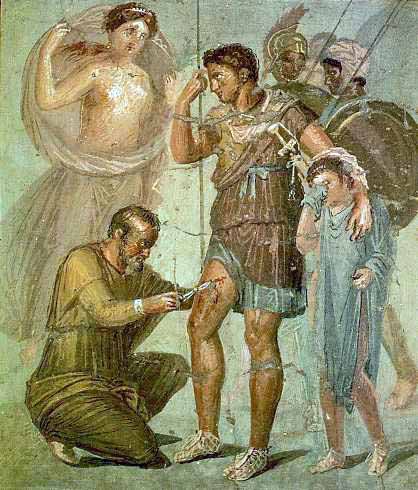
Mural in Rome. Hospital? “Medicine” anyway.
Depicts the treating of a wound. And … anesthesia?


 :doh2: . . .