
Do You Know How Bad the Dechristianization of Europe Really Is?

  • Thread starter Thread starter JamalChristophr
  • Start date Start date
Status
Not open for further replies.
I read in a reputable book written in the 90’s that stated only 12% of the population of Rome attends Sunday mass. That really does kind of shock me. What about you

Do you think it will continue like this? I have read that when Christianity loses ground, the diabolical gains ground. I wonder if sometimes the problem is much worse than we Sunday attending Catholics realize, living in to some degree a bubble, though that may be a bit of a stretch.
Re: polls, In the U.S.
22% go to mass faithfully on Sunday. **78% of Catholics don’t go to mass except maybe twice a year, Christmas and Easter**if at that. Hence the nickname C & E Catholics. They (the 78%) are all objectively speaking, in mortal sin, for deliberately missing the Eucharist on Sunday. . If one dies in mortal sin they go straight to hell.

Those stats come from a Georgetown study http://cara.georgetown.edu/frequently-requested-church-statistics/

That said,

Is it any wonder, Jesus knowing all in advance, and being the one who will judge EVERYONE at their death, said, few make it to heaven. Mt 7:13-14 Mt 7:13-14 RSVCE - The Narrow Gate - “Enter by the - Bible Gateway

. That, IMO ought to scare the Hell out of everyone, with any brain cells to rub together.
 
Last edited:
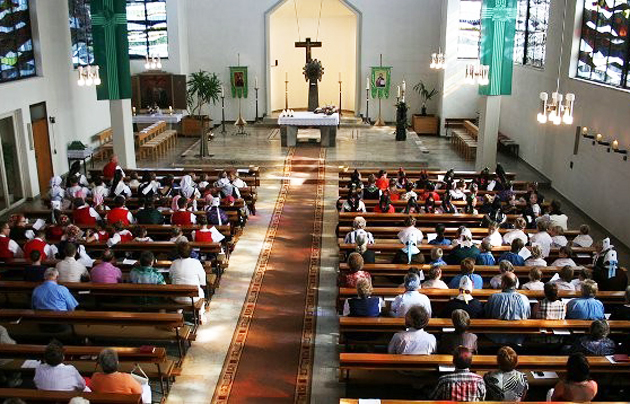
22% of Catholics who goes to church on all Syndays, it’s isn’t bad, if we compared with France, where there is approximatlely 5% of Catholics who goes to mass at least once a mouth.

I know, this is not an excuse…

When we knwo that, we don’t have to go to far to find an explanation why Catholics are so far from the Church on many society subjects…They are just like secular people.

@(name removed by moderator),
you have right. Strong practicing families tend to be larger than others. But they are small in numbers. It’s depend on the area. In the city where I was born there are some of them, and Catholics teenagers/children I know come often from large families (4-5 children). The father have usually a good job and the mother is a stay at home one.
In the place where I lived know, where there the city is much more little, a rural area and where the job opportunities are hard to find, there is fewer large families among Catholics. Even the deacons have small families. And there is a Catholic "milieu"and some youngs people, and we knew all. There is a lot of solidarity and friendliness. But not a a strong share prayer life.

In my experience in a Latin Traditional Parish, there was much more families and the families were larger. In fact there was almost more children than adults. Like in the 1950’s. The statistiques indicates that In catholic Tradition, fertility rate is highter.

And yes, muslin families, tend to have a little more children than the average, 3 children.

In France, the average number of children per family is two. In some others countries like Italy and poland, there is much more families who have just one child.
And from what I have see in travelling in Europe, French families, mostly Catholics one, have more children than in others contries like in Eastern Europe. I believe our natalist politics help us.
 
But we are an intense minority with the shrinking, liberal Catholic community, which dominates most institutions. The home schoolers are almost the only ones having baptisms in some parishes. These subgroups are the hope for slowing dechristianization.
It’s the same here in the UK. The majority of Catholics are good people who haven’t been catechised. I think this was a deliberate move on the part of liberal prelates because it means the laity won’t have the knowledge to oppose their radical reforms.
 
I too have wondered about liberal under-catchising having some ulterior motive. It is bizarre. I assumed the idea was just to attract a wider following through the door, but there is so much evidence from liberal Protestantism that this does not work. It is not like Church leaders are unintelligent. Something else is up. They are not ‘believers’ in that sense being the most likely.

One more thought on Europe and faith - watch a couple Fellini movies if you want to get an idea of Catholicism and Southern Europe, 20th century anyway. Not unlike Flaubert 19th century in France. They call it realism, and I believe it is.
 
I’ve always thought it’s just been a case of the church sticking it’s head in the sand and telling themselves that all Catholic parents are good teachers of the faith. I’ve never considered that it could be deliberate.
 
I’ve been reading about Bella Dodd, the close relationship between Saul Alinsky and Bishop Scheil of Chicago, and I have been deeply disturbed. On that face of it, Catholic officials were outspoken about the evils of leftist politics (at least until the 1950s or so). Now the USCCB seems quite liberal on a lot of issues to me.
 
Last edited:
I have also lately noticed an increase of those Evangelical type Churches in Slovenia and even in Croatia.
People seem to be becoming disillusioned with Catholic Church and these Envangelical types come in a give a “trendy alternative” with their workshops,and big meetings with heavily emotional music…
 
In Australia now,religion (of all types) is unpopular now too.
When religion is talked about in the media it is often in the negative sense.
There is a strong climate of pro gay marriage and so on…

This might sound unpopular on a Catholic forum,but I wonder if some of the “fault” isn’t from the Catholic Church itself.
Ie:in Australia the Catholic Church makes little efforts to engage younger people (below 45) and the attempts they do make can sometimes be “cheesy” or embarrassing (at least in my opinion) and maybe do attract young people who are already Catholic but does not interest or engage young from the general population.
 
Last edited:
Some recent data:
German Protestant Statistics:
Berlin-based journalist Markus Spieker said this in 2009:
The Protestant state church is fairly dead. The percent of committed Christians in Germany is maybe at 3 or 4 percent. Eighty percent belong to a church nominally, Protestant or Catholic. A mere 0.5 percent belong to a free evangelical church.
http://www.christianitytoday.com/ct/2009/novemberweb-only/145-11.0.html
From 2015:


Sweden:
Only 15 percent of members of the Church of Sweden say they believe in Jesus, and an equal number claim to be atheists according to the results of a recent survey.
[…]
Of the roughly 6.6 million members of the Church of Sweden, about 400,000 are active churchgoers, attending services at least once a month.
https://www.thelocal.se/20110615/34370
 
Last edited:
I have been tempted by these churches to be honest. Catholic churches in general simply don’t do young adults and it’s lonely. In a church like that you can get peer support in your faith and are more likely to be able to get involved before you reach retirement age.
 
In addition to many of the issues listed here, I think it should not be overlooked that the internet “happened”. Notwithstanding the wonderful qualities of many religious people, religion in general is perceived by the majority to have a certain degree of “ugliness” (for lack of a better word) to it. We see it often times here on CAF. Disparaging remarks about other’s beliefs, “disordered” comments, etc. I think it is possible that the internet has made the world a much smaller place. Prior to the internet, more people would stick with the religion into which they were born because it was sort of a pack mentality. We stick together for self-preservation. Nowadays, finding a group of people who are like minded is only as far away as ones fingertips. The pack mentality is no longer a necessity for survival.
 
Pope Francis endorsing these acts of faith would also be helpful.
I wonder if the Pope is concerned about these efforts being directed towards border control and thus going against his teachings re refugees. I’ve read about many “Rosaries for the Coasts and Borders” in and some of them were quite benign, others were taking political positons that I found extreme. I was part of a "Rosary for the Coasts and Borders " of USA recently and I thought it was very nice but I think some people were turned off because it was started by folks from Church Militant and publicized through Life Sitell News.
 
Agreed. But in UK one of the top atheist countries of EU reading the Rosary is so much more than just any political agenda attached to it, don’t you think?
 
I’d like to think it’s wonderful. I would worry slightly that it might be anti-Muslim in that country. I would look into the organizers and stated goals before I joined publicly in a Rosary. One is of course always free to say one’s own Rosary, including in a public place like a church, for any good intention.
 
Yes, I think the RCC is on cruise control and they are stuck in kind of a postmodernist version of a Vatican II different strokes for different folks mentality. This appeals to much of the hierarchy but it doesn’t compute with Christians or those seeking faith, guidance in their lives. Under Benedict, you had the New Evangelization which was a good effort to revitalize (not revise) the message of the RCC for the outside world but that has been stalled now, missing a wheel or two. The Church is regressing. This won’t stop until the Church reforms and sorts itself out. Maybe now maybe never.
 
Last edited:
40.png
Mary888:
Pope Francis endorsing these acts of faith would also be helpful.
I wonder if the Pope is concerned about these efforts being directed towards border control and thus going against his teachings re refugees. I’ve read about many “Rosaries for the Coasts and Borders” in and some of them were quite benign, others were taking political positons that I found extreme. I was part of a "Rosary for the Coasts and Borders " of USA recently and I thought it was very nice but I think some people were turned off because it was started by folks from Church Militant and publicized through Life Sitell News.
We are at the point now where almost anything the Church does will:
  1. attract the support of some persons who have extreme views;
    and
  2. Be denounced by the media.
For instance, some persons with extreme views applaud the work done by Missionaries of Charity. Should the Church, therefore, no longer support the order founded by Mother Teresa?

The reality is that there are always mixed motives in any good action. The Church needs to be careful about any endeavor, but we can’t take a position of extreme passivity, either.
 
Status
Not open for further replies.
Back
Top