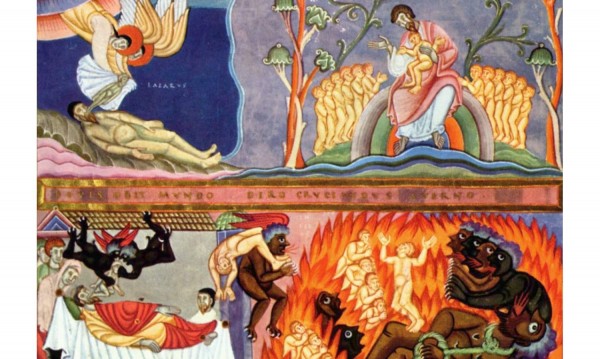
You must keep in mind that this is a
parable! Therefore you can’t dissect it like a frog with scientific precision.

If your #1 was correct, then we must also suppose that the rich man was a saint, since he has a vision of Abraham, which would take his mind off his torment, and give him a pure religious consolation. Unfortunately, however, this is not the case, that is why this is a parable.
What does having a vision have to do with being a saint? Ordinary works of mercy & kindness are exceedingly more pleasing to God than miracles or visions. Jesus doesn’t even like performing miracles, and uses them as little as possible, because he would much rather people follow him purely out of charity. He sometimes uses holy mystics as a means to enlighten us and further his Church on Earth, but this is far, far from the norm.
Besides, the characters in the parable are in the hereafter, and as such, it is not a vision.
1: The whole point of the parable is blunted and nullified. IOW, Jesus is teaching that the rich man will have to endure just temporary torment, but then he will be with Abraham and Lazarus. But isn’t this contradicted by Abraham himself when he says there is a chasm between them both, and nobody from either side can cross over to the other?
This isn’t a contradiction. Souls in Purgatory are confined to Purgatory until justice is satisfied. There is also a positive argument for Purgatory because Abraham states that those wanting to go from here to there cannot ,and those wanting to go from here (the place of peace) to there (the place of torment) cannot. And, nobody saved would ever want to go to hell, because those in hell irreversibly hate God and the blessed will accept their torment as being just and good. There will be no mourning in Heaven on behalf of the souls in hell. The doctrine of hell can sometimes be difficult for even devout Catholics to understand here on Earth, but once we are in Heaven, all of those doubts will be laid to rest. We will understand with an impassable knowledge that the souls in hell are set in their obstinacy and against the Lord that we will love with an unimaginable degree of intensity. When we see their hatred against our Beloved Jesus, and Mary, and the angels, and everything else that is good and deserving of love, then we will fully understand.
On the other hand, St Faustina tells us that Jesus’ mercy does not desire for the souls in Purgatory to suffer, but that justice demands it on account of their sins. [Jesus doesn’t desire the suffering of the damned either, as such, but it is understood as fitting, and irreversible, and necessary]
2: If this was purgatory (a VERY difficult doctrine to find explicitly in the Gospel) then surely the Church would point to this parable as a PRIMARY proof of Purgatory. Yet the Church has NEVER done this. In fact the only parable that the Church uses as an allusion to Purgatory is Matthew 5:26.
That’s because the parable isn’t about Purgatory, nor is it about hell. It is about judgement and for repenting of sins, and to love your neighbor & show mercy to them. I said this a page back and my opinion remains unchanged: that whether the Rich Man is in hell or in purgatory, the message is the same and can be applied to either or (or both) scenarios. Despite what some might believe, Purgatory is not a place that we should
expect to go to. Where we really want to go is Heaven, and then if we happen to end up in Purgatory, so be it, but God forbid that we should
desire to go to Purgatory, because that isn’t what Jesus wants for us, and we should never desire for something that Jesus doesn’t want for us. Moreover, complacency in venial sins may lead to mortal sin, therefore we should strive for Heaven and never for Purgatory. Striving for Purgatory is mediocrity (not to be confused with humility, which is very different) and dangerous to the soul.
And I think you’re undervaluing the presence of a purgation in the scripture. I seem to recall several occasions where it is implied. When I was protestant and knew nothing about the Catholic Church there were a few passages that threw me for a loop because - reading it to the best of my individual ability - it suggested some sort of temporal punishment.