Do you think the rich man was in purgatory? (Luke 16)

  • Thread starter Thread starter ResoluteSheep
  • Start date Start date
Status
Not open for further replies.
Were he really as self serving as this, wouldn’t he recognize that his brothers can do nothing for him?
Wouldn’t he then, realizing this, not care at all what befalls his brothers?

I can only see two possible motivations possible here.
1- his motives are altruistic, and he is therefore in purgatory.
2- he is trying to fool God with false altruism. Therefore he is likely in hell.
You must keep in mind that this is a parable! Therefore you can’t dissect it like a frog with scientific precision. 😉

If your #1 was correct, then we must also suppose that the rich man was a saint, since he has a vision of Abraham, which would take his mind off his torment, and give him a pure religious consolation. Unfortunately, however, this is not the case, that is why this is a parable.

What we must do with a parable is try to understand the underlying teaching. IF the underlying teaching was that despite all his unrepented sins against Lazarus (which even in torment he never confesses), and the rich man was really just in Purgatory then:

1: The whole point of the parable is blunted and nullified. IOW, Jesus is teaching that the rich man will have to endure just temporary torment, but then he will be with Abraham and Lazarus. But isn’t this contradicted by Abraham himself when he says there is a chasm between them both, and nobody from either side can cross over to the other?

2: If this was purgatory (a VERY difficult doctrine to find explicitly in the Gospel) then surely the Church would point to this parable as a PRIMARY proof of Purgatory. Yet the Church has NEVER done this. In fact the only parable that the Church uses as an allusion to Purgatory is Matthew 5:26.
 
Of course it is a parable.

But it is one given by God.
I would think a parable authored by God would stand scrutiny and reveal deeper meanings.

Sure a cigar can be just a cigar. But how often does God say anything that has no nuance?
 
You must keep in mind that this is a parable! Therefore you can’t dissect it like a frog with scientific precision. 😉

If your #1 was correct, then we must also suppose that the rich man was a saint, since he has a vision of Abraham, which would take his mind off his torment, and give him a pure religious consolation. Unfortunately, however, this is not the case, that is why this is a parable.
What does having a vision have to do with being a saint? Ordinary works of mercy & kindness are exceedingly more pleasing to God than miracles or visions. Jesus doesn’t even like performing miracles, and uses them as little as possible, because he would much rather people follow him purely out of charity. He sometimes uses holy mystics as a means to enlighten us and further his Church on Earth, but this is far, far from the norm.

Besides, the characters in the parable are in the hereafter, and as such, it is not a vision.
1: The whole point of the parable is blunted and nullified. IOW, Jesus is teaching that the rich man will have to endure just temporary torment, but then he will be with Abraham and Lazarus. But isn’t this contradicted by Abraham himself when he says there is a chasm between them both, and nobody from either side can cross over to the other?
This isn’t a contradiction. Souls in Purgatory are confined to Purgatory until justice is satisfied. There is also a positive argument for Purgatory because Abraham states that those wanting to go from here to there cannot ,and those wanting to go from here (the place of peace) to there (the place of torment) cannot. And, nobody saved would ever want to go to hell, because those in hell irreversibly hate God and the blessed will accept their torment as being just and good. There will be no mourning in Heaven on behalf of the souls in hell. The doctrine of hell can sometimes be difficult for even devout Catholics to understand here on Earth, but once we are in Heaven, all of those doubts will be laid to rest. We will understand with an impassable knowledge that the souls in hell are set in their obstinacy and against the Lord that we will love with an unimaginable degree of intensity. When we see their hatred against our Beloved Jesus, and Mary, and the angels, and everything else that is good and deserving of love, then we will fully understand.

On the other hand, St Faustina tells us that Jesus’ mercy does not desire for the souls in Purgatory to suffer, but that justice demands it on account of their sins. [Jesus doesn’t desire the suffering of the damned either, as such, but it is understood as fitting, and irreversible, and necessary]
2: If this was purgatory (a VERY difficult doctrine to find explicitly in the Gospel) then surely the Church would point to this parable as a PRIMARY proof of Purgatory. Yet the Church has NEVER done this. In fact the only parable that the Church uses as an allusion to Purgatory is Matthew 5:26.
That’s because the parable isn’t about Purgatory, nor is it about hell. It is about judgement and for repenting of sins, and to love your neighbor & show mercy to them. I said this a page back and my opinion remains unchanged: that whether the Rich Man is in hell or in purgatory, the message is the same and can be applied to either or (or both) scenarios. Despite what some might believe, Purgatory is not a place that we should expect to go to. Where we really want to go is Heaven, and then if we happen to end up in Purgatory, so be it, but God forbid that we should desire to go to Purgatory, because that isn’t what Jesus wants for us, and we should never desire for something that Jesus doesn’t want for us. Moreover, complacency in venial sins may lead to mortal sin, therefore we should strive for Heaven and never for Purgatory. Striving for Purgatory is mediocrity (not to be confused with humility, which is very different) and dangerous to the soul.

And I think you’re undervaluing the presence of a purgation in the scripture. I seem to recall several occasions where it is implied. When I was protestant and knew nothing about the Catholic Church there were a few passages that threw me for a loop because - reading it to the best of my individual ability - it suggested some sort of temporal punishment.

 
The rich man did not exist. He was a figure Jesus made up with the parable to make a point about compassion, humility, and repentance. To argue about Hell or purgatory is to miss the point.
This is the Lutheran position. Just a parable.

But purgatory has levels and the rich man was in the lowest level which only difference from hell is the temporary condition.

I think considering just as a parable is better because this way it can be viewed both as hell and purgatory (lowest level).
 
I’ve just read ‘‘The Biblical Basis of the Catholic Faith’’ and on page 220, John Salza says that it might have been possible that the rich man was in purgatory considering how he showed compassion for his brothers, wanting to warn them ‘‘not to come to this place’’

In hell, there is no compassion, only hatred. Do you think the rich man was in purgatory instead? I mean the description of the place the rich man was in sounded much more like hell, but considering how he still cared for his brothers not wanting them to come to the place, do you think ‘‘the place of torment’’ was purgatory instead of hell?
Before Jesus descended to the underworld to free the just the firery sword still guarded the Tree of Life. Upon His action, the just could then proceed to the state of heaven or purgatory, or the unjust to hell, per their particular judgement. Lazarus was in Abraham’s bosom and thre was an unpassiblel divide between them, which Jesus made clear.
 
Legend assigns him the name Dives, but we don’t know. As far as I know, I don’t remember Jesus assigning names in his other parables.


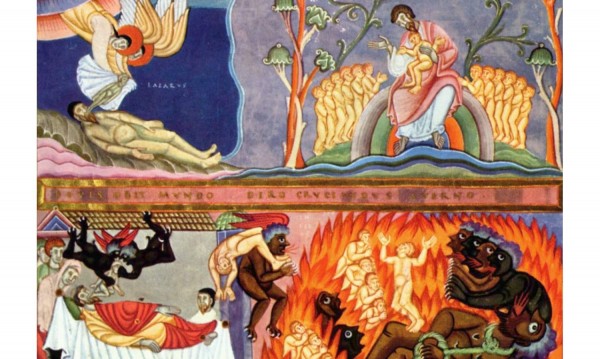
Lazarus (top) and Dives (bottom). The little person that is being pulled out through the mouth by the angels or demons represents the soul being carried away. Of course, the conventional view is that the Rich Man went to hell, hence the demons in the illustration. Him going to purgatory is a relatively recent view, though just because something is new doesn’t make it wrong, and just because something is old doesn’t make it right, or vice versa. Scripture can sometimes carry multiple meanings.

The only mentioned torment in the parable is the fire, which is present in either Purgatory or hell. Sin (blasphemy, hatred of God, hatred of neighbor, violence) is reserved to hell.

As was mentioned earlier, the place in the parable would not be Heaven/Purgatory/Hell, but Sheol.
 
From shamelesspopery.com. shamelesspopery.com/one-lazarus-or-two/ Unfortunately the link to Mark Shea’s article does not work.
Mark Shea discusses that today with a particularly interesting theory: that the “parable” might be actually be the true story of the real-life Lazarus. After all, this is the only person ever named in any of Jesus’ parables, and the account from Luke 16 (about how the rich man begged Abraham for Lazarus to come back from the dead to warn his brothers) fits in perfectly with John 11, in which the real-life Lazarus does come back from the dead. If nothing else, Mark’s post is worth the read if for no other reason than this priceless insight from John 11:
It is particularly notable that this suffering has come to this family, whom John records as the special objects of Jesus’ love. Indeed, John makes the shocking remark, “Now Jesus loved Martha and her sister and Lazarus. So when he heard that he was ill, he stayed two days longer in the place where he was” [John 11:5-6]
. It is the strange word “so” at the beginning of the second sentence that baffles the modern reader. We could accept “yet” or “but,” but “so” means that Christ deliberately allowed this affliction and death as a sign of special favor to Lazarus. And so He did, as He often does, permit suffering to afflict those who are His special favorites. To them, as to Lazarus, a special work of healing will be done for the one He loves so much. The supreme paradigm of this is Christ Himself, who endures the most suffering and has been exalted higher than all.
 
I think he was in purgatory due to:
  1. He was able to see and communicate with the people in “Abraham’s bosom,” and Lazarus and Abraham were able to see and hear him as well. In what kind of heaven are the saints in such close proximity to people suffering in hell? Would heaven be “heaven” if the saints had to constantly see and hear the suffering of the damned? That makes no sense to me.
  2. Even though he was being punished, he still expressed concern for others. He still retained his humanity.
  3. The only reason given as to why he was being punished and Lazarus was being comforted was this:
To me, it sounds like Lazarus did his purgatory on earth, while the rich man is doing his in the afterlife. :twocents:
Do we need not be 100% bad to be in Hell? I don’t think so. Even bad people can do at least one kind deed in their whole life. That kind deed may not earn them salvation though.
 
Do we need not be 100% bad to be in Hell? I don’t think so. Even bad people can do at least one kind deed in their whole life. That kind deed may not earn them salvation though.
Once a person is in the hereafter, they become either a perfect version of themself or a perfectly corrupt version of themself. Charity in a damned person is completely & permanently extinguished.

i.e. There is no such thing as a person in hell that feels authentically remorseful about their life and wish well for those on Earth.
 
Once a person is in the hereafter, they become either a perfect version of themself or a perfectly corrupt version of themself. Charity in a damned person is completely & permanently extinguished.

i.e. There is no such thing as a person in hell that feels authentically remorseful about their life and wish well for those on Earth.
His request was not charity. He didn’t say, “Let me warn my brothers.” He said “Let Lazarus warn my brothers.”
 
Maybe, but as far as I have learned, people undergoing purgation are unable to provide aid, especially for themselves, whereas those in glory can and do.

And sending Lazarus to warn his brothers would still be an act of charity, unless he was asking maliciously, such as “Make him get up and do something.” In my private opinion, this seems a little bit like a stretch since a face-value explanation is generally the correct explanation.

I always assumed the Rich Man was in hell (or the equivalent of hell in Sheol) since for most of my life I never even believed in Purgatory, but the more this thread forces me to rethink it with a new lens, the more it makes theological sense that maybe this was a description of Purgatory. The behavior & language don’t seem to fit quite as well with hell, as it has been described by numerous mystics.
 
Maybe, but as far as I have learned, people undergoing purgation are unable to provide aid, especially for themselves, whereas those in glory can and do.

And sending Lazarus to warn his brothers would still be an act of charity, unless he was asking maliciously, such as “Make him get up and do something.” In my private opinion, this seems a little bit like a stretch since a face-value explanation is generally the correct explanation.

I always assumed the Rich Man was in hell (or the equivalent of hell in Sheol) since for most of my life I never even believed in Purgatory, but the more this thread forces me to rethink it with a new lens, the more it makes theological sense that maybe this was a description of Purgatory. The behavior & language don’t seem to fit quite as well with hell, as it has been described by numerous mystics.
Mystics are approved, not binding.

His first request:

“Send Lazarus to dip water for my tongue.”

Second:

“Send Lazarus to my brothers.”

Pretty selfish to me. Why? He wanted Lazarus to do things for HIS own benefit. Firstly, he wanted Lazarus to leave the place of comfort and go to hell to give him water to ease his torment. Secondly, didn’t Jesus say that if a person causes scandal, it would be better for him to be thrown into the sea with a millstone 'round his neck? So he wanted to decrease his punishment, because he had been a scandal to his brothers.
 
@James:

I apologize for deleting my prior post. The thread was starting to become circular so I intended to pull out, but thank you for your contribution.

Yes: this is all a possible explanation for the Rich Man’s statements.
 
Once a person is in the hereafter, they become either a perfect version of themself or a perfectly corrupt version of themself. Charity in a damned person is completely & permanently extinguished.

i.e. There is no such thing as a person in hell that feels authentically remorseful about their life and wish well for those on Earth.
There are various levels of punishment in hell which corresponds to their level of sin, is it not? Assuming there are unbaptized infants in hell, I’d hate to see them converted to pure evil there. If hell is deprivation of the Beatific Vision, it shouldn’t in itself cause some one less evil to be converted to full evil there. An example would be a good person who lost belief in God in his last days/hrs but nevertheless did not resort to evil. I can’t imagine God making a hell just to make an imperfect person even worse i.e. you are not bad enough for hell, so let me get you truly bad. Divine Justice entails fitting the punishment to the sin, not making prisoners more bad. I can’t imagine God getting a kick out of doing that.
 
The rich man wouldn’t even look at Lazarus when he was alive so I believe he went to hell.
 
There are various levels of punishment in hell which corresponds to their level of sin, is it not? Assuming there are unbaptized infants in hell, I’d hate to see them converted to pure evil there. If hell is deprivation of the Beatific Vision, it shouldn’t in itself cause some one less evil to be converted to full evil there. An example would be a good person who lost belief in God in his last days/hrs but nevertheless did not resort to evil. I can’t imagine God making a hell just to make an imperfect person even worse i.e. you are not bad enough for hell, so let me get you truly bad. Divine Justice entails fitting the punishment to the sin, not making prisoners more bad. I can’t imagine God getting a kick out of doing that.
Such as:

++++ Beatific Vision
+++ Beatific Vision
++ Beatific Vision
  • Beatific Vision
    0 No Beatific Vision (unbaptized infants)
  • No Beatific Vision
    • No Beatific Vision
      • No Beatific Vision
        • No Beatific Vision
 
There are various levels of punishment in hell which corresponds to their level of sin, is it not? Assuming there are unbaptized infants in hell, I’d hate to see them converted to pure evil there. If hell is deprivation of the Beatific Vision, it shouldn’t in itself cause some one less evil to be converted to full evil there. An example would be a good person who lost belief in God in his last days/hrs but nevertheless did not resort to evil. I can’t imagine God making a hell just to make an imperfect person even worse i.e. you are not bad enough for hell, so let me get you truly bad. Divine Justice entails fitting the punishment to the sin, not making prisoners more bad. I can’t imagine God getting a kick out of doing that.
The torments in hell aren’t identical but in the worst state in Purgatory, sin is absent, and in the ‘best’ state of hell, charity is 100% absent.

This isn’t explicitly spelled out in scripture, but in the hereafter, everything becomes perfectly accentuated and focused. At a person’s judgment, the damned will utterly reject Christ and everything he represents - Love itself. Likewise, the least in Heaven will be greater than the greatest on Earth. There is no such thing as a minor fall, as the Didache says, “Great is the difference between them”.
 
Status
Not open for further replies.
Back
Top