
Erika Kirk Forgives Charlie's Killer in Heartbreaking Memorial Speech

Status
Not open for further replies.
Indeed, global south is an old fashion and offensive term coined in the 1960s. https://carnegieendowment.org/posts...south-is-surging-it-should-be-retired?lang=en
There is no need to use it in a thread about the Death Penalty.
Perhaps you can re-write the "mad-max" argument?
I'm leaving my comments as they are. "Global South" largely replaced the inaccurate term "Third World", which, strictly speaking, referred to countries not part of the Western alliance nor the Soviet bloc. That took in countries as widely dispersed as Yugoslavia, India, and Argentina, but as a practical matter, referred to less-developed Southern Hemisphere lands (and not just Southern Hemisphere, some of those countries were north of the equator), and, typically, various peoples of color in those regions.

Vatican News itself uses the term:

https://www.vaticannews.va/en/churc...l-south-appeal-un-climate-action-justice.html

The bishops of that region even refer to themselves as "the bishops of the Global South".

Aside from your objections and the Carnegie Endowment citation, I've never heard it objected to as offensive. Even the Carnegie article more emphasizes that it is, in the view of the author, too broad of a term that describes a high diversity of countries. Everyone has an opinion.
 
I'm leaving my comments as they are. "Global South" largely replaced the inaccurate term "Third World", which, strictly speaking, referred to countries not part of the Western alliance nor the Soviet bloc. That took in countries as widely dispersed as Yugoslavia, India, and Argentina, but as a practical matter, referred to less-developed Southern Hemisphere lands (and not just Southern Hemisphere, some of those countries were north of the equator), and, typically, various peoples of color in those regions.

Vatican News itself uses the term:

https://www.vaticannews.va/en/churc...l-south-appeal-un-climate-action-justice.html

Aside from your objections and the Carnegie Endowment citation, I've never heard it objected to as offensive. Even the Carnegie article more emphasizes that it is, in the view of the author, too broad of a term that describes a high diversity of countries. Everyone has an opinion.
Well, we learn something new everyday. It has been considered offensive for over 40 years, just as the term "less developed countries" instead of developing countries. However, it is more than just language. Better knowledge about development, has shed light on the characteristics of countries. Although no restricted to the success stories of the Asian tigers, and the 34 countries breaking out of the middle income trap to join high-income countries since the 1970s, there has been updating on the classical theories of economic growth that has changed our perspective. To keep it short, we no longer make assumptions about countries, even when we have accurate data on the PPA adjusted GDP per capita. We talk directly about the issue, with specific data about that country.
As for the "mad max" argument on the Death Penalty, perhaps you will kindly explain it again. What is the link between a moral teaching of the Catholic Church and the advise on security? Are you saying that the death penalty is acceptable if people can escape from prison?
 
Well, we learn something new everyday. It has been considered offensive for over 40 years, just as the term "less developed countries" instead of developing countries. However, it is more than just language. Better knowledge about development, has shed light on the characteristics of countries. Although no restricted to the success stories of the Asian tigers, and the 34 countries breaking out of the middle income trap to join high-income countries since the 1970s, there has been updating on the classical theories of economic growth that has changed our perspective. To keep it short, we no longer make assumptions about countries, even when we have accurate data on the PPA adjusted GDP per capita. We talk directly about the issue, with specific data about that country.
As for the "mad max" argument on the Death Penalty, perhaps you will kindly explain it again. What is the link between a moral teaching of the Catholic Church and the advise on security? Are you saying that the death penalty is acceptable if people can escape from prison?

Then I would say that someone needs to inform Vatican News, as well as those bishops who refer to themselves that way. People have various opinions, and varying levels of sensitivity, as to what is objectively "offensive" and what is not.

The "Mad Max" argument refers to a society that is so deteriorated, that capital criminals cannot be confined safely, nor rehabilitated. If that is the case, then, yes, I reluctantly have to say that the DP would be the only viable solution. The common good would trump any appeals to the dignity of the human person, people who are in danger from unrepentant capital criminals running loose have human dignity too.
 
Then I would say that someone needs to inform Vatican News, as well as those bishops who refer to themselves that way. People have various opinions, and varying levels of sensitivity, as to what is objectively "offensive" and what is not.

The "Mad Max" argument refers to a society that is so deteriorated, that capital criminals cannot be confined safely, nor rehabilitated. If that is the case, then, yes, I reluctantly have to say that the DP would be the only viable solution. The common good would trump any appeals to the dignity of the human person, people who are in danger from unrepentant capital criminals running loose have human dignity too.
I will not advance an assumption on why the Catholic Church would want to separate Bishops along a North-South divide.(it is not a matter of catechism) Do they discriminate amongst their postings? Is the missionary work different in north and south, meaning the ordained functionaries' work is detached from their parishioners, so much so that they do not get a proper sense of the issues?

At the base of the offense is the prejudice, the oversimplification. The lack of accuracy leads to the wrong assessments of people, regions or nations and to actions that may be profoundly incorrect. It is not "just language" - it has real effects.
It is the way you used it in your argument. When lacking for proper words, or writing in haste, you used "poorer countries in the global south" as a blanket term to say how unlikely it would be to have "mad-max conditions" that would make the Death Penalty acceptable. In other words, the "worse of the worse". Isn't it more in tune with Christian sensitivity to explicitly state the condition to which you refer?
When citing Mad-max (dystopian fiction) you are perhaps thinking of a complete break down in social order? A massive earth quake in which people loot stores, rob cadavers, assault the weak? Martial law is declared, people are shot in place until the reinforcements arrive?

Just as a note about the obsolescence of the North-South divide: the U.S. ranks 7 in terms of adjusted Purchasing Power (PPA) GDP per capita- a measure of wealth - Singapore is first, followed by Macau, Qatar, Norway, Switzerland, and Brunei. https://www.economist.com/graphic-d...I2AAI&mi_u=0033z00002otqI2AAI&mi_ecmp=2096269
 
Last edited by a moderator:
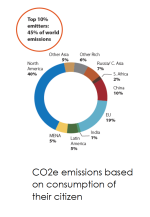
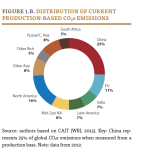
I am addressing separately the ecological issue - Screenshot 2025-09-23 at 1.32.52 PM.png1758648884110.png

The use of north-south is again incorrect.
1. In terms of producers of CO2 emissions, China leads the pack, with north America second. Emissions are associated with the highest concentration of manufacturing.
2. The highest concentration of consumption of manufactured goods that caused CO2 emission is in North America. - without demand there is no supply.
3. The most affected nations by global warming are neither in the south nor north, but along the equatorial line, in which rising temperatures is challenging survival (and production) (I attempted to load a map with the most affected regions, but the server did not allow it).

I would say that the bishops bringing the letter to the UN had the best intention to reflect the fact that the regions bearing most of the cost of global warming are not the regions responsible for it (the ultimate analysis puts high weight on consumption). The poor nations in warm areas are in need of urgent assistance. To do so, the Bishops used an old fashioned term, vestige of the cold war. Perhaps the term will appeal to the members of the former eastern block and it will gather the attention it merits.
 
Last edited by a moderator:
When citing Mad-max (dystopian fiction) you are perhaps thinking of a complete break down in social order? A massive earth quake in which people loot stores, rob cadavers, assault the weak? Martial law is declared, people are shot in place until the reinforcements arrive?

Yes, that is an accurate characterization.

God forbid such a situation would ever exist in the real world, but I'm sure it has before.

Only there might not be reinforcements.
 
The arguments against and in favor of abolishing the death penalty are moral and empirical (is the DP a deterrent). The wealth of a country is but one of the determinants of crime and safety, and perhaps not even a very relevant one. Safety is a complex discussion on itself, one that has to be based in accurate information to begin with.

The north-south divide is an obsolete term, and it does not help in understanding the issues of the DP.
The divide north-south is a complex term, dating from the 1960, and from steaming from a leftist perspective of the world at the time (colonialism, center-periphery development model, etc.) has no role in the analysis. It was a response to colonial prejudices towards
the "third world" countries (also a term no longer in use), which perpetuated the stereotypes, in pure marxist fashion, it contended that the way out was a power struggle between north and south.
The concept is obsolete.
Both the colonial powers and the East block marxists believed those countries would never get out of their "underdevelopment", each group of different reasons. The colonial powers had a number of prejudices toward the "third world" (lazy, they do not save, they are not good entrepreneurs). The marxists beliefed the cards were stucked against them, and the imbalanced of power could only be overcome by forming trade blocks with marxists countries and use importot substitution policies.
Yet, many of those countries reached middle income level (income here refers to GDP per capita) and 34 made it to the high level income with neo-liberal policies and trade, they proofed both camps wrong. They proofed the marxists wrong by achieving growth without revolutions and they proved the colonial powers that thought them incapable wrong by working hard, saving and investing.
 
Last edited by a moderator:
Yes, that is an accurate characterization.

God forbid such a situation would ever exist in the real world, but I'm sure it has before.

Only there might not be reinforcements.
If there are no reinforcements, there is no penal system, there is no judge condemning people to the death penalty. I posted the development of the catechism - the 1997 change, driven by Evangelicum Vitae (1995) and then the 2018 text- the discussion is always within the framework of a working penal system. (for example, how much certainty do we have that the guilty verdict is correct).
However, I was disturbed by the prejudice of making assessments of penal systems solely on the base of GDP per capita and making bad inferences about poor nations.
Here is a story in 1965, Tonga, then considered a "third World" country. According to my google search today: " No, Tonga is not a "third world country"; that term is outdated and inaccurate. Instead, Tonga is classified as a Small Island Developing State (SIDS) and an upper-middle-income economy by the World Bank. While it faces economic vulnerabilities, a narrow export base, and high reliance on foreign aid and remittances, it also has a strong Human Development Index score and improving social services"
You probably read the book "Lord of the Flies", William Golding's 1954 novel about British schoolboys stranded on a deserted island (with no system to safe guard law and order) who descend into savagery, marking the collapse of their civilization due to the inherent capacity for evil in human nature.
In 1965 six boys from Tonga were stranded in an island for 15 months. Their story diverges in every way from Golding's prediction. Perhaps we can be surprised by the culture in poorer countries.
One important fact: all six boys attended a catholic school, and they kept their morale through the ordeal by following their teachings.
here is the story: https://www.theguardian.com/books/2...-when-six-boys-were-shipwrecked-for-15-months
 
If there are no reinforcements, there is no penal system, there is no judge condemning people to the death penalty. I posted the development of the catechism - the 1997 change, driven by Evangelicum Vitae (1995) and then the 2018 text- the discussion is always within the framework of a working penal system. (for example, how much certainty do we have that the guilty verdict is correct).
However, I was disturbed by the prejudice of making assessments of penal systems solely on the base of GDP per capita and making bad inferences about poor nations.
Here is a story in 1965, Tonga, then considered a "third World" country. According to my google search today: " No, Tonga is not a "third world country"; that term is outdated and inaccurate. Instead, Tonga is classified as a Small Island Developing State (SIDS) and an upper-middle-income economy by the World Bank. While it faces economic vulnerabilities, a narrow export base, and high reliance on foreign aid and remittances, it also has a strong Human Development Index score and improving social services"
You probably read the book "Lord of the Flies", William Golding's 1954 novel about British schoolboys stranded on a deserted island (with no system to safe guard law and order) who descend into savagery, marking the collapse of their civilization due to the inherent capacity for evil in human nature.
In 1965 six boys from Tonga were stranded in an island for 15 months. Their story diverges in every way from Golding's prediction. Perhaps we can be surprised by the culture in poorer countries.
One important fact: all six boys attended a catholic school, and they kept their morale through the ordeal by following their teachings.
here is the story: https://www.theguardian.com/books/2...-when-six-boys-were-shipwrecked-for-15-months

In any isolated community where there are only the rudiments of a social polity, an imperfect society has to be created out of necessity, basic "rules" have to be established, and if the society is large enough, there will emerge natural leaders, "alpha dogs", if you will, as well as followers. That is where natural law kicks in, and more to the point, the natural-law right of self-defense. And you are quite correct in noting, through your example, that these ad hoc social orders need not descend into savagery and brutality. The six young Tongans were evidently good boys who had been raised and educated correctly, not to suggest that the LOTF boys hadn't been as well, but each society, very small or very large as the case may be, will have its own unique mix, and, yes, possibly its troublemakers. The ad hoc society must have ways to deal with such miscreants. One hopes that things would never get to the point of a decision needing to be made about putting one such miscreant to death.

I did indeed read LOTF in my college literature class, and my son and I read it as part of our homeschool curriculum. My son was not the most robust pupil in the world, and we were not able to cover as much literature, especially voluminous works, as deeply as I would have liked, so I replaced quantity with quality, and, with the exception of a couple of popular contemporary works that I allowed for "fun", we read canonical works of high caliber, LOTF being one of them. We also read Crime and Punishment, which for a novel of the 19th century was very accessible to the modern reader. We tried Silas Marner, but while it is a great story, it is very dense, ornate, and almost unreadable, so we had to resort to excerpts and summaries instead.
 
In any isolated community where there are only the rudiments of a social polity, an imperfect society has to be created out of necessity, basic "rules" have to be established, and if the society is large enough, there will emerge natural leaders, "alpha dogs", if you will, as well as followers. That is where natural law kicks in, and more to the point, the natural-law right of self-defense. And you are quite correct in noting, through your example, that these ad hoc social orders need not descend into savagery and brutality. The six young Tongans were evidently good boys who had been raised and educated correctly, not to suggest that the LOTF boys hadn't been as well, but each society, very small or very large as the case may be, will have its own unique mix, and, yes, possibly its troublemakers. The ad hoc society must have ways to deal with such miscreants. One hopes that things would never get to the point of a decision needing to be made about putting one such miscreant to death.

I did indeed read LOTF in my college literature class, and my son and I read it as part of our homeschool curriculum. My son was not the most robust pupil in the world, and we were not able to cover as much literature, especially voluminous works, as deeply as I would have liked, so I replaced quantity with quality, and, with the exception of a couple of popular contemporary works that I allowed for "fun", we read canonical works of high caliber, LOTF being one of them. We also read Crime and Punishment, which for a novel of the 19th century was very accessible to the modern reader. We tried Silas Marner, but while it is a great story, it is very dense, ornate, and almost unreadable, so we had to resort to excerpts and summaries instead.
Let's keep in mind that LOTF is fiction. Not sure it would happened as badly as the book suggests. I am no expert on British schools, but I would not choose a public school (which are the privileged private ones).
George Elliot is a difficult writer, I do not blame your boy. I read Middlemarch and Daniel Deronda after high school, and after having read a lot of Dickens, Trollope, Foster and Gaskell. I think that made it easier to grasps the characters of that time. I truly enjoyed it.
 
Let's keep in mind that LOTF is fiction. Not sure it would happened as badly as the book suggests. I am no expert on British schools, but I would not choose a public school (which are the privileged private ones).
George Elliot is a difficult writer, I do not blame your boy. I read Middlemarch and Daniel Deronda after high school, and after having read a lot of Dickens, Trollope, Foster and Gaskell. I think that made it easier to grasps the characters of that time. I truly enjoyed it.

But if everything had been harmonious and in accord with a Tongan-like scenario of benevolent youths committed to the natural law, you wouldn't have had much of a book. I bristle at the prescription of canons that have to exist to create a novel, conflict being one of those canons --- if I want to write a work of fiction, I'll write it as I see fit, and let those read it who wish to --- but the various conflicts in LOTF make the book.

C&P reads as crisply as any 20th (or now, 21st)-century popular work does (think Stephen King). And it's not just pre-20th-century literature that is mind-numblingly prolix. I got Atlas Shrugged as a birthday gift twenty years ago and I still have not finished it, about halfway through, I threw up my hands and said no more, I can't take this excruciating detail, it's just too much. It's not especially hard reading... it's just so thick and dense. Great story, but Miss Rand could have said the very same thing in half the words.
 
The arguments against and in favor of abolishing the death penalty are moral and empirical (is the DP a deterrent).
Apologies, I was not clear.
This thread was NOT supposed to be about the DP.
It was about the Charlie Kirk memorial. Specifically Erika Kirk specifying forgiveness for the assassin.

A sentiment that is sorely lacking in our society, and contrasts well against the onslaught of people celebrating Charlie Kirk's death.

And that is why I question the statement "There is no need to use the in a thread about the Death Penalty."

I understand people believe this to be an important topic.
But I have to question...is it so important we cannot create another thread for it?

Perhaps people would rather not discuss Charlie Kirk. Which is fine. Not discussing him is fine. Hijacking the thread is rude.
 
 
Last edited by a moderator:
Apologies, I was not clear.
This thread was NOT supposed to be about the DP.
It was about the Charlie Kirk memorial. Specifically Erika Kirk specifying forgiveness for the assassin.

A sentiment that is sorely lacking in our society, and contrasts well against the onslaught of people celebrating Charlie Kirk's death.

And that is why I question the statement "There is no need to use the in a thread about the Death Penalty."

I understand people believe this to be an important topic.
But I have to question...is it so important we cannot create another thread for it?

Perhaps people would rather not discuss Charlie Kirk. Which is fine. Not discussing him is fine. Hijacking the thread is rude.
I am not aware of people celebrating Charlie Kirk's death as representative of our society. I read about some people losing their jobs for posting such remarks. But I would say that in mass our society condemned the shooting. Note that there have been reports of people complaining that their posts were misconstrued as such (and getting death threads themselves) : there was a story of a local school board member in PA (Misty Hunt) who posted about gardening the same day of the shooting using an unfortunate title. I will address this further below.

Erika Kirk was clear about forgiveness, but she fell short of asking that the shooter be spared the death penalty (legally, her pledge might not make a difference if she had). For example: " In an interview with the New York Times published on Sunday, Erika Kirk said she had been asked whether she wants to see the suspect face the death penalty.

She remarked: “I’ll be honest. I told our lawyer, I want the government to decide this. I do not want that man’s blood on my ledger.

“Because when I get to heaven, and Jesus is like, ‘Uh, [an] eye for an eye? Is that how we do it?’ And that keeps me from being in heaven, from being with Charlie?”

That fell short of the words of Pope Francis Address to Participants in the Meeting organized by the Pontifical Council for the Promotion of the New Evangelization, 11 October 2017: L’Osservatore Romano, 13 October 2017 when presenting Catechism 2267. Recourse to the death penalty on the part of legitimate authority, following a fair trial, was long considered an appropriate response to the gravity of certain crimes and an acceptable, albeit extreme, means of safeguarding the common good.
"Consequently, the Church teaches, in the light of the Gospel, that “the death penalty is inadmissible because it is an attack on the inviolability and dignity of the person”, and she works with determination for its abolition worldwide”.


If Erika, as a Catholic, in her role as head of Turning Points should launch such a pledge or embrace that particular line of activism is a different issue. It is early to say what direction Turning Point will take under her guidance. I read Charlie Kirk was considering conversion to Catholicism before his death. George Farmer, the chairman of Turning Point UK is Catholic.

It is also early in the papacy of Pope Leo XIV- the first American Pope who will have a well informed view of this country. In his first interview ( September 18th) https://www.vaticannews.va/en/pope/...s-building-bridges-avoiding-polarization.html
he shared that he wants to continue Pope Francis work avoiding polarization.

In the last section of the interview, Pope Leo talks about the danger of fake news. Pope Leo is talking of a global trend, and links it to the increasing income gap. This tendency plays out locally - with local violence and aggression - on both sides (the story of the Gardening school board member for example).
I want to take on this in responding to you: I write when an inaccuracy becomes apparent. I also shared some info on how inaccuracies can work to feed a chain of incorrect conclusions - it was the part on spurious correlations- a technical term which describes a pratice prevalent in journalism. In simple language it refers to the tendency of our minds to "fill in the blanks" when we see a pattern or an association -always when following news we need to stop and think twice (I shared the reference to the book "Think Again") and probe. Getting to the facts is often painstaking work, but it is necessary. So, although I do not look to hijacking threads, sometimes correcting inaccuracies can take a longer detour. The risk for our society from fake news is great- so much so that the Pope included it in his first interview.
 
Last edited by a moderator:
Apologies, I was not clear.
This thread was NOT supposed to be about the DP.
It was about the Charlie Kirk memorial. Specifically Erika Kirk specifying forgiveness for the assassin.

A sentiment that is sorely lacking in our society, and contrasts well against the onslaught of people celebrating Charlie Kirk's death.

And that is why I question the statement "There is no need to use the in a thread about the Death Penalty."

I understand people believe this to be an important topic.
But I have to question...is it so important we cannot create another thread for it?

Perhaps people would rather not discuss Charlie Kirk. Which is fine. Not discussing him is fine. Hijacking the thread is rude.
I don't think anybody deliberately hijacked the thread, it just took on a life of its own, and the DP discussion emerged organically from the Charlie Kirk discussion. Multi-channel thinkers with fertile minds tend to go off on tangents, and they are often very good tangents.

I might see if I can split off the DP segue into its own thread, or move posts past a certain point to the existing DP thread (the world will not come to an end if we have two DP threads). Let me tinker around with the CQ program and see if that's possible.
 
I am not aware of people celebrating Charlie Kirk's death as representative of our society. I read about some people losing their jobs for posting such remarks.
I doubt it representative of society as a whole.
I think more that these individuals are going to discover how alone they really are in their aberrant behavior, and slink back under whatever rock they came from.

Erika Kirk was clear about forgiveness, but she fell short of asking that the shooter be spared the death penalty (legally, her pledge might not make a difference if she had). For example: " In an interview with the New York Times published on Sunday, Erika Kirk said she had been asked whether she wants to see the suspect face the death penalty.

She remarked: “I’ll be honest. I told our lawyer, I want the government to decide this. I do not want that man’s blood on my ledger.
I wouldn't say it falls short.
Whether or not someone is forgiven does not provide an escape from the lawful consequences of their actions.
It is only with God and his law that forgiveness carries such power.

Am I to understand that you believe the act of forgiveness is somehow less for not calling for the sparing of the man's life?

I read Charlie Kirk was considering conversion to Catholicism before his death.
Based upon the debates I watched, I would say he was pretty far from conversion, but I considered it a likely eventuality.
 
I don't think anybody deliberately hijacked the thread, it just took on a life of its own, and the DP discussion emerged organically from the Charlie Kirk discussion. Multi-channel thinkers with fertile minds tend to go off on tangents, and they are often very good tangents.

I might see if I can split off the DP segue into its own thread, or move posts past a certain point to the existing DP thread (the world will not come to an end if we have two DP threads). Let me tinker around with the CQ program and see if that's possible.

I've gone back through the thread, and the DP was an intrinsic part of it almost from the very beginning. The whole concept of Mrs Kirk forgiving her husband's assassin perforce brings the DP into the discussion, or at least that's how it turned out (though, arguendo, you can forgive someone and acquiesce to their execution at the same time, the two concepts aren't mutually exclusive, and it's not as though the criminal whose life is spared is just going to walk out of prison a free man because he's been forgiven by the victim's loved one).

I'm leaving the thread as it is. If I attempted to unstring it and siphon off the DP discussion into its own thread, there wouldn't be much of a thread left after that.
 
I doubt it representative of society as a whole.
I think more that these individuals are going to discover how alone they really are in their aberrant behavior, and slink back under whatever rock they came from.


I wouldn't say it falls short.
Whether or not someone is forgiven does not provide an escape from the lawful consequences of their actions.
It is only with God and his law that forgiveness carries such power.

Am I to understand that you believe the act of forgiveness is somehow less for not calling for the sparing of the man's life?

IT is exactly that- The words of Pope Francis: ""Consequently, the Church teaches, in the light of the Gospel, that “the death penalty is inadmissible because it is an attack on the inviolability and dignity of the person”, and she works with determination for its abolition worldwide”.
Erika did not ask the Governor or prosecutor in Utah not to seek the death penalty - she said "I told our lawyer, I want the government to decide this.....“Because when I get to heaven, and Jesus is like, ‘Uh, [an] eye for an eye? Is that how we do it?’ "
Her statement can be seen as "the Utah prosecutor has no reason to seek the DP to right me (an eye for en eye)"
This is not the same as saying, do not seek the DP for any reason (DP is inadmissible) bc it violates human dignity. Life sentence would be a lawful consequence, and it would comply with the teaching of the Church, don't you think?


The prosecutor in Utah will move according to their agenda/priorities. It is possible that it would not make a difference if Erika Kirk did ask that the DP not be sought.


It could make a difference for followers of turning point if the organization took the position of opposing the DP. It could make a difference in voters and change legislation regarding the DP in the US.


On the other hand, if my research is correct: mormons condemn the DP but have a position of neutrality regarding legality of it. ( 42% of adult population is mormon, and about 5% is Catholic- perhaps not enough to win an election on it)
https://newsroom.churchofjesuschrist.org/official-statement/capital-punishment#:~:text=The Church of Jesus Christ of Latter-day,We neither promote nor oppose capital punishment.
So in taking that neutral legal stance, Erika Kirk is siding with the Turning Point followers in Utah that are members of the LDS.


Based upon the debates I watched, I would say he was pretty far from conversion, but I considered it a likely eventuality.
Possibly correct- I did not read in detail that part, take your word.
It was really just an aside thought when guessing if the direction of Turning Point might change now that two Catholics are top leaders.
 
Last edited by a moderator:
Status
Not open for further replies.
Back
Top