I don't know what their prison facilities are like, but evidently the respective countries think they are up to the task of confining capital felons without having to resort to the DP. Or they may just regard it as something to be avoided, regardless of how good those facilities may be. No country has to impose the DP, it's at their discretion.
And heavily Catholic countries may be seeking to implement what the Catechism calls for.
Thank you for the clarification. However, we do not know what people in the countries think about their prisons. Also, it is not at all evident that the state of prisons has anything to do with abolishing the DP. To add to the complexity of the issue, in some non-Western countries the abolition of the DP came from out side pressure. For example, Chad abolished the DP in 2020 to harmonize its anti-terrorist laws with other G5 Sahel countries in Africa. G5 Sahel had a partnership with the EU and received financial support from them, the UN and various other organizations.
The decision about the DP in democracies, is usually based on security. For example, past June, the transitional government in Chad created a commission to consider re-establishment of the DP because of "marked deterioration of security and a perceived increase in instability."
(The G5 Sahel group fell apart and started dissolution in 2023.)
Their argument is that re-establishing the DP might deter criminals (not in prison). In the case of Chad, they look at decreasing people joining terrorists groups like Boko Haram. The argument against re-establishing the DP is that it would perpetuate the cycle of violence, attracting fanatic martyrs intended on more extreme violence to join terrorist organizations
The situation in the U.S. is very different, but the argument made by Western organization in Chad is rooted in our debate. HomeschoolDad properly touches on the deterrent argument- although it needs to be considered more widely- Tyler Robinson in maximum security would not be a further threat. People requesting the DP might make the argument that it might deter future violence by other people.
The request from Erika Kirk counters the argument of people that look at the DP as "proper punishment" or even worse, as "proper retribution".
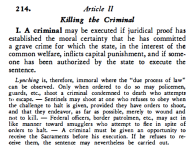
The fundamental argument of Catholic Catechism - that as a punishment is goes against the dignity of human life, is broader.
Scientific evidence is not conclusive regarding the deterrent argument (which is expected given the nature of the issue). We have
strong associations that support the argument against DP. (States with the DP do not have lower rates of violent crime- this is an association, not a proof. It is worth taking time to see how it can be done)
Other insights on the issue
- According to a study from 2009, deathpenaltyinfo.org/files/DeterrenceStudy2009.pdf
88% of top criminologists think it is not a deterrent.
- National surveys on Police Chiefs ranked DP as last amongst effective ways to reduce violent crime.
https://dpic-cdn.org/production/legacy/CostsRptFinal.pdf
The argument on how to deter violent crime is based on empirical considerations (what works). But there is a religious dimension in it - it regards the human condition. For example most police Chiefs in the survey named drugs and economic factors as the main determinants of violent crime.
they believe that resources would be better used in other programs. This lines up with Erika Kirk pledge "the answer is love and always love".