Erika Kirk Forgives Charlie's Killer in Heartbreaking Memorial Speech

Status
Not open for further replies.

vz71

Well-known member


For those that don't want to go through the entirety, this is the pertinent part...


My husband, Charlie. He wanted to save young men, just like the one who took his life. That young man. That young man on the cross. Our Savior said, "Father, forgive them, for they not know what they do." That man. That young man. I forgive him. I forgive him because it was what Christ did in his. What Charlie would do. The answer to hate is not hate. The answer we know from the gospel is love and always love.
 
Fulton J. Sheen said "There are not one hundred people in the United States who hate The Catholic Church, but there are millions who hate what they wrongly perceive the Catholic Church to be."

I am seeing something similar with here. An inordinate hatred for things that were never said or done.
Perhaps that speech will get through to some.
 
If the Holy Ghost was in charge of prompting the Church to call for the abolition of the death penalty throughout the world in our time, when penal systems make it possible not to have to resort to that, then Mrs Kirk's call is an especially powerful witness, as well as to the larger mandate of unconditional forgiveness of one's enemy, which never changes with times and circumstances.

The existence of the DP, while in and of itself licit as a last resort per traditional Catholic moral theology, doesn't bring out the best in people. It is one thing to carry it out regretfully and even mournfully, with prayers that the condemned may be saved, but people standing in demonstrations outside prisons and cheering when the sentence is carried out, and calling for the condemned to burn in hell (one hopes and prays none of these people are Catholic), is a horrible example of how low the human spirit can sink in those uninformed by divine grace.

Even the Baltimore Catechism, which reliably contains the basics (but just the basics) of traditional Catholic theology, moral and otherwise, calls the DP a last resort when no other means of justice are possible. It's certainly not the first and best way to deal with capital felons.
 
The existence of the DP, while in and of itself licit as a last resort per traditional Catholic moral theology, doesn't bring out the best in people.
At the risk of making this thread about the DP instead of Kirk, I do not believe the DP is warranted here.
Per traditional catholic teaching, the killer is no longer a threat to anyone or anything.

I did not realize Erika was Catholic. Interesting.
 
At the risk of making this thread about the DP instead of Kirk, I do not believe the DP is warranted here.
Per traditional catholic teaching, the killer is no longer a threat to anyone or anything.

I did not realize Erika was Catholic. Interesting.
And that's what I'm trying to bring out. The Church, in her most recent catechism, makes the same point, that the DP is, in her judgment, never needed in our day and age. Even some poor African countries no longer impose the DP, and their penal facilities, while adequate, are probably not world-class.
 
And that's what I'm trying to bring out. The Church, in her most recent catechism, makes the same point, that the DP is, in her judgment, never needed in our day and age. Even some poor African countries no longer impose the DP, and their penal facilities, while adequate, are probably not world-class.
Africa is a huge continent, which countries are you talking about?
 
Africa is a huge continent, which countries are you talking about?
Angola, Benin, Burundi, Cape Verde, Central African Republic, Chad, Congo, Djibouti, Gabon, Gambia, Guinea, Guinea-Bissau, Ivory Coast, Liberia, Madagascar, Mauritius, Mozambique, Namibia, Rwanda, Sao Tome and Principe, Senegal, Seychelles, Sierra Leone, South Africa, Togo, and Zimbabwe.
 
Angola, Benin, Burundi, Cape Verde, Central African Republic, Chad, Congo, Djibouti, Gabon, Gambia, Guinea, Guinea-Bissau, Ivory Coast, Liberia, Madagascar, Mauritius, Mozambique, Namibia, Rwanda, Sao Tome and Principe, Senegal, Seychelles, Sierra Leone, South Africa, Togo, and Zimbabwe.
All those countries have adecuate prison facilities?
For example, here is what the U.S. State Department says about Chad

I agree about DP and I want to keep the focus of the thread, but I am always dismayed when words are used loosely, even if to make a good point.
Which African countries have adecuate prisons?
 
All those countries have adecuate prison facilities?
For example, here is what the U.S. State Department says about Chad

I agree about DP and I want to keep the focus of the thread, but I am always dismayed when words are used loosely, even if to make a good point.
Which African countries have adecuate prisons?
I don't know what their prison facilities are like, but evidently the respective countries think they are up to the task of confining capital felons without having to resort to the DP. Or they may just regard it as something to be avoided, regardless of how good those facilities may be. No country has to impose the DP, it's at their discretion.

And heavily Catholic countries may be seeking to implement what the Catechism calls for.
 
I don't know what their prison facilities are like, but evidently the respective countries think they are up to the task of confining capital felons without having to resort to the DP. Or they may just regard it as something to be avoided, regardless of how good those facilities may be. No country has to impose the DP, it's at their discretion.

And heavily Catholic countries may be seeking to implement what the Catechism calls for.
Thank you for the clarification. However, we do not know what people in the countries think about their prisons. Also, it is not at all evident that the state of prisons has anything to do with abolishing the DP. To add to the complexity of the issue, in some non-Western countries the abolition of the DP came from out side pressure. For example, Chad abolished the DP in 2020 to harmonize its anti-terrorist laws with other G5 Sahel countries in Africa. G5 Sahel had a partnership with the EU and received financial support from them, the UN and various other organizations.

The decision about the DP in democracies, is usually based on security. For example, past June, the transitional government in Chad created a commission to consider re-establishment of the DP because of "marked deterioration of security and a perceived increase in instability."
(The G5 Sahel group fell apart and started dissolution in 2023.)
Their argument is that re-establishing the DP might deter criminals (not in prison). In the case of Chad, they look at decreasing people joining terrorists groups like Boko Haram. The argument against re-establishing the DP is that it would perpetuate the cycle of violence, attracting fanatic martyrs intended on more extreme violence to join terrorist organizations

The situation in the U.S. is very different, but the argument made by Western organization in Chad is rooted in our debate. HomeschoolDad properly touches on the deterrent argument- although it needs to be considered more widely- Tyler Robinson in maximum security would not be a further threat. People requesting the DP might make the argument that it might deter future violence by other people.

The request from Erika Kirk counters the argument of people that look at the DP as "proper punishment" or even worse, as "proper retribution".
The fundamental argument of Catholic Catechism - that as a punishment is goes against the dignity of human life, is broader.

Scientific evidence is not conclusive regarding the deterrent argument (which is expected given the nature of the issue). We have strong associations that support the argument against DP. (States with the DP do not have lower rates of violent crime- this is an association, not a proof. It is worth taking time to see how it can be done)
Other insights on the issue
- According to a study from 2009, deathpenaltyinfo.org/files/DeterrenceStudy2009.pdf
88% of top criminologists think it is not a deterrent.
- National surveys on Police Chiefs ranked DP as last amongst effective ways to reduce violent crime.
https://dpic-cdn.org/production/legacy/CostsRptFinal.pdf

The argument on how to deter violent crime is based on empirical considerations (what works). But there is a religious dimension in it - it regards the human condition. For example most police Chiefs in the survey named drugs and economic factors as the main determinants of violent crime.
they believe that resources would be better used in other programs. This lines up with Erika Kirk pledge "the answer is love and always love".

 
Last edited by a moderator:
This is all very good, detailed information, and I thank you for posting it. There might not be that much of a connection between being able to provide adequately for the security of the larger society, and concomitantly getting rid of the DP. As I noted above, no state has to administer the DP. The state could very well say "no, our prisons aren't the best, but because [insert reason here], we don't see the DP as acceptable".

I'm not sure how "deterrence" would stand up as a justification for the DP in Catholic moral theology. Even if it did act as a deterrent, is the state within her rights, or is it "the end justifies the means" --- "look, capital criminals know they will be executed, so they're less likely to commit those crimes in the first place, most people don't want to commit that crime so badly, that they are willing to die to do it"?

(I say "most" people because some people might not care, or would even welcome death for this reason or that. For instance, a terminal cancer patient might decide to avenge some perceived wrong, thinking "yes, I know I'll get the DP, but I'm going to die anyway, I'd rather die like that, than to die being eaten away by cancer".)
 
This is all very good, detailed information, and I thank you for posting it. There might not be that much of a connection between being able to provide adequately for the security of the larger society, and concomitantly getting rid of the DP. As I noted above, no state has to administer the DP. The state could very well say "no, our prisons aren't the best, but because [insert reason here], we don't see the DP as acceptable".

I'm not sure how "deterrence" would stand up as a justification for the DP in Catholic moral theology. Even if it did act as a deterrent, is the state within her rights, or is it "the end justifies the means" --- "look, capital criminals know they will be executed, so they're less likely to commit those crimes in the first place, most people don't want to commit that crime so badly, that they are willing to die to do it"?

(I say "most" people because some people might not care, or would even welcome death for this reason or that. For instance, a terminal cancer patient might decide to avenge some perceived wrong, thinking "yes, I know I'll get the DP, but I'm going to die anyway, I'd rather die like that, than to die being eaten away by cancer".)
I have not seen one argument coming from a Catholic source that would consider the DP if it were to reduce violence. So it seems that it is unqualified no. (DP is never approved).

I see no reason why Catholics would need to reason through the security argument, but some Catholic sources do it. Perhaps in an attempt to gain wider support against DP. The line of reasoning is: although we can not show conclusively that DP does not deter violent crime, there is enough "circumstantial" evidence for the statement.

We all agree that It is impossible to completely eliminate violent crime. Deter crime usually means decrease the violent crime rate or decrease the impulse of an individual to commit a violent crime.
For example, premeditated violent crime may be less probable if the person thinks there is a higher probability of being caught: many experts argue that the probability of being caught (and how fast) weights more in the decision than the severity of the punishment.
 
Last edited by a moderator:
I have not seen one argument coming from a Catholic source that would consider the DP if it were to reduce violence. So it seems that it is unqualified no. (DP is never approved).

I see no reason why Catholics would need to reason through the security argument, but some Catholic sources do it. Perhaps in an attempt to gain wider support against DP. The line of reasoning is: although we can not show conclusively that DP does not deter violent crime, there is enough "circumstantial" evidence for the statement.

We all agree that It is impossible to completely eliminate violent crime. Deter crime usually means decrease the violent crime rate or decrease the impulse of an individual to commit a violent crime.
For example, premeditated violent crime may be less probable if the person thinks there is a higher probability of being caught: many experts argue that the probability of being caught (and how fast) weights more in the decision than the severity of the punishment.
Traditional Catholic moral teaching says that the state has the right to administer the DP, but this is subject to conditions. The Baltimore Catechism stresses that it is to be used as a last resort when no other solution is possible. The present teaching is that in our world in the here and now, there are always other solutions, but that does not vitiate the theoretical possibility of a society having no other choice. I always use an apocalyptic "Mad Max" scenario, where the state and the social order have deteriorated to the point that the worst criminals cannot be confined in such a way that the rest of society is protected from them. Thankfully we're not anywhere near such a scenario in today's world. To assert that the threat acts as a deterrent is highly problematical from a moral standpoint.

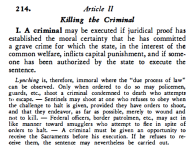
Here is what Jone has to say in Moral Theology (last imprimatur 1961):

1758581723259.png
Seen in light of the present Catechism, the argument seems to be "but the common welfare never requires it".
 
Traditional Catholic moral teaching says that the state has the right to administer the DP, but this is subject to conditions. The Baltimore Catechism stresses that it is to be used as a last resort when no other solution is possible. The present teaching is that in our world in the here and now, there are always other solutions, but that does not vitiate the theoretical possibility of a society having no other choice. I always use an apocalyptic "Mad Max" scenario, where the state and the social order have deteriorated to the point that the worst criminals cannot be confined in such a way that the rest of society is protected from them. Thankfully we're not anywhere near such a scenario in today's world. To assert that the threat acts as a deterrent is highly problematical from a moral standpoint.

Here is what Jone has to say in Moral Theology (last imprimatur 1961):

View attachment 242051
Seen in light of the present Catechism, the argument seems to be "but the common welfare never requires it".

2267 paragraph of Catholic Catechism in 1997 did not exclude recourse to the death penalty in “very rare, if not practically nonexistent” circumstances:

Assuming that the guilty party's identity and responsibility have been fully determined, the traditional teaching of the Church does not exclude recourse to the death penalty, if this is the only possible way of effectively defending human lives against the unjust aggressor.

If, however, non-lethal means are sufficient to defend and protect people's safety from the aggressor, authority will limit itself to such means, as these are more in keeping with the concrete conditions of the common good and more in conformity to the dignity of the human person.

Today, in fact, as a consequence of the possibilities which the state has for effectively preventing crime, by rendering one who has committed an offense incapable of doing harm - without definitely taking away from him the possibility of redeeming himself - the cases in which the execution of the offender is an absolute necessity "are very rare, if not practically nonexistent."

This followed from Pope John Paul II encyclical "Evangelium Vitae" (1995)

In 2018 Pope Francis declared the death penalty inadmissible in all cases, which lead to the change of paragraph 2267 in Catholic Catechism to:

Recourse to the death penalty on the part of legitimate authority, following a fair trial, was long considered an appropriate response to the gravity of certain crimes and an acceptable, albeit extreme, means of safeguarding the common good.
Today, however, there is an increasing awareness that the dignity of the person is not lost even after the commission of very serious crimes. In addition, a new understanding has emerged of the significance of penal sanctions imposed by the state. Lastly, more effective systems of detention have been developed, which ensure the due protection of citizens but, at the same time, do not definitively deprive the guilty of the possibility of redemption.

Consequently, the Church teaches, in the light of the Gospel, that the death penalty is inadmissible because it is an attack on the inviolability and dignity of the person, and she works with determination for its abolition worldwide.
 
Last edited by a moderator:
"The dignity of the human person" is a recurring leitmotif throughout the most recent Catechism, such that it would not be a stretch to think of it as "the catechism of human dignity". I don't think any violence is being done to past teaching, nor is that teaching being declared patently false. It is basically the Church saying, in so many words, "you know, given our deeper understanding of human dignity, and the way penal systems and systems of detention are today, there isn't any morally licit reason to administer the death penalty in our time". Again, this does not vitiate the "Mad Max" scenario I described above, where penal systems and the state of corrections would revert to some pre-modern state, but Deo gratias there's no place in the world where such a deterioration of civil society has taken place. Even the poorest countries of the Global South manage to put together reasonably civilized penal and correctional systems, at least at some baseline level.
 
"The dignity of the human person" is a recurring leitmotif throughout the most recent Catechism, such that it would not be a stretch to think of it as "the catechism of human dignity". I don't think any violence is being done to past teaching, nor is that teaching being declared patently false. It is basically the Church saying, in so many words, "you know, given our deeper understanding of human dignity, and the way penal systems and systems of detention are today, there isn't any morally licit reason to administer the death penalty in our time". Again, this does not vitiate the "Mad Max" scenario I described above, where penal systems and the state of corrections would revert to some pre-modern state, but Deo gratias there's no place in the world where such a deterioration of civil society has taken place. Even the poorest countries of the Global South manage to put together reasonably civilized penal and correctional systems, at least at some baseline level.
1. Can you cite source for the statement of "reasonably civilized penal and correction systems" as well as what the meaning of "baseline level"?
2. How does that statement? Are you saying that in poor countries there is a higher probability that prisoners would escape from jail?
Actually in bad conditions in jail, dangerous criminals are more probable to kill other prisoners, who's live have as much dignity as that of a free person - from 2018 version: "Today, however, there is an increasing awareness that the dignity of the person is not lost even after the commission of very serious crimes. "
The argument against the DP rests solely in the dignity of human life, not on deterring future crime. The argument creates a social responsibility to treat prisoners with dignity, including giving them a safe environment.
 
Last edited by a moderator:
1. Can you cite source for the statement of "reasonably civilized penal and correction systems" as well as what the meaning of "baseline level"?
2. How does that statement? Are you saying that in poor countries there is a higher probability that prisoners would escape from jail?
Actually in bad conditions in jail, dangerous criminals are more probable to kill other prisoners, who's live have as much dignity as that of a free person - from 2018 version: "Today, however, there is an increasing awareness that the dignity of the person is not lost even after the commission of very serious crimes. "
The argument against the DP rests solely in the dignity of human life, not on deterring future crime. The argument creates a social responsibility to treat prisoners with dignity, including giving them a safe envirnment.
(1) The source is me. In both statements, I merely refer to systems that, at least in the estimation of those who establish and maintain them, are sufficient for the task of confining the capital felon without danger to self or others, and without danger to the larger society. That would ultimately be the judgment of those who run the systems. And it cannot be excluded that the sovereign entity might simply not wish to impose the DP for this reason or that. It might have nothing to do with the quality of their penal system.

(2) Ceteris paribus, if poor countries have inadequate penal systems, I'd say that, yes, it is very likely they would be more likely to escape. There's a substantial difference between Supermax and the county lockup.

I will grant that, as you say, the Church's opposition to the DP in our time is informed primarily (I won't say solely) by this heightened emphasis upon the dignity of the human person. So far as I am aware, the United States and Japan are the only two large, wealthy "Western" countries (I use that word primarily in an economic sense as well as a structural one, geographically Japan is anything but "Western") that impose the DP, probably as much for cultural reasons as any other. Japan could not care less what the Catholic Church has to say about it, in the US, it's a mixed bag.
 
(1) The source is me. In both statements, I merely refer to systems that, at least in the estimation of those who establish and maintain them, are sufficient for the task of confining the capital felon without danger to self or others, and without danger to the larger society. That would ultimately be the judgment of those who run the systems. And it cannot be excluded that the sovereign entity might simply not wish to impose the DP for this reason or that. It might have nothing to do with the quality of their penal system.

(2) Ceteris paribus, if poor countries have inadequate penal systems, I'd say that, yes, it is very likely they would be more likely to escape. There's a substantial difference between Supermax and the county lockup.

I will grant that, as you say, the Church's opposition to the DP in our time is informed primarily (I won't say solely) by this heightened emphasis upon the dignity of the human person. So far as I am aware, the United States and Japan are the only two large, wealthy "Western" countries (I use that word primarily in an economic sense as well as a structural one, geographically Japan is anything but "Western") that impose the DP, probably as much for cultural reasons as any other. Japan could not care less what the Catholic Church has to say about it, in the US, it's a mixed bag.
Your statement (1) is pure speculation, which may reveal prejudices about the "global south". "Global south" is a blanket statement perpetuating stereotypes about nations and people. This treatment of nations in the "south" (southern hemisphere, south of the border?) does not fit with the brotherhood the Catholic Church promotes.

Every single nation in the "global south" has an separate identity. Accuracy helps to treat with respect. I have requested statements in the site to be accurate several times. this time I do it in the name of respect
 
Your statement (1) is pure speculation, which may reveal prejudices about the "global south". "Global south" is a blanket statement perpetuating stereotypes about nations and people. This treatment of nations in the "south" (southern hemisphere, south of the border?) does not fit with the brotherhood the Catholic Church promotes.

Every single nation in the "global south" has an separate identity. Accuracy helps to treat with respect. I have requested statements in the site to be accurate several times. this time I do it in the name of respect
The term "Global South", in common parlance, denotes a level of poverty and being disadvantaged, and it is not strictly a geographic term, while it is in the Southern Hemisphere, Australia is one of the wealthiest countries in the world with a very high standard of living.

Even in the countries often thought of as "Global South", there could be exceptions, for instance, Botswana is doing quite well, and if you view street scenes at random, while it is not a very prosperous Western-style country, it actually looks quite pleasant, clean and well-organized. Mauritius is also a very nice, attractive place.

And there are parts of the United States, some of the inner cities as well as corners of deepest Appalachia, that are horrible places to live. I'd much rather live in Botswana or Mauritius than those places.
 
The term "Global South", in common parlance, denotes a level of poverty and being disadvantaged, and it is not strictly a geographic term, while it is in the Southern Hemisphere, Australia is one of the wealthiest countries in the world with a very high standard of living.

Even in the countries often thought of as "Global South", there could be exceptions, for instance, Botswana is doing quite well, and if you view street scenes at random, while it is not a very prosperous Western-style country, it actually looks quite pleasant, clean and well-organized. Mauritius is also a very nice, attractive place.

And there are parts of the United States, some of the inner cities as well as corners of deepest Appalachia, that are horrible places to live. I'd much rather live in Botswana or Mauritius than those places.
Indeed, global south is an old fashioned and offensive term coined in the 1960s, and no longer in use.

https://carnegieendowment.org/posts...south-is-surging-it-should-be-retired?lang=en


There is no need to use the in a thread about the Death Penalty.
Perhaps you can re-write the "mad-max" argument with focus how it would relate to a moral teaching? The Catholic church does not advise on national safety, only of the moral aspect of the choices countries make. In the specific case of the Death Penalty, it is advising its abolition on moral grounds.
 
Last edited by a moderator:
Status
Not open for further replies.
Back
Top