D
Dorothy
Guest
Yes,Sister can just mean female relative.

Yes,Sister can just mean female relative.
Yes.Is it possible that Mary of Clopas was the Virgin Mary’s sister in law and that Mary of Clopas was married to Clopas who was Joseph’s brother?
Yes.
But Mary’s sister is different from Mary of Clopas.
I agree 100%It’s hard for me to believe Mary had a biological sister, given all the traditions (small t) surrounding the immaculate conception. Do you have a patristic source on that?

I already dicussed this.
Salome the mother of the sons of Zebedee is being refered to as Mary’s sister.
I didn’t make a mistake on that point, re-read my posts.They were not the men mentioned in Mark 6:3. You just made a common mistake.
No, I haven’t moved them.You were the one who brought Mark 6:3 as the reference to Jesus’ brothers. Now you’ve gone and moved the goal posts to another country altogether
Execpt James the less does mean he was younger than James the Great. The Greek word mikros translates to the younger.I didn’t make a mistake on that point, re-read my posts.
My point is that the Apostles/of the 12, AREN’T Mentioned in Mark 6:3.
If John was mentioned, then the James mentioned in Mark 6:3 could be his sibling. But John isn’t mentioned, so the James in the list is a different one. eg:. James of Mark 6:3 is not of the group “James and John, Zebedee’s son”
But – The James is mentioned in Mark 6:3 IS a brother of the Lord, by definition.
SO, as far as I know, the only James who would be called brother of the Lord by unbelievers among Jesus’ house is the one who became bishop of Jerusalem.
Let me demonstrate the assumption underlying my point:
The Orthodox, according to the other thread, distinguish three different James.
James the Greater (the youngest James, who is son of Zebedee and brother of John)
James the Less ( an older James, but one of the 12 apostles; son of Alpheus / brother of Matthew. See: Mark 15:40; He is called “less” not on account of age, but of stature or status. )
James the Just – the man who became bishop of Jerusalem.
If there are three different James, Then the only one who would be both a closest relative and not preach Jesus AT THE time Mark 6:3 was happening, would be James the Just.
Both James the Greater, and James the Less, are numbered among the twelve and would be expected to preach Jesus to the family. The very fact that Mark 6:3 excludes the other Apostles, underscores that they had not received preaching from the Apostles.
eg: If they were familiar with either of the James’ who were already Apostles, they would be far harder pressed to call Jesus a nobody.
Therefore, the James in the list of Mark 6:3 is most like a James whom is NOT an apostle (at that time); and simultaneously that James needs to be a very close relative to Jesus.
The only one in Orthodox tradition who would fit that description, is James the Just.
That’s why I said “I think” that James the Just was an unbeliever at this time.
For he was not yet preaching Jesus to the rest of the family.
Ok the Orthodox need to look at this logically, because there is NOTHING good that can come out of claiming Joseph had a daughter. These claims can only chance dishonoring Jesus (Mark 6:4).No, I haven’t moved them.
You’re also dodging my questions and not really clarifying.
I’ve restated my contention in the immediately previous post.
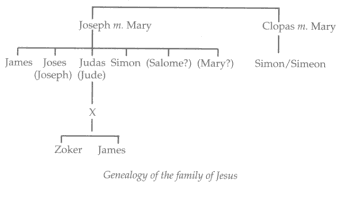
Q for you: How, in Orthodox tradition, did Joseph come to have a daughter by the name of Salome?

How is saying Joseph had kids from a previous marriage dishonoring him?Ok the Orthodox need to look at this logically, because there is NOTHING good that can come out of claiming Joseph had a daughter. These claims can only chance dishonoring Jesus (Mark 6:4).
The picture below is a rare find because it has a true depiction of Mary’s age. She would have become pregnent before her first blood and being deemed ritually unclean. I personally put the conception at 11 to 12 years old, but the delivery would have happened at 12 or 13. Mary seems to tell us 13 (Guadalupe and Fatima ‘clues’). This also could be because with her baptism we all become in a new spiritual 13th tribe of the promise, that are made of the 13th apostles of Christ.
So considering her young age, and the actual importance of her birth, and even St. Joseph being somewhat ‘chosen’ himself, we must seriously look at the role Joseph would have played in Mary and Jesus upbringing. Remember Mary was likely holy and given to the temple, the husband Joseph would have surely been holy also for God to lead him to chose this particular wife. Luther was a monk and his wife was a nun. Luther supposedly would do sufferings and sit lay out in the snow for so long in pain he had to be carried back in. Im suggesting that its always been known that clergy runs down family lines.
So why is Joseph different? Why would people think he had an ex wife, defiled, other kids, and for some reason would chose a holy wife? Do secular people think of godly holy nuns for wives? no. God scares them and makes them guilty. Joseph was OVIOUSLY holy.
If Jesus was the Son, and Mary the Mother, well obviously THE FATHER HIMSELF needs a sort of ‘stand in’ on earth to help raise Jesus and even Mary together and fulfille the law and meet prophecy. God would NOT have allowed Jesus and Mary to be raised by a loveless, divorcee, a widower, a non-virgin man, and most importantly sinful flesh from groups of siblings which would require JOSEPHS grandparents and inlaws in the mix raising all the kids. Remember Jesus knew scripture inside and out at 12 yrs old so he needed to be raised and grow in wisdom, only the parents would have done this, specifically JOSEPH considering Mary’s age. Obviously, the scripture is going to talk as LITTLE as possible about Joseph because it will promote our natual instinct to consider him the natual father.
St Joseph is honored worldwide for a reason. All the hospitals, churches, schools named after Joseph. Joseph is always depicted as being much older than he likely was. That is a symbol of his very hidden role. Its only recently people have been universily been believing all these things as fact. The below picture reveals the most likely, truthful scenario that we all believed as kids. The carpender trade might be overstated as we liken it to todays western work hours and schedule. And maybe his age a tad less.
http://www.family-prayer.org/images/st-joseph-husband-of-mary.jpg
SnoopSword, you need to have a good long talk with your priest about all this. There is nothing defiled about the marriage bed and St Joseph was a widower, so it a complete misrepresentation to speak of an “ex-wife”.Ok the Orthodox need to look at this logically, because there is NOTHING good that can come out of claiming Joseph had a daughter. These claims can only chance dishonoring Jesus (Mark 6:4).
The primary meaning of the word is, literally, “smaller”Execpt James the less does mean he was younger than James the Great. The Greek word mikros translates to the younger.
Many Orthodox do not share the same viewpoints in this matter so I’m not the only one.SnoopSword, you need to have a good long talk with your priest about all this. There is nothing defiled about the marriage bed and St Joseph was a widower, so it a complete misrepresentation to speak of an “ex-wife”.
I’m not going to say any more as you need to speak with someone you recognise as an authority.
And no one has a precise seating arrangement for His last supper.The primary meaning of the word is, literally, “smaller”
Macro means bigger.
We still use these Greek words, uniformly, in English to mark “sizes” of things.
eg: Micro-scopes look at small things, and a macroscopic objects are ones that can be seen with the naked eye. Macro lenses are for looking at larger objects, but up close.
Size only really implies relative age with very young children; eg: but not with adults.
James and John, Zebedee’s sons; are generally understood to be the youngest of the apostles according to seating arrangements of the last supper. I don’t know where you get the idea James the less is younger than the other James. But I seriously doubt it.
Translating “micro” as younger is simply a very sloppy translation without other evidence to back it up.
When only age is meant, the Greek will use other words like neO (new).
Or with references to the firstborn, Presbyteros (Elder.)
Micro very often does mean age, but other factors such as size or stature.
Consider, there are many examples where the age of people is clearly intended, and the word “micro” is NOT what the scripture writers use. It simply is NOT a very common common word used to indicate relative age in adults.
Consider 1Timothy 5:2
.
biblehub.com/interlinear/1_timothy/5-2.htm
Rather it’s neo-teras ( νεω-τέρ-ας ) vs. presbyter-as.