Mary's virginity ?

  • Thread starter Thread starter realtorrickone
  • Start date Start date
Status
Not open for further replies.
Is it possible that Mary of Clopas was the Virgin Mary’s sister in law and that Mary of Clopas was married to Clopas who was Joseph’s brother?
 
Is it possible that Mary of Clopas was the Virgin Mary’s sister in law and that Mary of Clopas was married to Clopas who was Joseph’s brother?
Yes.
But Mary’s sister is different from Mary of Clopas.
 
They were not the men mentioned in Mark 6:3. You just made a common mistake.
I didn’t make a mistake on that point, re-read my posts.
My point is that the Apostles/of the 12, AREN’T Mentioned in Mark 6:3.

If John was mentioned, then the James mentioned in Mark 6:3 could be his sibling. But John isn’t mentioned, so the James in the list is a different one. eg:. James of Mark 6:3 is not of the group “James and John, Zebedee’s son”

But – The James is mentioned in Mark 6:3 IS a brother of the Lord, by definition.

SO, as far as I know, the only James who would be called brother of the Lord by unbelievers among Jesus’ house is the one who became bishop of Jerusalem.

Let me demonstrate the assumption underlying my point:

The Orthodox, according to the other thread, distinguish three different James.

James the Greater (the youngest James, who is son of Zebedee and brother of John)
James the Less ( an older James, but one of the 12 apostles; son of Alpheus / brother of Matthew. See: Mark 15:40; He is called “less” not on account of age, but of stature or status. )
James the Just – the man who became bishop of Jerusalem.

If there are three different James, Then the only one who would be both a closest relative and not preach Jesus AT THE time Mark 6:3 was happening, would be James the Just.

Both James the Greater, and James the Less, are numbered among the twelve and would be expected to preach Jesus to the family. The very fact that Mark 6:3 excludes the other Apostles, underscores that they had not received preaching from the Apostles.

eg: If they were familiar with either of the James’ who were already Apostles, they would be far harder pressed to call Jesus a nobody.

Therefore, the James in the list of Mark 6:3 is most like a James whom is NOT an apostle (at that time); and simultaneously that James needs to be a very close relative to Jesus.

The only one in Orthodox tradition who would fit that description, is James the Just.

That’s why I said “I think” that James the Just was an unbeliever at this time.
For he was not yet preaching Jesus to the rest of the family.
 
You were the one who brought Mark 6:3 as the reference to Jesus’ brothers. Now you’ve gone and moved the goal posts to another country altogether :rolleyes:
No, I haven’t moved them.
You’re also dodging my questions and not really clarifying.
I’ve restated my contention in the immediately previous post.

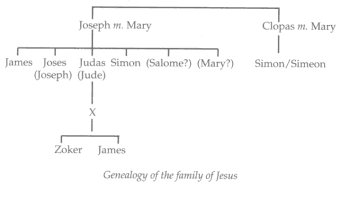
Q for you: How, in Orthodox tradition, did Joseph come to have a daughter by the name of Salome?
 
I didn’t make a mistake on that point, re-read my posts.
My point is that the Apostles/of the 12, AREN’T Mentioned in Mark 6:3.

If John was mentioned, then the James mentioned in Mark 6:3 could be his sibling. But John isn’t mentioned, so the James in the list is a different one. eg:. James of Mark 6:3 is not of the group “James and John, Zebedee’s son”

But – The James is mentioned in Mark 6:3 IS a brother of the Lord, by definition.

SO, as far as I know, the only James who would be called brother of the Lord by unbelievers among Jesus’ house is the one who became bishop of Jerusalem.

Let me demonstrate the assumption underlying my point:

The Orthodox, according to the other thread, distinguish three different James.

James the Greater (the youngest James, who is son of Zebedee and brother of John)
James the Less ( an older James, but one of the 12 apostles; son of Alpheus / brother of Matthew. See: Mark 15:40; He is called “less” not on account of age, but of stature or status. )
James the Just – the man who became bishop of Jerusalem.

If there are three different James, Then the only one who would be both a closest relative and not preach Jesus AT THE time Mark 6:3 was happening, would be James the Just.

Both James the Greater, and James the Less, are numbered among the twelve and would be expected to preach Jesus to the family. The very fact that Mark 6:3 excludes the other Apostles, underscores that they had not received preaching from the Apostles.

eg: If they were familiar with either of the James’ who were already Apostles, they would be far harder pressed to call Jesus a nobody.

Therefore, the James in the list of Mark 6:3 is most like a James whom is NOT an apostle (at that time); and simultaneously that James needs to be a very close relative to Jesus.

The only one in Orthodox tradition who would fit that description, is James the Just.

That’s why I said “I think” that James the Just was an unbeliever at this time.
For he was not yet preaching Jesus to the rest of the family.
Execpt James the less does mean he was younger than James the Great. The Greek word mikros translates to the younger.
 
No, I haven’t moved them.
You’re also dodging my questions and not really clarifying.
I’ve restated my contention in the immediately previous post.

Q for you: How, in Orthodox tradition, did Joseph come to have a daughter by the name of Salome?
Ok the Orthodox need to look at this logically, because there is NOTHING good that can come out of claiming Joseph had a daughter. These claims can only chance dishonoring Jesus (Mark 6:4).

The picture below is a rare find because it has a true depiction of Mary’s age. She would have become pregnent before her first blood and being deemed ritually unclean. I personally put the conception at 11 to 12 years old, but the delivery would have happened at 12 or 13. Mary seems to tell us 13 (Guadalupe and Fatima ‘clues’). This also could be because with her baptism we all become in a new spiritual 13th tribe of the promise, that are made of the 13th apostles of Christ.

So considering her young age, and the actual importance of her birth, and even St. Joseph being somewhat ‘chosen’ himself, we must seriously look at the role Joseph would have played in Mary and Jesus upbringing. Remember Mary was likely holy and given to the temple, the husband Joseph would have surely been holy also for God to lead him to chose this particular wife. Luther was a monk and his wife was a nun. Luther supposedly would do sufferings and sit lay out in the snow for so long in pain he had to be carried back in. Im suggesting that its always been known that clergy runs down family lines.

So why is Joseph different? Why would people think he had an ex wife, defiled, other kids, and for some reason would chose a holy wife? Do secular people think of godly holy nuns for wives? no. God scares them and makes them guilty. Joseph was OVIOUSLY holy.

If Jesus was the Son, and Mary the Mother, well obviously THE FATHER HIMSELF needs a sort of ‘stand in’ on earth to help raise Jesus and even Mary together and fulfille the law and meet prophecy. God would NOT have allowed Jesus and Mary to be raised by a loveless, divorcee, a widower, a non-virgin man, and most importantly sinful flesh from groups of siblings which would require JOSEPHS grandparents and inlaws in the mix raising all the kids. Remember Jesus knew scripture inside and out at 12 yrs old so he needed to be raised and grow in wisdom, only the parents would have done this, specifically JOSEPH considering Mary’s age. Obviously, the scripture is going to talk as LITTLE as possible about Joseph because it will promote our natual instinct to consider him the natual father.

St Joseph is honored worldwide for a reason. All the hospitals, churches, schools named after Joseph. Joseph is always depicted as being much older than he likely was. That is a symbol of his very hidden role. Its only recently people have been universily been believing all these things as fact. The below picture reveals the most likely, truthful scenario that we all believed as kids. The carpender trade might be overstated as we liken it to todays western work hours and schedule. And maybe his age a tad less.

 
Ok the Orthodox need to look at this logically, because there is NOTHING good that can come out of claiming Joseph had a daughter. These claims can only chance dishonoring Jesus (Mark 6:4).

The picture below is a rare find because it has a true depiction of Mary’s age. She would have become pregnent before her first blood and being deemed ritually unclean. I personally put the conception at 11 to 12 years old, but the delivery would have happened at 12 or 13. Mary seems to tell us 13 (Guadalupe and Fatima ‘clues’). This also could be because with her baptism we all become in a new spiritual 13th tribe of the promise, that are made of the 13th apostles of Christ.

So considering her young age, and the actual importance of her birth, and even St. Joseph being somewhat ‘chosen’ himself, we must seriously look at the role Joseph would have played in Mary and Jesus upbringing. Remember Mary was likely holy and given to the temple, the husband Joseph would have surely been holy also for God to lead him to chose this particular wife. Luther was a monk and his wife was a nun. Luther supposedly would do sufferings and sit lay out in the snow for so long in pain he had to be carried back in. Im suggesting that its always been known that clergy runs down family lines.

So why is Joseph different? Why would people think he had an ex wife, defiled, other kids, and for some reason would chose a holy wife? Do secular people think of godly holy nuns for wives? no. God scares them and makes them guilty. Joseph was OVIOUSLY holy.

If Jesus was the Son, and Mary the Mother, well obviously THE FATHER HIMSELF needs a sort of ‘stand in’ on earth to help raise Jesus and even Mary together and fulfille the law and meet prophecy. God would NOT have allowed Jesus and Mary to be raised by a loveless, divorcee, a widower, a non-virgin man, and most importantly sinful flesh from groups of siblings which would require JOSEPHS grandparents and inlaws in the mix raising all the kids. Remember Jesus knew scripture inside and out at 12 yrs old so he needed to be raised and grow in wisdom, only the parents would have done this, specifically JOSEPH considering Mary’s age. Obviously, the scripture is going to talk as LITTLE as possible about Joseph because it will promote our natual instinct to consider him the natual father.

St Joseph is honored worldwide for a reason. All the hospitals, churches, schools named after Joseph. Joseph is always depicted as being much older than he likely was. That is a symbol of his very hidden role. Its only recently people have been universily been believing all these things as fact. The below picture reveals the most likely, truthful scenario that we all believed as kids. The carpender trade might be overstated as we liken it to todays western work hours and schedule. And maybe his age a tad less.

http://www.family-prayer.org/images/st-joseph-husband-of-mary.jpg
How is saying Joseph had kids from a previous marriage dishonoring him?
 
Ok the Orthodox need to look at this logically, because there is NOTHING good that can come out of claiming Joseph had a daughter. These claims can only chance dishonoring Jesus (Mark 6:4).
SnoopSword, you need to have a good long talk with your priest about all this. There is nothing defiled about the marriage bed and St Joseph was a widower, so it a complete misrepresentation to speak of an “ex-wife”.
I’m not going to say any more as you need to speak with someone you recognise as an authority.
 
Execpt James the less does mean he was younger than James the Great. The Greek word mikros translates to the younger.
The primary meaning of the word is, literally, “smaller”
Macro means bigger.

We still use these Greek words, uniformly, in English to mark “sizes” of things.
eg: Micro-scopes look at small things, and a macroscopic objects are ones that can be seen with the naked eye. Macro lenses are for looking at larger objects, but up close.

Size only really implies relative age with very young children; eg: but not with adults.

James and John, Zebedee’s sons; are generally understood to be the youngest of the apostles according to seating arrangements of the last supper. I don’t know where you get the idea James the less is younger than the other James. But I seriously doubt it.

Translating “micro” as younger is simply a very sloppy translation without other evidence to back it up.

When only age is meant, the Greek will use other words like neO (new).
Or with references to the firstborn, Presbyteros (Elder.)

Micro very often does mean age, but other factors such as size or stature.

Consider, there are many examples where the age of people is clearly intended, and the word “micro” is NOT what the scripture writers use. It simply is NOT a very common common word used to indicate relative age in adults.

Consider 1Timothy 5:2
.
biblehub.com/interlinear/1_timothy/5-2.htm

Rather it’s neo-teras ( νεω-τέρ-ας ) vs. presbyter-as.
 
SnoopSword, you need to have a good long talk with your priest about all this. There is nothing defiled about the marriage bed and St Joseph was a widower, so it a complete misrepresentation to speak of an “ex-wife”.
I’m not going to say any more as you need to speak with someone you recognise as an authority.
Many Orthodox do not share the same viewpoints in this matter so I’m not the only one.

If Joseph had widow, that opens up a new can of worms because Satan will infuence people to believe he killed her, or better yet, STONED his ex wife to death theough a TRIAL… just like JESUS. Imagine the mystery solved! “Go and sin no more”. They would say that Jesus was really speaking of his mother in law who Joseph brought to kill with false aligations of adultry. The story would plague the name of Joseph and upbringing Jesus with Mary.

So the questions beggs, how did the ex-wife die? Who was helping look after all the kids? Who was raising the already young 12/13 yr old Mary?

Were they rasied around sinfulfull flesh and among dogs and cats all over the floor like animals?

Whats wrong with sticking to this?

http://www.ncregister.com/images/editorial/Baby-Jesus-Picture-Sitting-On-Mary-With-Joseph.jpg
 
The primary meaning of the word is, literally, “smaller”
Macro means bigger.

We still use these Greek words, uniformly, in English to mark “sizes” of things.
eg: Micro-scopes look at small things, and a macroscopic objects are ones that can be seen with the naked eye. Macro lenses are for looking at larger objects, but up close.

Size only really implies relative age with very young children; eg: but not with adults.

James and John, Zebedee’s sons; are generally understood to be the youngest of the apostles according to seating arrangements of the last supper. I don’t know where you get the idea James the less is younger than the other James. But I seriously doubt it.

Translating “micro” as younger is simply a very sloppy translation without other evidence to back it up.

When only age is meant, the Greek will use other words like neO (new).
Or with references to the firstborn, Presbyteros (Elder.)

Micro very often does mean age, but other factors such as size or stature.

Consider, there are many examples where the age of people is clearly intended, and the word “micro” is NOT what the scripture writers use. It simply is NOT a very common common word used to indicate relative age in adults.

Consider 1Timothy 5:2
.
biblehub.com/interlinear/1_timothy/5-2.htm

Rather it’s neo-teras ( νεω-τέρ-ας ) vs. presbyter-as.
And no one has a precise seating arrangement for His last supper.
You also said o micros often means younger in scripture.
 
  1. Both in East and West, the Church has many variant traditions about the close relatives of Joseph and Mary, about whether or not Joseph had ever married anybody before Mary, and about whether Joseph had other kids from a previous marriage. There also seem to have been a lot of complicated genealogical things going on, in both Mary and Joseph’s parts of the House of David, which is why there are so many variant traditions about how to interpret the Gospel genealogy lists. There seem to have been a lot of adoptions and levirate marriages and nicknames and Hebrew names vs. Aramaic names involved, too, which would confuse anybody.
Nobody has ever had any legends that implied anything bad about Joseph’s marital history. Sheesh, people. If anything, the implication of the Church not remembering stuff well enough to be definitive is that Joseph’s life was boringly normal and righteous, up until his engagement to Mary.
  1. It is known that the Jews (like other ancient peoples) had extensive genealogical archives. Unfortunately, it would seem that these were destroyed at some point, most likely during the Roman destruction and rebuilding of Jerusalem. So there wasn’t much time for Christians to copy out the official records, and then persecution prevented copying of most material.
  2. We also know that the remaining members of the House of David got hassled a lot after Jesus’ death, and the Christian members were always having to tell the Romans that they weren’t interested in a political kingdom or taking over from the Emperor. So Christians had a vested interest in not publishing the exact details of the genealogy of everybody who was blood kin to Jesus.
  3. Papias is the oldest source we have, and he know he made a point of interviewing only eyewitnesses of Jesus and people who had learned from the Apostles, and that he believed oral teaching was the most authoritative teaching. Unfortunately, we also know that some of his informants seem to have “learned” some pretty wild things; and only a few fragments (mostly copied out by Eusebius) remain of his five volume book.
  4. It’s amazing how many people fixate on the phrase, “James, brother of the Lord,” when nobody fixates on Tobit calling the angel Raphael his brother. Raphael was calling himself Azariah, and Tobit was under the impression that this Azariah guy was some kind of relation of his; but he was clearly not supposed to be a close relation, or even any relation that he or his dad had ever met in their lives. We don’t call “that dude who’s supposed to be related to me whom I’ve never met before” our brother; but that’s because we speak Modern English, not Aramaic.
  5. The only reason the Bible doesn’t call Elizabeth a “sister” of Mary, is that a “syngenis” (person of the same ancestry) is somebody who’s a really really distant relation, like no closer than second cousins. It’s apparently Greek tradition that you keep up the relationship of being “syngenis” by doing family sorts of things with your “syngenis” relatives; otherwise, they start to get too distant to count as family. So it’s possible that Luke is saying, “You know, Mary didn’t have any obligation to go see Elizabeth and help her, and she might not have even known her; but she chose to do it as a nice relative-ish thing to do. Because Mary was just that kind of girl.”
The Aramaic Peshitta Bible uses the rather distant kinswoman word “ahyana”. So again, they agree that she’s not a very close relation. (Of course, sometimes a big difference in age leads to using a more distant relationship word, but that doesn’t seem to be the implication here.)
 
Stuff from Eusebius’ Church History about St. James the Just:

Book 2, Chapter 1:
  1. Then James… is recorded to have been the first to be made bishop of the church of Jerusalem. This James was called “the brother of the Lord” because he was known as a son of Joseph, and Joseph was supposed to be the father of Christ, because the Virgin, being betrothed to him, “was found with child by the Holy Ghost before they came together,” (Matthew 1:18) as the account of the holy Gospels shows.
  2. But Clement [of Alexandria] in the sixth book of his Hypotyposes [Outlines] writes thus: “For they say that Peter and James and John… chose James the Just bishop of Jerusalem.”
  3. But the same writer, in the seventh book of the same work, relates also…“The Lord after his resurrection imparted knowledge to James the Just and to John and Peter, and they imparted it to the rest of the apostles, and the rest of the apostles to the seventy, of whom Barnabas was one. But there were two Jameses: one called the Just, who was thrown from the pinnacle of the temple and was beaten to death with a club by a fuller, and another who was beheaded.”
There’s a lot more info, but I’ll abridge it pretty severely.

Book 2, Chapter 23:.
  1. But after Paul, in consequence of his appeal to Cæsar, had been sent to Rome by Festus, the Jews, being frustrated in their hope of entrapping him by the snares which they had laid for him, turned against James, the brother of the Lord, to whom the episcopal seat at Jerusalem had been entrusted by the apostles…
  2. Leading him into their midst they demanded of him that he should renounce faith in Christ in the presence of all the people. But… he spoke out before the whole multitude and confessed that our Saviour and Lord Jesus is the Son of God. But they were unable to bear longer the testimony of the man who, on account of the excellence of ascetic virtue and of piety which he exhibited in his life, was esteemed by all as the most just of men, and consequently they slew him…
  3. The manner of James’ death has been already indicated by… Clement… But Hegesippus, who lived immediately after the apostles, gives the most accurate account in the fifth book of his Memoirs. He writes as follows:
  4. James, the brother of the Lord, succeeded to the government of the Church in conjunction with the apostles. He has been called the Just by all from the time of our Saviour to the present day; for there were many that bore the name of James.
  5. He was holy from his mother’s womb; and he drank no wine nor strong drink, nor did he eat flesh. No razor came upon his head; he did not anoint himself with oil, and he did not use the bath. [The implication here is that he was a Nazirite.]
  6. He alone was permitted to enter into the holy place; for he wore not woolen but linen garments. And he was in the habit of entering alone into the temple, and was frequently found upon his knees begging forgiveness for the people, so that his knees became hard like those of a camel, in consequence of his constantly bending them in his worship of God, and asking forgiveness for the people…
[The implication here is that he was a Levitic priest, even though Joseph was a Davidic guy. So probably James was closely related to Zechariah and Elizabeth and John, and not so closely related to Joseph.]
  1. So they went up and threw down the just man, and said to each other, ‘Let us stone James the Just.’ And they began to stone him, for he was not killed by the fall; but he turned and knelt down and said, ‘I entreat you, Lord God our Father, forgive them, for they know not what they do.’ Luke 23:34

  1. And one of them, who was a fuller, took the club with which he beat out clothes and struck the just man on the head. And thus he suffered martyrdom. And they buried him on the spot, by the temple, and his monument still remains by the temple. He became a true witness, both to Jews and Greeks, that Jesus is the Christ. And immediately Vespasian besieged them.
  2. … this was the cause of the siege of Jerusalem, which happened to them immediately after his martyrdom, for no other reason than their daring act against him.
  3. Josephus, at least, has not hesitated to testify this in his writings, where he says, “These things happened to the Jews to avenge James the Just, who was a brother of Jesus, that is called the Christ. For the Jews slew him, although he was a most just man.”
  4. And the same writer records his death also in the twentieth book of his Antiquities … "But the emperor, when he learned of the death of Festus, sent Albinus to be procurator of Judea. But the younger Ananus, who, as we have already said, had obtained the high priesthood, was of an exceedingly bold and reckless disposition…
  5. "Ananus, therefore, being of this character, and supposing that he had a favorable opportunity on account of the fact that Festus was dead, and Albinus was still on the way, called together the Sanhedrin, and brought before them the brother of Jesus the so-called Christ, James by name, together with some others, and accused them of violating the law, and condemned them to be stoned.
  6. "But those in the city who seemed most moderate and skilled in the law were very angry at this, and sent secretly to the king, requesting him to order Ananus to cease such proceedings… And certain of them also went to meet Albinus, who was journeying from Alexandria, and reminded him that it was not lawful for Ananus to summon the Sanhedrin without his knowledge.
  7. “And Albinus, being persuaded by their representations, wrote in anger to Ananus, threatening him with punishment. And the king, Agrippa, in consequence, deprived him of the high priesthood, which he had held three months, and appointed Jesus, the son of Damnæus.”
 
*If *Joseph had a previous/overlapping marraige vocation before God called him to his next vocation that was to overlap with his first vocation (hence the term: Bi-Vocation), and his second vocation having nothing to do with his first vocation, and, assuming it was a normal marraige and so he had children with a former wife, then he, being a just man worthy to be Our Lord’s father on earth, obviously he would have enjoyed perfect marital relations with his wife, and loved her perfectly and chastely and fruitfully.

But I am not going with that. I believe he had only* one* kind of chaste vocation. Just one. The *unusual *kind. Being the only husband to ever live on the Lord’s earth whose child was God.

Nope, I do not believe Joseph was Bi-Vocation, and I do not believe Jesus grew up in a Big Blended Family. I think the Holy family looked more like this, which we know, and love, which just feels right and true. (Because, it is.):

http://www.ccr.littleway.ca/HolyFamily219.jpg

http://washingtoncatholicradio.com/...11/Icon-of-the-Holy-Family-e1414933879298.jpg
 
Re: Mary being “greatly troubled” - Actually, the Greek word for Zechariah’s feelings was “frightened” or “troubled” (etarachthe), and the word for Mary’s feelings was “thoroughly frightened” (dietarachthe). Hence the KJV translation of “sore afraid.” So yeah, Mary was not blase about angels or their freaky greetings and announcements; she understood the full implications and was really really stunned. (And John said that Jesus was “etarachthe” when He was saying that “One of you will betray Me.” So it’s a strong expression.

Stuff from Eusebius about Jesus’ family. Again, this isn’t inspired, so it’s not guaranteed to be correct. But he was the first church historian whose stuff survived as a whole book, as opposed to guys like Hegesippus and Papias who only have their books survive in fragments; and he does seem to be reliable as a recorder of what early Christian people thought was going on. This says that Herod burned the official Jewish genealogical records, but that private records survived in various places in Africanus’ time.

Book 1, Chapter 7:
  1. Matthew and Luke in their gospels have given us the genealogy of Christ differently, and many suppose that they are at variance with one another. Since as a consequence every believer, in ignorance of the truth, has been zealous to invent some explanation which shall harmonize the two passages, permit us to subjoin the account of the matter which has come down to us, and which is given by [Sextus Julius] Africanus… in his epistle to Aristides, where he discusses the harmony of the gospel genealogies. After refuting the opinions of others as forced and deceptive, he give the account which he had received from tradition in these words:
  2. "For whereas the names of the generations were reckoned in Israel either according to nature or according to law—according to nature by the succession of legitimate offspring, and according to law whenever another raised up a child to the name of a brother dying childless… in order that the name of the one deceased might be perpetuated—
  3. "Whereas then some of those who are inserted in this genealogical table succeeded by natural descent, son to father, while others, though born of one father, were ascribed by name to another, mention was made of both of those who were progenitors in fact and of those who were so only in name.
  4. "Thus neither of the gospels is in error, for one reckons by nature, the other by law. For the line of descent from Solomon and that from Nathan were so involved, the one with the other, by the raising up of children to the childless and by second marriages, that the same persons are justly considered to belong at one time to one, at another time to another; that is, at one time to the reputed fathers, at another to the actual fathers. So that both these accounts are strictly true and come down to Joseph with considerable intricacy indeed, yet quite accurately.
  5. "But in order that what I have said may be made clear I shall explain the interchange of the generations. If we reckon the generations from David through Solomon, the third from the end is found to be Matthan, who begot Jacob the father of Joseph. But if, with Luke, we reckon them from Nathan the son of David, in like manner the third from the end is Melchi, whose son Eli was the father of Joseph. For Joseph was the son of Eli, the son of Melchi.
  6. "Joseph therefore being the object proposed to us, it must be shown how it is that each is recorded to be his father, both Jacob, who derived his descent from Solomon, and Eli, who derived his from Nathan; first how it is that these two, Jacob and Eli, were brothers, and then how it is that their fathers, Matthan and Melchi, although of different families, are declared to be grandfathers of Joseph.
  7. "Matthan and Melchi having married in succession the same woman, begot children who were uterine brothers, for the law did not prohibit a widow, whether such by divorce or by the death of her husband, from marrying another.
  8. "By Estha, then (for this was the woman’s name according to tradition) Matthan, a descendant of Solomon, first begot Jacob. And when Matthan was dead, Melchi, who traced his descent back to Nathan, being of the same tribe but of another family, married her as before said, and begot a son, Eli.
  9. "Thus we shall find the two, Jacob and Eli, although belonging to different families, yet brethren by the same mother. Of these the one, Jacob, when his brother Eli had died childless, took the latter’s wife and begot by her a son Joseph, his own son by nature and in accordance with reason. Wherefore also it is written: ‘Jacob begot Joseph.’ (Matthew 1:6) But according to law he was the son of Eli, for Jacob, being the brother of the latter, raised up seed to him.
  10. “Hence the genealogy traced through him will not be rendered void, which the evangelist Matthew in his enumeration gives thus: ‘Jacob begot Joseph.’ But Luke, on the other hand, says: ‘Who was the son, as was supposed’ (for this he also adds), ‘of Joseph, the son of Eli, the son of Melchi’; for he could not more clearly express the generation according to law. And the expression ‘he begot’ he has omitted in his genealogical table up to the end, tracing the genealogy back to Adam the son of God. This interpretation is neither incapable of proof nor is it an idle conjecture.”
More in next post.
 
Status
Not open for further replies.
Back
Top
