The Minor, Trivial Stuff Thread

  • Thread starter Thread starter patrick457
  • Start date Start date
Status
Not open for further replies.
Woot! Time for more trivial stuff!

So, we hear about Jesus eating in the house of Simon the Pharisee, and the woman washes Jesus’s feet with her tears, dries them with her hair, then anoints them with nard. Simon the Pharisee rebuked Jesus in his thoughts, and then Jesus rebuked him with a parable, and concluded with this:

[BIBLEDRB]Luke 7:44-46[/BIBLEDRB]

So, my question is about how a Jew would welcome someone into his house. What did the foot-washing consist of? Was there a kiss of welcome? Was there typically an anointing? What would that consist of?
Ooh, you raised the thread! :clapping:

So, from what I could glean:

The very first thing you would do for your visitor (in a culture that wears sandals or none at all in a hot climate) when he arrives at your place is, of course, have his feet washed. I’ve already written about foot-washing in some detail a good while ago.

A kiss is, as you would see in many other passages of the Bible (Genesis 27:26ff.; 29:11; 31:28, 55; 33:4; 45:15; Exodus 4:27; 2 Samuel 14:33; 20:9; 1 Kings 19:20; Job 31:27; Matthew 26:49 and parallels), often a sign of greeting. Arabs continue to retain a similar custom today, where the traditional greeting is a kiss on both cheeks.

Anointing with oil (the most common base in Palestine was olive oil, which could be used as it is or with added perfumes or spices) is often used as a means of refreshing or invigorating the guest - as oil served as emollients and moisturizers, as well as deodorants if the oil was perfumed. Ancient Egyptians were already known to practice the custom of anointing the heads of their guests, and the Greeks and Romans have a similar custom as well. In fact, according to Suetonius, Nero had dining rooms which “had ceilings of fretted ivory, the panels of which could slide back and let a rain of flowers, or of perfume from hidden sprinklers, fall on his guests.” In what could be an interesting parallel custom in some Arab countries, guests there were sprinkled with rosewater or some other perfume, or smoked with incense at the end of a feast, before the guests leave the table.

BTW, you would notice that according to Jesus, Simon did not do these rituals which a polite host is expected to perform for his guest (!!!). This in a culture where hospitality is not just some nice custom, but an act of piety. What is more amazing is, Jesus did not really complain that a faux pas is being committed (perhaps intentionally), but rather, absorbs the hostility between the lines.
 
Based on their dialogues between them, Pharisees and Sadducees are usually seen as very hostile towards Jesus, and Him being hostile towards them. But I heard somewhere that this is a rather false tradition, and that in fact, the dialogues, when properly translated and interpreted, aren’t really hostile at all. For instance, Jesus calling them ‘snakes’ isn’t so much as swearing but a (ironic) remark to them considering themselves as ‘cunning as snakes’ or something.

Who knows more about this?
Sorry for taking so long.
Well, serpents are certainly not seen as very positive in Biblical culture. Yes, they can sometimes be seen as crafty (a rather dubious trait, if you ask me), but because snakes tend to be life-threatening creatures (or at least, the venomous ones) who lurk and can attack people unawares, the serpent is often a symbol of evil, the wicked and one’s enemies, as it is in many places in the Bible (Genesis 49:17; Deuteronomy 32:33; Psalm 58:4/5; 140:3/4; Proverbs 23:32 Isaiah 14:29; Jeremiah 8:17; Matthew 3:17; 12:34). So I think the traditional interpretation is alright here.
 
Hi all,
Hospitality was very important in ancient times:

And hospitality do not forget; for by this some, being not aware of it, have entertained angels.
(Hebrews 13: 2).

God Bless,
Colmcille.🙂
 
And from a dog-eared Bible encyclopaedia, I found this:

‘Among the nomadic, tent-dwelling people, a traveller was always welcome to stay- for three days and four hours!- the length of time the hosts believed their food sustained their guest. Flat loaves of bread, and milk, were basic to the meal. For the time of his stay the traveller became one of the clan.’
(The Lion Encyclopaedia of the Bible.)

God Bless,
Colmcille.🙂
 
And from a dog-eared Bible encyclopaedia, I found this:

‘Among the nomadic, tent-dwelling people, a traveller was always welcome to stay- for three days and four hours!- the length of time the hosts believed their food sustained their guest. Flat loaves of bread, and milk, were basic to the meal. For the time of his stay the traveller became one of the clan.’
(The Lion Encyclopaedia of the Bible.)

God Bless,
Colmcille.🙂
Thanks for this! 🙂
 
Just a thought.

Could that be thought of as insulting- to perfume a guest and go so far as to wash their feet? That would suggest that they were dirty and smelly. And anointing with oil someone who had long hair could be a messy business indeed!
 
Just a thought.

Could that be thought of as insulting- to perfume a guest and go so far as to wash their feet? That would suggest that they were dirty and smelly. And anointing with oil someone who had long hair could be a messy business indeed!
The roads were dusty, and wearing only sandals would have made for dusty feet after even a short journey 😉
 
Just a thought.

Could that be thought of as insulting- to perfume a guest and go so far as to wash their feet? That would suggest that they were dirty and smelly. And anointing with oil someone who had long hair could be a messy business indeed!
Not really, considering that most people back then would have been ‘dirty and smelly’ as well, since in that part of the world men went either barefoot or wore sandals on stockingless feet. That would be a pot-calling-kettle-black situation. 😛

This is actually something I complain about in Jesus films: many of them, especially the older epics, do not show any indication of grime or dirt on the actors, as if it’s somehow blasphemous to show the Son of God and His disciples sweating or with dirty feet. Or even with body hair. 😃
 
Hi Patrick,
Browsing through the aforementioned Lion Encyclopaedia of the Bible, I came across a reference to Matthew 27:28-29 :
‘And stripping him, they put a scarlet cloak about him.
And platting a crown of thorns, they put it upon his head, and a reed in his right hand. And bowing the knee before him, they mocked him, saying: Hail, King of the Jews.’

According to the encyclopaedia:
‘The game played by the soldiers at the trial of Jesus was also a dice game. As a four sided dice** (four-sided pyramids called teetotum)** was used, they moved a skittle from a central mark to positions where it could be ‘robed’, ‘crowned’ and ‘sceptred’, and the soldier whose move completed the ‘ceremony’ called ‘king’ and collected the stakes which had been put down. In this instance the prisoner was used as a human skittle (Matthew 27:28-29).’

For me, this fact about an otherwise harmless dice game being used in the trial of Our Lord adds an extra horrendous dynamic to an already pitiful tragedy.
God Bless,
Colmcille.
 
It’s Advent, everyone! Has anyone got something timely they’d like to ask or contribute? 😃
 
What would shepherds be doing in December? …and by extension, the whole year?
Winter, which occurs between December and February in Israel, is the cold, rainy season, in contrast to the dry and hot Judean summer. The heaviest rainfall occurs between December and January (more than 70% of the average rainfall in Israel actually falls between November and March), sometimes with hail, thunder and lightning; there are at times snowfall up in the north and central parts of Israel. The climate is as such due to Israel’s location between the subtropical aridity of the Sahara and the Arabian deserts, and the subtropical humidity of the Levant and Eastern Mediterranean.

December was still warmer than January (the coldest month with average temperatures ranging from 6 to 15 °C, that is 42.8 to 59 °F), but the rains can make things unpleasant. I quote from The Victor Journey Through the Bible by V. Gilbert Beers:

The coldest temperature recorded in Palestine is 19°F (-7°C), much colder than a normal winter night, which on the Bethlehem hills was probably not down to freezing temperatures. However, a 40° night on a lonely hillside in a rainy season can be quite cold. The rain was almost more unpleasant than the cold. Rainfall in Palestine averages from less than an inch in the south at Eilat to about 40 inches per year in the north at Metulla.
Jerusalem averages about 25 inches per year with only slightly less in Bethlehem.

Because of the quite unpleasant weather conditions that happened, it is sometimes suggested that sheep would not have been out in the hillsides in midwinter (flocks were usually kept outside from April to November). Which is true in most cases, but the enormous Temple flocks kept in the greater Jerusalem area were apparently grazing out in the open all year.

Cattle (i.e. livestock) found all the way from Jerusalem to Migdal Eder, and in the same vicinity in all directions, are considered, if male, as whole-offerings, and if female as peace-offerings. Rabbi Yehudah says, “If they are fit for Passover-offerings they may be used for such purpose, providing Passover is not more than thirty days off.” (Shekalim 7.4)

This passage in the Mishnah suggests that any stray animals found between Jerusalem and a spot known as Migdal Eder (‘tower of Eder’ or ‘tower of the flock’; cf. Genesis 35:21?), were automatically destined to be sacrificed at the Temple. Some propose based on the passage in Genesis that this spot may be somewhere close to Bethlehem, where Rachel was buried (35:19-20). And because Rabbi Yehudah speaks of these being in the open fields thirty days before Passover (which would be in around February, when conditions are still not so good), they infer that these livestock were kept all year round.
 
The 'Inn’

And it came to pass, that in those days there went out a decree from Caesar Augustus, that the whole world should be enrolled. This enrolling was first made by Cyrinus, the governor of Syria. And all went to be enrolled, every one into his own city. And Joseph also went up from Galilee, out of the city of Nazareth into Judea, to the city of David, which is called Bethlehem: because he was of the house and family of David, to be enrolled with Mary his espoused wife, who was with child.

And it came to pass, that when they were there, her days were accomplished, that she should be delivered. And she brought forth her firstborn son, and wrapped him up in swaddling clothes, and laid him in a manger; because there was no room for them in the inn.

-Luke 2:1-7 (Douay-Rheims Challoner)

I’m sure many of our readers know of the manifold inspirational stories, poems, and sermons that have been made on the innkeeper who either gave Mary and Joseph room or shooed them away. However, did Luke really refer to an ‘inn’ (in the sense we often understand the word) in Luke 2:7?

First, we need to know what word it was that Luke used in his story which is rendered as “inn” in our Bibles. Luke had used the word κατάλυμά (katalyma). In extra-biblical literature, katalyma has a wider connotation than “inn;” it can also mean “house,” “guest room” or “lodging-place”. It is a noun form of the verb καταλυο (katalyo), a compound verb (kata “among” + luo “break up” or “(un-)loose”) which translates literally as “to disintegrate” or “to unyoke,” i.e. “to loosen down.” As a place of rest and lodging, a katalyma was a place to drop your baggage, to untie the straps and packs of the beasts of burden and simply sit down and relax. Such is the way that the word is used in the Septuagint: a place of hospitality for people on a journey.

Another place where Luke uses the noun katalyma is in 22:11, where it refers to the upper-room where Jesus and company held the Last Supper, which is clearly not a commercial “inn” but some available space in what is apparently, a private house (either a guest-room or even the flat rooftop). Mark 14:14 also uses katalyma to describe the upper room itself. There are two other places where some form of it appears as well: in 9:12, where the disciples ask Jesus to “Send away the multitude, that going into the towns and villages round about, they may lodge” (katalysosin), and in 19:7, where the crowd complains of Jesus: “He has gone in to be the guest (katalysai) of a man who is a sinner.” While katalyma can mean ‘inn’, we can see from these examples that the word does not have so narrow a meaning, and Luke does not necessarily employ it as such.

When Luke does speak of a commercial inn where someone pays for lodgings, as he does in Luke 10:34 (in the parable of the Good Samaritan), he uses a different word, πανδοχεῖον (pandocheion), which literally means “that which receives all”. This word, pandocheion, is the root of Aramaic pundheqa’ and the Arabic funduq. All these are used of public inns, and they all correspond to the khan or caravanserai. These are to be found on the great trade routes all over the East.

Inns were not in great repute in those days. Innkeepers were seen as invariably untruthful, dishonest and oppressive, and such commercial lodgings were said to be dens of sin and vice, even disease and death (inns were often the last resort of travelers who fell ill or were injured on the road). Pandocheia and other hostelries, usually lower-class ones (such as the Roman stabulum, also used to mean ‘brothel’) were linked with prostitution, theft, drunkenness and even murder. The Roman laws in many places recognize this. In two places at the Mishnah, the word of an innkeeper was doubted, and they were placed in the lowest scale of degradation. Even the word for female innkeepers in Aramaic (pundaqit) eventually became synonymous with “harlot”. Josephus (Antiquities III.276, 451) adds female innkeepers to the list laid out in Leviticus 21:7 of women whom priests may not marry.

In a positive sense, such roadside spaces could be places of unusual encounters, interaction and personal change, conversion and reform. One Midrash speaks of two merchants who despised each other, until one had difficulties with his pack animals, at which the other merchant assisted him. Both went to a pundaq, where they ate and were reconciled to each other. Another story from the Babylonian Talmud speaks of another chance meeting between two merchants, one from the south and one from the north, who wished to eat at the same table while one ate meat and the other consumed cheese (cf. the forbidden combination of meat and dairy products). The forbidden conjunction became permissible in this special context, as long as the two food items came from separate containers. The Greek orator Dio Chrysostom even speaks of how the happenstance of travelers in a pandocheion might lead to friendship between them.
 
http://new.rejesus.co.uk/images/area_uploads/nativity_film/to_bethlehem.jpg

Another reason of the negative image of inns is because of the Semitic spirit of hospitality, which required people to keep open house for travelers (relatives or no), to make themselves as comfortable as possible at the host’s expense. Entertaining a guest in one’s home is considered a pious and meritorious act (cf. Hebrews 13:2 “Do not neglect to show hospitality to strangers, for thereby some have entertained angels unawares”). Since Joseph and Mary came to Bethlehem in the region of Judea as that was his ancestral home, we could assume that Joseph, at least, may have had a number of distant relations living in the town who could serve as potential hosts. Kinship ties throughout the village would have been the rule, not the exception.

Note: there were probably inns in Palestine at this period, but no structure discovered as of now were positively identified as one. Most likely, ‘inns’ in those days were just extra spaces in private houses that were rented to travelers for a price, which was not exactly the most comfortable place in the world: the accomodations would have been quite bad.

So no, we need not necessarily think anymore of the Holy Couple frantically looking for any good hostelries or rude innkeepers in Bethlehem who shut the door at Joseph’s face. Bethlehem was, after all, not large and there was simply no other place to stay. 😉

To go back, Mary and Joseph has now arrived in Bethlehem and is now inside the house of someone who would kindly let them stay in. The problem is, there’s no room for the delivery of the child! The house they were staying in were occupied by the host’s family, and there were probably a group or two of fellow pilgrims who stayed as well. And since the houses tended to be small (and dingy, due to lack of windows) affairs, there’s now the problem of lack of space for the pregnant teenage girl. The question now is: so then, Mary and Joseph went to the barn outside, right?


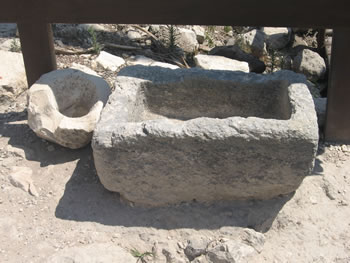
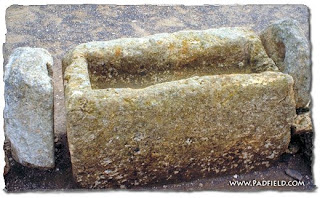
Feeding/water troughs made of stone found in the Holy Land

Not necessarily! The whole ‘barn’ is just assumed because of the manger. The word translated as ‘manger’ in fact is phatnē, which comes from pateomai ‘to eat’. The Greek is more ambiguous in meaning here: while it could refer to the feeding trough itself (which in those days were usually made of stone; see pic above), it could also refer to the place were animals are kept and fed itself.

Which still doesn’t answer the question: where was the barn? Well, the answer was, there probably was no barn. In the ancient world, as well as in primitive modern cultures, animals are regularly kept in or near homes at night, and feeding troughs would thus have been located there. By being inside, the animals were protected from the elements and theft. In addition, their presence provided body heat for cool nights, access to milk for the daily meal and dung as a critical fuel source. In one possible scenario, the animals as well as the family stayed under one large enclosed space that was divided so that the animals would usually be on the lower level, while the family would sleep on an upper level. Another possibility was that the house would have been built in front of or next to a cave (either natural or man-made), which would serve as the holding place for animals. Even today, shepherds in the Middle East employ caves as shelters for their flocks.

img641.imageshack.us/img641/5823/manger.th.png
An image by yours truly (courtesy of Sketchup) as to how one form of such a two-level house would have looked like. The animals are below, while the family would have stayed on the wooden platform overhead.

Consequently, Mary and Joseph did not find any space in the living quarters of the family home. Instead, they stayed downstairs where the animals are.
 
Giving Birth

In my opinion, one of the miracles of Jesus’ birth that many people often overlook nowadays is: the fact that both Jesus and Mary survived.

Childbirth was a risky business in the ancient world. Mortality is considered to have been quite high in antiquity, due to a few factors: a lack of sanitation and hygienic awareness, no understanding of micro-organisms, and a dearth of effective drugs all contributed. In the context of childbirth, however, maternal and infant mortality were seriously raised by modern standards. This inflation resulted from the toll childbirth took on women, and the increased risk of infection following labor.

Producing children was a woman’s greatest job, but the act itself was fraught with danger; death in childbirth was one of, if not the, common causes of death among women in antiquity. One estimate puts a 25% chance that the woman would die while delivering her child, and most maternal deaths were likely caused by infection. Even if the woman survived, there still remains the possibility that her baby might not. Infant mortality rate was quite high, like the rate of deaths in childbirth.

For the record, let’s check as to how the Jews viewed death in childbirth: the rabbis answer that the cause of death was the transgression of any of the three commandments that women and only women are obligated to carry out: the laws of niddah, challah (the dough-offering), and the lighting of the Shabbat candle. These commandments were given in punishment for Eve’s sin in the garden, and non-fulfillment was a matter of life and death, and carried a heavy penalty with it. By contrast, giving birth without birth pangs was seen as a sign of God’s favor and the righteousness of the woman: Josephus records a tradition about how Moses’ mother Jochebed gave birth to him without effort, which her parents took to be a good sign (Antiquities 2.218).

So, we now approach the question: how did women give birth in those days? Many Nativity scenes picture Mary and Joseph being by themselves alone, but the actual picture may be quite differently.

For the Middle Eastern peasant, it is a bad thing to be alone. He does his thinking in a crowd, as his culture is a group-centered one, as opposed to the individualistic thinking of the 21st century West. Thus, in the case of a birth, the men will sit apart with the neighbors, but the room will be full of women assisting the midwife, as childbirth was then the domain of women, and men did not take part in it.

In the 2nd century AD, the physician Soranus of Ephesus wrote a text on gynecology introducing the occupation of the midwife, giving us a picture as to how wealthy women in the Greco-Roman world. Soranus described her role in great detail. For example, the midwife was to have certain tools to ensure a safe delivery including: clean olive oil, sea sponges, pieces of wool bandages to cradle the infant, a pillow, strong smelling herbs in case of fainting, and a birthing stool (in those days, women did not give birth lying down, but sitting!)

The midwife would ready her supplies as labor began. During the labor process, the mother would lay on her back on a hard, low bed with support under her hips. Her thighs were parted with her feet drawn up. Gentle massage was implemented to ease labor pains as cloths soaked in warm olive oil were laid over her stomach and genital area, to soften the skin. Against the woman’s sides were placed hot compresses in the form of warm oil-filled bladders. During the actual birth, the mother would be moved to the birthing stool where she was seated with a midwife in front of her and female aids standing at her sides. In a normal headfirst delivery, the cervical opening was stretched slightly, and the rest of the body was pulled out. Soranus instructed the midwife to wrap her hands in pieces of cloth or thin papyrus so that the slippery newborn did not slide out of her grasp.

Superstitions and religion also played a major role in antiquity including childbirth, and thus, mixed with the actual process itself were invocations to the goddess Artemis who had the ability to bring new life into the world and take it away: if a woman died while during childbirth, her clothes were taken to the temple of Artemis due to the fact her death was attributed to her, but if the birth was successful, the mother would make a thank-offering of some of her clothes to the goddess as well. There were also the preparation and consumption of herbs and other strange concoctions - say, a drink mixed with powdered cow’s dung and fumigating with hyena fat! :eek:
 
http://new.rejesus.co.uk/images/area_uploads/nativity_icon/icon_whole.jpg

Let’s now look at the Jewish method of childbirth. While there were also some rather superstitious customs which we know were present in later ages (say, whispering passages from Scripture into the ears of the woman or the use of talismans such as magic bowls or silver sheets inscribed with the names of angels to ward off child-preying demons) and were something that proper authorities discouraged, such is not our concern for the moment.

Because this was a modest affair, the process was not as sophisticated as Soranus’ description. The midwife’s assistants would have walked Mary first (probably around the room), perhaps to speed delivery. Then comes the delivery: lower-class women would probably not even have had the luxury of a birthing stool, and Mary would have just rested somewhere, say on the lap of the assistants. The midwife then placed a cloth just below, so the Baby’s would not come into contact with the dirt floor of the house.

Eventually, the Infant then comes out of the womb, and makes His first cry - the first thing that all babies make when they enter into this world. The umbilical cord is cut with either a knife or a hard crust of bread that has been heated (a more sanitary alternative!). After the cord was cut and tied off, the midwife thoroughly examines the Baby. Then the Baby is, in true Hebrew fashion, then washed and rubbed with salt (cf. Ezekiel 16:4). After that, the Baby is then swaddled snuggly with bands of cloth, which is believed to help infants develop proper posture. It was around this moment that the husband (in this case, Joseph) would be able to enter inside and catch his first glimpse of the newborn Infant.

Luke tells us that Mary swaddled the newborn infant by herself, and indeed some take this as evidence that the Holy family were alone; however, there are accounts on how Palestinian women are not incapacitated by childbirth and could even give birth in a field and go back to the village, baby in tow, with no unusual effort required. In this scenario, it would then perhaps be natural that Mary would have swaddled the babe, since she could physically do so with little to no assistance; so when Luke tells us that Mary “wrapped the babe in swaddling clothes” that does not necessarily mean that they were alone. The process was almost complete: all that was left is to lay the Infant to rest somewhere. A stone trough, which the family’s animals grazed on, would probably do.

But it was not over yet. According to the Law, the blood of childbirth made a woman ritually impure, and Mary still had to undergo ritual purification to cleanse herself.

Then the LORD spoke to Moses, saying, “Speak to the children of Israel, saying: ‘If a woman has conceived, and borne a male child, then she shall be unclean seven days; as in the days of her customary impurity she shall be unclean. And on the eighth day the flesh of his foreskin shall be circumcised. She shall then continue in the blood of her purification thirty-three days. She shall not touch any hallowed thing, nor come into the sanctuary until the days of her purification are fulfilled.
But if she bears a female child, then she shall be unclean two weeks, as in her customary impurity, and she shall continue in the blood of her purification sixty-six days.
‘When the days of her purification are fulfilled, whether for a son or a daughter, she shall bring to the priest a lamb of the first year as a burnt offering, and a young pigeon or a turtledove as a sin offering, to the door of the tabernacle of meeting. Then he shall offer it before the LORD, and make atonement for her. And she shall be clean from the flow of her blood. This is the law for her who has borne a male or a female.

And if she is not able to bring a lamb, then she may bring two turtledoves or two young pigeons—one as a burnt offering and the other as a sin offering. So the priest shall make atonement for her, and she will be clean.’”
 
Ben Witherington III also makes the same points, only in less words. I quote:

Archeology of the area shows that houses in Bethlehem and its vicinity often had caves as the back of the house where they would keep their prized ox, or beast of burden, lest it be stolen. The guest room was in the front of the house, the animal shelter in the back, and Joseph and Mary had come too late to get the guest room, so the relatives did the best they could by putting them in the back of the house. Bethlehem was indeed a one stoplight town off the beaten track, and we have not a shred of archaeological evidence there ever was a wayfarer’s inn in that little village in Jesus’ day.

In other words, all this silliness about ‘no room at the Holiday Inn’ for the Holy family, is not at all what Luke is talking about. This is not a story about ‘no room in the inn’ or about the world’s giving Jesus the cold shoulder. It’s a story about no inn in the room! It’s a story about a family making do when more relatives than expected suddenly show up on the doorstep. It’s a story most of us can relate to in one way or another. Jesus was born in his relative’s home, in the place where they kept the most precious of their animals. One can well imagine the smell in that room, and probably the shock of the Magi when they saw where the King was born.

But this story is not meant to meet our expectations or desires about what a Christmas story must be like. Jesus did not come to meet our expectations or desires—he came to meet our needs. George MacDonald puts it this way—‘We were all looking for a king to slay our foes and lift us high, but thou camst a little baby thing, that made a mother cry.” Jesus came as he did to make clear that no one and no place however humble was beneath his dignity, and every age and stage of life he would hallow, and save and sanctify.
 
Status
Not open for further replies.
Back
Top