
Why do you feel socialism is bad?

  • Thread starter Thread starter PlipPlop
  • Start date Start date
Status
Not open for further replies.
“It is important to remember that government interference always means either violent action or the threat of such action. The funds that a government spends for whatever purposes are levied by taxation. And taxes are paid because the taxpayers are afraid of offering resistance to the tax gatherers. They know that any disobedience or resistance is hopeless. As long as this the state of affairs, the government is able to collect the money that it wants to spend. Government is the last resort the employment of armed men, of policemen, gendarmes, soldiers, prison guards, and hangmen. The essential feature of government is the enforcement of its decrees by beating, killing, and imprisoning. Those who are asking for more government interference are asking ultimately for more compulsion and less freedom.” Luwig von Misses
 
Hong Kong, for one, [and don’t give credit to the commies – it was an economic success before they took over].
I was not going to give credit to a communist dictatorship that exploits the labors of their peoples and has virtually unregulated environmental and work policies putting their people in harm all for a profit (now that is irony haha).

Hong Kong was a colony of UK. So its business direction came from London. Furthermore in some respect Hong Kong has some degree of autonomy from mainland China.
 

Hong Kong was a colony of UK. So its business direction came from London. …
So?
“Back when Hong Kong was a British colony and its wage rates were set by supply and demand, the Wall Street Journal reported that its unemployment rate was less than 2 percent. Then, after China took over Hong Kong and mandated various worker benefits – which add to labor costs, the same as higher wage rates – Hong Kong’s unemployment rate went over 8 percent. This was not high by European standards but it was unprecedented for Hong Kong. There is no free lunch in any part of the world.” – Thomas Sowell
P.S. You never answered my question in #488.
 
Did you ever consider that this responsibility is currently being met? .
No. Our education system is in continued decline. There are many folds to which the cause of the problem (that includes, parenting, declining family values). However you also have government split apart on that issue. One wants to rid it entirely while one wants to fund education but does not hold the system accountable. Teachers are sorely underpaid which we are now only getting substandard talent. After all you get what you paid for.

To blame it on the teachers, liberals or just conversative politicians is just the surface. It is a society problem.

With continued falling wages due many factors does not help either. No longer can you have a single income household, which causes mothers and fathers to work. Wages have been stagnent or falling for the past 30 years. However since 1980 CEO and executive compensation went from 40:1 ration in 1979 to 256:1 as of last year. That is crazy. With that you can see more and more there is less investment back into the companies these executives work for. It goes to them and the shareholders.

Do I believe the government has the sole responsbility to be the provider? No that is socialism. Our society comprises of individual, government and business. With out cohesion between the 3 there becomes a systematic failure in our society. With out morals and each of the 3 keeping each other in check society begans to break down because one will begin to abuse the other. ESPECIALLY when it is the individual who turns a blind eye to both business and government.

I could go on.

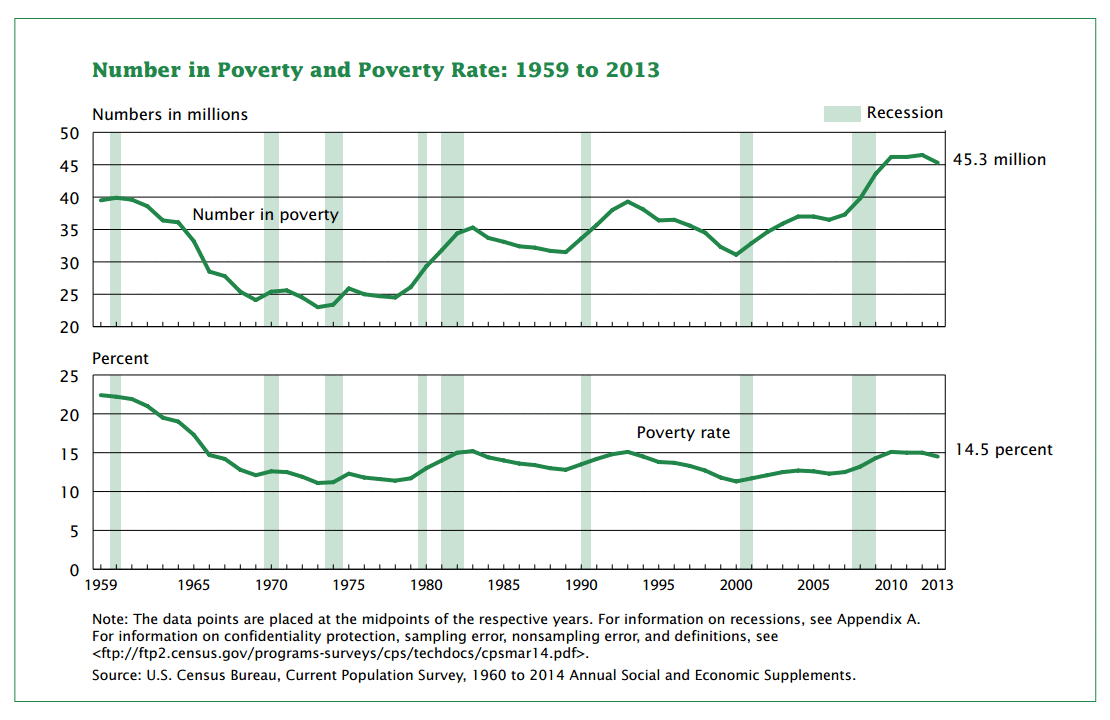
I will ask you this: What was the poverty rate prior to 1964? What was the literacy rate before public education was expanded and mandated in the 1800’s?
 
No. Our education system is in continued decline. …
I will ask you this: What was the poverty rate prior to 1964? What was the literacy rate before public education was expanded and mandated in the 1800’s?
Fair is fair. Before I answer this, you have to answer my question in #488.
 
My last post was in reply to your question on 488.
For whatever it’s worth:

The most common measure of poverty in the United States is the “poverty threshold” set by the U.S. government. This measure recognizes poverty as a lack of those goods and services commonly taken for granted by members of mainstream society. The official threshold is adjusted for inflation using the consumer price index.
Relative poverty describes how income relates to the median income, and does not imply that the person is lacking anything. In general the United States has some of the highest relative poverty rates among industrialized countries, reflecting both the high median income and high degree of inequality. – en.wikipedia.org/wiki/Poverty_in_the_United_States
A question never addressed by such figures is, “At what cost?” Not only do poor people get money, there is a vast government “Poverty Industrial Complex” to administer the programs that, at a minimum, discourage people from getting out of poverty. If you are a bureaucrat or a contractor to a bureaucracy, the last thing you want is fewer poor people. The elimination of poverty would spell the end of their fiefdoms.

In any event, in my mind, the data above doesn’t justify dumping capitalism for socialism.

BTW, do you know how many dogs there were in Oxnard, CA, in 1978? [This is no joke.]

As far as mandated education in the 1800s is concerned, I don’t have any literacy rate figures, but since you are the one trying to make a point, perhaps you do.
 
“The two ideas of human freedom and economic freedom working together came to their greatest fruition in the United States…We have been forgetting the basic truth that the greatest threat to human freedom is the concentration of power, whether in the hands of government or anyone else. We have persuaded ourselves that it is safe to grant power, provided it is for good purposes.”

“We are again recognizing the dangers of an over-governed society, coming to understand that good objectives can be perverted by bad means, that reliance on the freedom of people to control their own lives in accordance with their own values is the surest way to achieve the full potential of a great society.”

References

Friedman, M., & Friedman, R. D. (1990). Free to Choose. New York: Harcourt, Inc.
 
I can not see how anyone would want socialism. Just study Hugo Chavez, Cuba, the Soviet Union. My family comes from Poland it did not exist for 150 years under socialism and you could not even speak Polish. The schools were underground for the language and history of the country. Study history visit those countries talk to the people.
 
For whatever it’s worth:
http://upload.wikimedia.org/wikipedia/commons/b/b7/US_poverty_rate_timeline.gif

A question never addressed by such figures is, “At what cost?” Not only do poor people get money, there is a vast government “Poverty Industrial Complex” to administer the programs that, at a minimum, discourage people from getting out of poverty. If you are a bureaucrat or a contractor to a bureaucracy, the last thing you want is fewer poor people. The elimination of poverty would spell the end of their fiefdoms.

In any event, in my mind, the data above doesn’t justify dumping capitalism for socialism.

BTW, do you know how many dogs there were in Oxnard, CA, in 1978? [This is no joke.]

As far as mandated education in the 1800s is concerned, I don’t have any literacy rate figures, but since you are the one trying to make a point, perhaps you do.
Who said dumping capitalism for socialism? Nobody wants socialism. We want a responsible government, responsible and moral citizens, also responsible and morally run businesses.
 
Joseph David
Can’t agree more we need a responsible government who listens to the people. We don’t need elitists in office.
Lets vote in Nov and in the future for responsible people.
 
Who said dumping capitalism for socialism? Nobody wants socialism. …
Hello there! I’m a supporter of the United States becoming a socialist democracy, and having systems such as socialized health care.

Looking over this forum, most (if not all) of the members are strongly anti-socialist. Why?

Your posts strongly appear to support this position.
 
Part 1
United States Postal Service: Elements of Cost
(April 29, 2002)

Benjamin Franklin’s beloved Post Office is in trouble, again. Postal volume is falling, and the USPS is unable to cut costs fast enough. The General Accounting Office says, “USPS’s basic business model, which assumes that rising mail volume will cover rising costs and mitigate rate increases, is increasingly problematic since mail volume could stagnate or decline further.” Its business model is “unsustainable” and its financial outlook is “increasingly dire (Krause, 2002).”

The United States Postal Service’s basic problem is its Universal Service Obligation (USO). The Postal Service USO is a positive externality that Congress wants to subsidize. “Every American – no matter who, no matter where – has a fundamental right to affordable, accessible mail service,” said John E. Potter, Postmaster General (Potter, 2002). Congress gave the USPS a monopoly over First-Class Mail in exchange for universal postal service to all areas of the United States.

What is the cost of the Universal Service Obligation? The U.S. Postal Service does not know. One of the difficulties in addressing USO costs arises from the law. Legislation broadly defines postal obligations. The law requires uniform rates for letters and requires service across the United States. Universal Service Obligations permeate the entire Postal Service, from the shipment of live animals to Express Mail for remote communities. There is no accounting for USO costs.

There is no easy way to allocate USO costs. A USO does not come in a neat business segment. The Postal Service simply averages rates across a number of mail pieces with different cost characteristics. To the extent that the Postal Service averages rates, low-cost customers subsidize high-cost customers. Additionally, there is no precise definition for Postal Service USO costs. If a USO includes an extensive list of obligations, there will be high costs. A limited definition will have lower costs.

As long as the Postal Service is a subsidized quasi-government agency, we may never know the full scope and costs of the Postal Service’s universal service obligations. A privatized Postal Service would drop unprofitable services and products. These abandoned services and products would be a visible sign of the scope and costs of the Postal Service’s USOs.
 
Part 2
United States Postal Service:
Elements of Cost

Stamp prices are being driven up by the Postal Service’s labor costs, which account for 85% of its spending (Castro, 1988). The US Postal Service employs more than 900,000 people. The Government Accounting Office accuses the Postal Service of being overstaffed. The GAO says that the Postal Service needs to restructure its workforce to reduce the number of employees (Delahoussaye, 2002). Labor costs are increasing, despite the Postal Service’s financial woes. The Postal Service reached a tentative five-year contract with one of its largest unions, the National Association of Letter Carriers. The new contract calls for raises totaling 7.1 percent over the term of the deal, plus cost of living increases (Lake Charles American Press, 2002). The American Postal Workers Union announced similar wage increases in December, 2001. Another element of labor costs is labor disputes. The Postal Service spends $300 million a year on labor-management disagreements (Potter, 2002).

Milton Friedman (1999) says that the government takes credit for all favorable occurrences. That seems to be the case with the Postal Service. On April 9, 2002 the Postal Service said, “Success in controlling expenses was due to aggressive work-hour cuts…The Postal Service trimmed 8,100 career employees from its rolls during the first two quarters of this fiscal year (Postal News, 2002). Did the Postal Service fire these 8,100 employees, or did they retire? The Postal Service did not say. Chief Financial Officer and Executive Vice President of the US Postal Service, Richard Strasser Jr. said, “During Quarter 1, the Postal Service reduced work-hours usage by 17.8 million work hours compared to the same period last year. That reduction, coupled with the cumulative work-hour reduction of 23.1 million hours in fiscal year 2001, means the Postal Service has cut 16,300 full-time career employees (more than 40 million work hours) from its operating expenses since fiscal year 2000 (Postal News, 2002).” Strasser also reports that overtime work hours were down 25% compared to 2001. The Postmaster General Potter (2002) reports that the Postal Service is using 700,000 fewer work hours per accounting period because of new machines that increase flat productivity. How much of the work hour reductions are due to an increase in productivity, and how much is due to the decrease in mail volume? The General Accounting Office says that productivity grew by only 11 % over the past 30 years, despite an investment of billions of dollars in automation and information technology (Zurier, 2001). It looks like the number of work hours declined because of a significant decrease in mail volume, and only a marginal increase in productivity.
 
Part 3
United States Postal Service:
Elements of Cost

The Postal Service had a deficit of $1.7 billion in fiscal 2001. To help eliminate some of the losses, the Postal Service is raising rates on June 30, 2002. The new rate increases will generate less than $5 billion in new revenue. The Postal Service estimates that it will still face a $2 billion deficit for fiscal 2002 (Chen, 2002).

USPS has a debt load of $5½ billion, and that debt is growing exponentially. Cash outlays for interest increased to $339 million in 2001 (Financial Statement, 2001). Postal officials project retirement plan costs to escalate from $8.5 billion in fiscal 2000 to about $14 billion in fiscal 2010. “The projected future cost of retirement benefits could have a material impact on the Service’s ability to operate on a break-even basis (GAO, 2002).

How does the Postal Service cover its fixed costs? Unlike the telecommunications network, the Postal Service does not have a physical connection to its customers. The Postal Service incurs fixed costs in setting up a postal network, but the USPS has no connection fee. USPS does not have a monthly charge to cover its fixed costs. The USPS simply sets rates high enough to cover its fixed costs and hopes that the volume of mail does not fall.

However, mail volume is falling. Mail volume fell by 5½ % last year. Milton Friedman (1999) says that the government blames all problems on external influences beyond its control. The Postmaster General Potter blames the attacks of September 11 and the subsequent anthrax assault for much of the Postal Service’s financial woes. Potter (2001) told Congress that the direct cost of the terrorist attacks cost the Postal Service $3 billion or more. He also said that the secondary business impact of these incidents was a significant decline in mail volume and revenue. Potter said that the secondary financial impact of falling mail volume could affect the Postal Service’s bottom line by as much as $2 billion in fiscal year 2001. He also did not want these “terror costs” to be allocated to the Postal Service. “These costs should be considered as part of homeland security…we require assistance in coping with this year’s impact (Potter, 2001).”

The Postmaster General did not mention the negative impact of higher postal rates on mail volume. Is the Postal Service assuming that mail volume will remain constant after a rate increase? Postmaster General Potter seems to think so; he blames the decline in mail volume on the terrorist attacks. Could mail deliveries fall because of sharply higher postal rates? History suggests that may be the case. The USPS boosted periodical rates by 21% in 1991 and periodical mail shipments declined by over 10 per cent (Afand, 2000). The USPS increased Priority Mail rates 13% to 20% in 2001 and volume dropped 4.4% (Miller, 2001). Postal rates will increase an average of 8½% on June 30, 2002 (Ridder, 2002). How much will mail volume drop because of the new rate increase?

The Postal Service increases rates regardless of customer demand and in isolation from competitive cost realities (Posch, 1999). Higher rates will force many customers to seek alternative means of delivery, possibly to the point that postal revenues will rise only marginally, or not at all. The cost of telecommunications is decreasing while the Postal Service rates are increasing. Is there any doubt where cost conscious consumers are heading? The Postal Service is losing money because more and more Americans are communicating by e-mail and fax, not “snail mail.” The Postal Service seems to be pricing itself out of the market. The “stamp-licking” era is drying up. Wealth flows to the markets where labor and regulations generally are most deregulated (Posch, 1999).

Postmaster General Potter (2002) says, “The Postal Service receives no taxpayer dollars for routine operations, but derives its operating revenues solely from the sale of postage, products and services.” However, Potter is requesting appropriations in three distinct areas in 2003. He is requesting $29 million to pay for a portion of the postage for reduced rate mail. Potter is requesting $49 million for free mail for the blind and overseas voting materials. He is also requesting $929 million for capital projects.

The United States Postal Service seems to be following Dr. Max Gammon’s Theory of Bureaucratic Displacement: An increase in expenditure of money will be followed by a fall in production. Such a system acts like a black hole in the economic universe. Costs go up and benefits decline. James Miller, director of the Office of Management and Budget said, “The Postal Service is a monstrosity. It is overstaffed, overpriced and inefficient. Postal patrons are paying more and more and getting less and less in return (Castro, 1988).” Postmaster General Potter (2002) wants to restructure the Postal Service into “a commercial government enterprise that would operate under more businesslike conditions than currently possible. The author thinks that Postmaster General Potter is rearranging the deck chairs on the USPS Titanic.
 
In 1990 Congress gave the SEC, the authority to impose hefty penalties without the approval of a judge.

The role of the government is an umpire. Thomas Jefferson supported this idea, and it is embedded in our laws going all the way back to 1775 (e.g. Virginia and Massachusetts Constitutions). The SEC, IRS, Social Services, and all the “alphabet police” incorporate another idea, the idea that government is a participant. Some judicial activists feel that the Constitution is a “flexible” document that should be interpreted differently as society changes. Based upon this theory, this is how some judges have gotten away with making law instead of interpreting it. There is no Constitutional justification for this idea, as far as I can see.

Additionally, government bureaucracies violate another intent of the Founding Fathers, the separation of powers. For example, Congress gives the IRS very broad powers to make law (legislative). The IRS has the power to go out to find the people who break “the law” (executive). Additionally, the IRS has the power to judge a taxpayer guilty (judicial).

The SEC maintains that substantial penalties deter corporate criminals. But the more money the SEC collects from fines, the easier it is to justify larger budgets and more power.

The SEC and regulations on financial transparency are a perfect example in explaining additional regulatory burden. More regulations mean more federal employees. Here is how the system works. In order to become a government supervisor, the federal employee must supervise a specific number of individuals. For example, a federal employee may have to supervise a total of 14 people before being promoted to a GM-15. However, to support these 14 people there must be some work for these federal employees. Enter a major regulatory proposal to expand reporting requirements on accounting transparency. Accounting transparency becomes a new form of regulatory burden. This increased regulatory burden provides many new jobs in the federal government. Additionally, regulatory burden promotes many federal employees to supervisor. New accounting regulations will cause the need for many new jobs in the Federal government. New regulations will also cause unnecessary additional regulatory burden for private companies.

At the present time a taxpayer does not have the right to a trial by jury if there is a dispute with a government agency. I would like to remedy that. I do not want our judicial system run by “professionals,” lawyers and judges. I want to limit the role of judges. I believe that the eroding role of juries is contrary to the intent of the Founding Fathers. To remedy the eroding role of juries, I support a constitutional amendment to inform all jurors of their Constitutional right to nullify the law. Juries have the right to evaluate both the facts and the law in a court case.
 
I was not able to read all answers, don’t have the time, but just to share my 2 cents:
I don’t see anything bad in a government that helps people. Take a look at Canada, for example - we have some of the highest life standards in the world, the economic crisis didn’t hit us here as hard as in the US precisely because the government makes it its business to regulate most things, including the banking system - and this is what prevented such a horrible crisis here. Besides, even people who lose their jobs here have a chance of getting unemployment for a longer period of time that in the US, giving them a better chance of finding another job without losing their homes and everything they own. And if they are unable to find a job, then there’s welfare, and programs to help people find a job. The government health care system is for everyone, and no one complains of the fact that he/she needs to pay higher taxes because we know that this helps disadvantaged people.

On a strictly Christian basis, however, I can NEVER understand people who call themselves Christian, but speak about how “the last thing you want is fewer poor people”. I’m sorry if this seems harsh, but this sounds HORRIBLE!! It seems as we have forgotten what Christ taught us, things like:
“If I speak with the tongues of men, and of angels, and have not charity, I am become as sounding brass, or a tinkling cymbal.”
“And if I should have prophecy and should know all mysteries, and all knowledge, and if I should have all faith, so that I could remove mountains, and have not charity, I am nothing.”
“And now there remain faith, hope, and charity, these three: but the greatest of these is charity.”

“Woe to you scribes and Pharisees, hypocrites: because you devour the houses of widows, praying long prayers. For this you shall receive the greater judgment.”

Now open your Bibles and check, how many times God talks about the poor, and what does he demand that we do to help them. And then come back here, and tell me how you know better than Him.

One of the saints of our Church said that if someone has two shirts, the second one belongs to the poor. Now tell me how each of us should work for himself.

This way of thinking will alienate anyone considering converting to Catholicism. In this particular case, the ‘neopagan’ who revers Jesus, as he writes about himself, is a better Christian than many of us will ever be. Sorry to say that, it should be the other way around.
 
Status
Not open for further replies.
Back
Top