WSJ: Whatever Happened to Global Warming?

  • Thread starter Thread starter Theo520
  • Start date Start date
Status
Not open for further replies.
Evidently AGW must be taken as a matter of Faith. Absolutely nothing disproves it. If its hot in December that is proof of AGW. If it snows in Sept that proves AGW. If Sea ice shrinks that is proof of AGW-if sea ice increase that is proof of AGW.
And yet such claims undermine their own theory as it makes it untestable and not science.

Their rhetoric smells of a con game.
 
On the contrary I cited 11 different data sets in post #149 that support my point that recent warming has been much faster than the natural warming that occurred after the Little Ice Age. You have cited zero data sets that support your claim to the contrary.
When did AGW begin? Looking at the increases in CO2 concentrations a reasonable conclusion can be made that it wasn’t until around 1950 that the additional CO2 was sufficiently high to have caused warming. The warming period from 1910-1940 is statistically no different than the period of warming from 1975-1998 even though the former was almost surely not caused by AGW even as AGW is the supposed cause of the latter increase.

If you look at warming over the entire 20th century it was indeed rapid, but there seems suspiciously little reason to believe that warming in the first half of the century, before there was any significant rise in CO2 emissions, was driven by the same AGW concerns credited with causing the second half rise. This is an EPA graph of CO2 emissions.

http://www.epa.gov/climatechange/images/ghgemissions/TrendsGlobalEmissions.png

And this is a Hadley MET chart of temperature change during the 20th century.

http://www.metoffice.gov.uk/hadobs/hadcrut4/data/current/web_figures/hadcrut4_annual_global.png

There really doesn’t seem to be much correlation between these two; there certainly isn’t anything to indicate a cause and effect relationship.
Regardless, claims that “Global warming is the unusually rapid increase in Earth’s average surface temperature over the past century” are erroneous and indicative of either ignorance or duplicity on the part of NASA’s Earth Observatory, NASA’s Climate Consensus page, The Daily Mail, the EPA and many others.
wattsupwiththat.com/2014/03/29/when-did-anthropogenic-global-warming-begin/
Ender
 
I agree it is not a matter of winning or losing. I think each of us is trying to convince the other of their point, as we should. But an argument is much more convincing when it is backed up by something other than someone’s gut level feeling. That is why I have not asked you to take my word for anything I have said. You don’t know me from anyone, and there is no reason you should take my word for anything. Instead I have referred you to publicly available sources that show that temperatures have risen substantially faster in the industrial age. You dispute the accuracy of those sources, but many learned people do not. If you are going to propose the exceptional view that my sources are corrupted, and if you expect your proposal to be convincing, you should cite some better source of data that supports your point more than it supports my point. Then you would be on the road to being convincing. But if you have no interest in convincing anyone of your point, then just keep right on making unsubstantiated claims. (Saying that your claims are supported by public data, but declining to point to that data does not count as substantiation.)
I have no pretensions of being a scientist. However, this isn’t just a theoretical scientific debate, like about what was “there” before the Big Bang. This has practical and immediate effects because of politics.

A person like me looks at the competing studies (and they are often wildly different in their conclusions); looks at his own life experience and that of those who are older, looks at the fact that there’s really no global warming going on despite undoubtedly increased CO2 emissions, and it’s pretty clear there is not conclusive evidence of MMGW. It’s a theory, and those who promote it have some facts behind them. But then, so do those who don’t think it’s happening.

But the politics of it is what makes it truly poisonous. Obama is an ideologue, or at least caters to those who are. He has promised to make utility bills “skyrocket” (whatever he means by that) for the sake of quelling MMGW. We know for sure that nothing we do in the U.S. will prevent increased CO2 emissions, and we know using the least expensive sources of energy make a difference in jobs and the economy. We do not KNOW there are going to be more hurricanes or droughts or the other things the MMGW people tell us are out there in the (varied) future somewhere. But we do know for sure this administration wants to make energy use painful for us, and without giving much thought to just how painful it’s going to be for many.

So, it’s really not going to be resolved here on CAF; not even the science part of it. But since the whole thing is so entangled with politics, non-resolution is guaranteed.
 
I have no pretensions of being a scientist. However, this isn’t just a theoretical scientific debate, like about what was “there” before the Big Bang. This has practical and immediate effects because of politics.

A person like me looks at the competing studies (and they are often wildly different in their conclusions); looks at his own life experience and that of those who are older, looks at the fact that there’s really no global warming going on despite undoubtedly increased CO2 emissions, and it’s pretty clear there is not conclusive evidence of MMGW. It’s a theory, and those who promote it have some facts behind them. But then, so do those who don’t think it’s happening.

But the politics of it is what makes it truly poisonous. Obama is an ideologue, or at least caters to those who are. He has promised to make utility bills “skyrocket” (whatever he means by that) for the sake of quelling MMGW. We know for sure that nothing we do in the U.S. will prevent increased CO2 emissions, and we know using the least expensive sources of energy make a difference in jobs and the economy. We do not KNOW there are going to be more hurricanes or droughts or the other things the MMGW people tell us are out there in the (varied) future somewhere. But we do know for sure this administration wants to make energy use painful for us, and without giving much thought to just how painful it’s going to be for many.

So, it’s really not going to be resolved here on CAF; not even the science part of it. But since the whole thing is so entangled with politics, non-resolution is guaranteed.
One can not help but be skeptical when the solution to the alleged problem is instituting the agenda the Left has been pushing for the last 100 years.
 
No, but it makes the argument** for** AGW a little less convincing.
Not really. If it did warm faster coming out of the Little Ice Age (and I don’t know or care one way or the other, since it doesn’t relate to current AGW), then it would be because of some causal factors. Like maybe a meteor hit the largest close-to-the-surface coal seam in the world and ignited it, sending up lots of CO2.

I think I might have something here. Maybe that is what happened BEFORE the LIA, because such burning would have caused a strong cooling effect in the beginning, with all those aerosol emissions, sending the earth into a LIA. Then when the air cleared (aerosols only last in the atmosphere weeks, not centuries & millennia like CO2), then the CO2 warming would have become dominant.

Now all we have to do is find that humungous coal seam and meteor strike…or remnants of it. (That’s what happened during the end-Permian 251 mya to send the earth into hyper-warming and kill off 95% of life on earth.)

Or there were some other causal factors.

The contrarian argument that there are no causes for cooling or warming but it “just happens naturally” is total bunk, another fallacious argument.
 
Well, since the support for AGW is basically 1) the Earth is warming, 2) we know CO2 is a Greenhouse gas and 3) we are producing more greenhouse gas, therefore 4) our increased CO2 emissions MUST be the cause of that warming, to show OTHER sources for that warming is germane for most thinking people.
It has been well proven over the past 200 years ago that CO2 causes warming, and that is why we are here today. Without CO2 in our atmosphere our earth would be much too cold to support life. The greenhouse effect is not disputed. It is based on laws of physics.

en.wikipedia.org/wiki/Joseph_Fourier#Discovery_of_the_greenhouse_effect
en.wikipedia.org/wiki/John_Tyndall#Main_scientific_work
en.wikipedia.org/wiki/Svante_Arrhenius#Greenhouse_effect
ucar.edu/learn/1_3_1.htm
 
It has been well proven over the past 200 years ago that CO2 causes warming, and that is why we are here today. Without CO2 in our atmosphere our earth would be much too cold to support life. The greenhouse effect is not disputed. It is based on laws of physics.

en.wikipedia.org/wiki/Joseph_Fourier#Discovery_of_the_greenhouse_effect
en.wikipedia.org/wiki/John_Tyndall#Main_scientific_work
en.wikipedia.org/wiki/Svante_Arrhenius#Greenhouse_effect
ucar.edu/learn/1_3_1.htm
So the law of physics has been suspended for the last 18 years?
 
From the blog Bob cited:

Antarctic Sea Ice Extent Sept 13 2014 – New All Time Record (well at least for satellite data)

This is a new All-Time Record. Breaking the record set in 2013 by 48,000 sq km.

Interesting:

sunshinehours.wordpress.com/2014/09/13/antarctic-sea-ice-extent-sept-13-2014-new-all-time-record/
Due to AGW. Who knew? Even I thought it was just a case of some few places still getting cooler, despite the overall trend of warming.

See climatedesk.org/2014/09/antarctic-sea-ice-hits-a-record-max-and-thats-not-good/

“…the expanding ice … might be a symptom of the world heating up. The larger extent could be caused by more ice melting, say researchers at NOAA: ‘We suspect that the increasing presence of icebergs broken off from ice shelves and glaciers within the Antarctic sea ice pack is a major contributor to a temporary but increasing trend in the Antarctic sea ice extent.’”

I engage in “kitchen physics” and noted last night that when I put two frozen Swai (fish) fillet in a pot of warm water to defrost them quickly, they got stuck together and I had a rough time separating them without breaking them. I think I can understand how a huge number of icebergs floating around can get stuck together and form larger ice extent. It seems to make sense.

And note that they are not saying the Antarctic is getting colder, only that the ice extent is increasing…

 
So the law of physics has been suspended for the last 18 years?
They’re holding up fine, considering that the warming has continued, even tho a larger amount is going into the deeper oceans (where it can’t warm up the atmosphere as well as sea-surface temps) and even tho one might expect it to dip cooler or remain at the same level now & then…with cause, of course, and due to various factors, like a huge volcanic eruption, as happened with Mt. Pinatubo in 1991. Notice how the temps dipped down in 1992 and for a few years thereafter:

 
They’re holding up fine, considering that the warming has continued, even tho a larger amount is going into the deeper oceans (where it can’t warm up the atmosphere as well as sea-surface temps) and even tho one might expect it to dip cooler or remain at the same level now & then…with cause, of course, and due to various factors, like a huge volcanic eruption, as happened with Mt. Pinatubo in 1991. Notice how the temps dipped down in 1992 and for a few years thereafter:

http://whyfiles.org/wp-content/uploads/2014/07/global_land_ocean_temps.gif
So sometimes rising CO2 causes warming and sometimes it does not. And which law of physics is that?
 
So sometimes rising CO2 causes warming and sometimes it does not. And which law of physics is that?
I didn’t say that, but it is true that CO2-caused warming has a long lag time, so the CO2 that is presently in the atmosphere is expected to continue warming the earth for many decades to come, even if we halt all emissions today – some high-end studies have suggested up to 2.4C more warming.

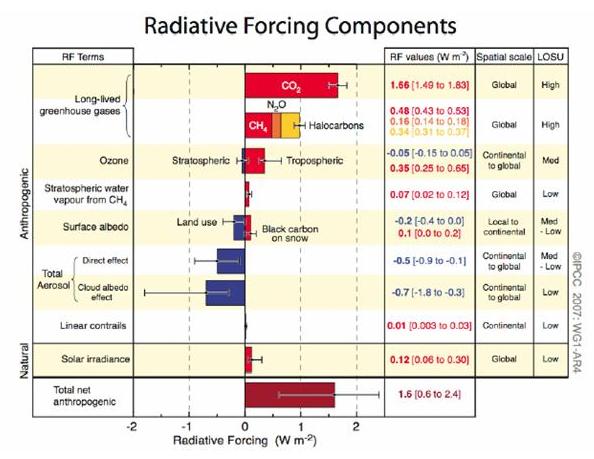
The point is there are various factors that have a warming effect and various factors that have a cooling effect, like SO2 aerosols, which are also emitted along with CO2 when burning coal. However, their cooling effect is short-lived, as SO2 molecules have a residency in the atmosphere of several weeks, unlike CO2, which can stay in the atmosphere for centuries and many millennia (those molecules not reabsorbed by plants and the ocean and through weathering).

This chart may help explain these various warming and cooling components:


In addition there are various natural “sloshings” or oscillations of air and ocean currents that have an impact on weather patterns, making some years and some areas a bit warmer and some a bit cooler (but net effect over time being zero) – such as ENSO, NAO, AO, AMO, etc.

For example, see ENSO at en.wikipedia.org/wiki/El_Ni%C3%B1o_Southern_Oscillation

Climate science is a lot more complex than looking at just one variable, and the scientists have been struggling to understand the impact of aerosols and clouds, with a couple back in the 1970s who thought the aerosol effect might be at the high end, it could have a big impact on cooling the planet…but as skeptics love to point out, those scientists were wrong!
 
It has been well proven over the past 200 years ago that CO2 causes warming, and that is why we are here today. Without CO2 in our atmosphere our earth would be much too cold to support life. The greenhouse effect is not disputed. It is based on laws of physics.

en.wikipedia.org/wiki/Joseph_Fourier#Discovery_of_the_greenhouse_effect
en.wikipedia.org/wiki/John_Tyndall#Main_scientific_work
en.wikipedia.org/wiki/Svante_Arrhenius#Greenhouse_effect
ucar.edu/learn/1_3_1.htm
Yes, I said we know that CO2 is a greenhouse gas.

Your point is…?
 
They’re holding up fine, considering that the warming has continued, even tho a larger amount is going into the deeper oceans (where it can’t warm up the atmosphere as well as sea-surface temps)
The first statement is wrong and even AGW proponents admit we have seen a ‘pause’ in global warming and the second is simply presumed.

What is your FAIL result for AGW? What are the criteria for c oming to the conclusion that AGW is WRONG?

Do you even have any in mind?
 
Due to AGW. Who knew? Even I thought it was just a case of some few places still getting cooler, despite the overall trend of warming.

See climatedesk.org/2014/09/antarctic-sea-ice-hits-a-record-max-and-thats-not-good/

“…the expanding ice … might be a symptom of the world heating up. The larger extent could be caused by more ice melting, say researchers at NOAA: ‘We suspect that the increasing presence of icebergs broken off from ice shelves and glaciers within the Antarctic sea ice pack is a major contributor to a temporary but increasing trend in the Antarctic sea ice extent.’”

I engage in “kitchen physics” and noted last night that when I put two frozen Swai (fish) fillet in a pot of warm water to defrost them quickly, they got stuck together and I had a rough time separating them without breaking them. I think I can understand how a huge number of icebergs floating around can get stuck together and form larger ice extent. It seems to make sense.

And note that they are not saying the Antarctic is getting colder, only that the ice extent is increasing…
I am trying to get an answer out of AGE proponents but I cant seem to get one on this question “What has to happen that would DISPROVE Anthropogenic Global Warming?”

Would you like to answer it?
 
I didn’t say that, but it is true that CO2-caused warming has a long lag time, so the CO2 that is presently in the atmosphere is expected to continue warming the earth for many decades to come…
No, a lag time would be the period between the introduction of something and the appearance of its effects. In the case of CO2 there is no lag time; it begins to absorb IR energy as soon as it is exposed to it. It may well be that CO2 has a long duration such that its effects will continue for years, but those effects would begin immediately. Or in this case, not for at least 18 years. I’m with estesbob on this one: I don’t know what law of physics explains it either.

Ender
 
They’re holding up fine, considering that the warming has continued, even tho a larger amount is going into the deeper oceans (where it can’t warm up the atmosphere as well as sea-surface temps)
This precisely backwards: it is the atmosphere that is presumed to have warmed the oceans, not the oceans that are warming the atmosphere.

Ender
 
They’re holding up fine, considering that the warming has continued, even tho a larger amount is going into the deeper oceans (where it can’t warm up the atmosphere as well as sea-surface temps) and even tho one might expect it to dip cooler or remain at the same level now & then…with cause, of course, and due to various factors, like a huge volcanic eruption, as happened with Mt. Pinatubo in 1991. Notice how the temps dipped down in 1992 and for a few years thereafter:

http://whyfiles.org/wp-content/uploads/2014/07/global_land_ocean_temps.gif
Can you explain or counter the point made in the following video that CO2 levels from ice core data frequently rise after increases in temperature and decline after decreases in temperature, so that a causal relationship between C02 levels and temperature change is not clearly demonstrated?

youtube.com/watch?v=Hm6cEgEghwg

Mr. Gore’s contention is that "when there is more carbon dioxide the temperature gets warmer,” yet if CO2 levels increase AFTER warming (and cooling precedes a decrease in CO2 levels) then it is possible that the opposite is true; in fact, “when the temperature gets cooler there will be less carbon dioxide in the air,” AND deciding which is the cause and which the effect becomes more complicated than Mr. Gore allows.

Correlation does not equal causation, correct?

Added to the point of the video is that both CO2 levels and temperature are constantly in a correlated flux, but not inexorably rising or falling.

Clearly, when temperatures rise AND more CO2 is available, that would inevitably lead to plant flourishing and the fixing of more CO2 into carbohydrates, thereby depleting the amount of CO2 in the air.
 
The first statement is wrong…
No, your idea of a pause is wrong. I guess you haven’t been digging deeply enough into climate science to understand that the deeper oceans have been taking up a larger portion of the warming. The earth’s total heat content has been increasing, even if atmospheric temps have not increased significantly for over a decade.

See: skepticalscience.com/The-Deep-Ocean-Warms-When-Global-Surface-Temperatures-Stall–.html

And that bodes ill for further climate change, since it may mean more melting of ocean hydrates and release of methane. See “Widespread methane leakage from the sea floor on the northern US Atlantic margin” at nature.com/ngeo/journal/v7/n9/full/ngeo2232.html

(Please Note: This uploaded content is no longer available.)
 
And that bodes ill for further climate change, since it may mean more melting of ocean hydrates and release of methane. See “Widespread methane leakage from the sea floor on the northern US Atlantic margin” at nature.com/ngeo/journal/v…/ngeo2232.html
Funny that you brought this up. I’ve been on work related telecons with one of the foremost experts in methane hydrates at wood’s hole (see author) and have asked another coworker about this subject who has done hydrate research.

Basically, as far as I understand this, methane is undersaturated in the oceans and most or all of the CH4 from the destabilized hydrate would get absorbed into the ocean water before it can be released into the atmosphere to cause global warming. This isn’t to say it couldn’t happen in some circumstances, but the complexities of when this can happen escapes me.

If you have any questions about methane hydrates, I probably can find someone who has a good answer.
 
The thing holding India back is not her population or lack of a food surplus.
That’s exactly the point – more population > more food needed > less chances of a food surplus. Which is why increasing population does not automatically mean increasing inventivesness to the level which will automatically solve all the problems created by the increased population.

If overpopulation causes resource strain to the point that there is no food surplus, or even no economic surplus – any further innovation stops.
Japan, of course, is greatly more populated per square mile of useable space than is the U.S. So population doesn’t tell us everything. China has a huge population, but it outproduces India which has a smaller one. And, of course, Singapore has perhaps the most dense population of any nation on earth.

Governance also makes a great deal of difference. Poland was locked into 1939 until 1991.When it has as much decent governance for as long as Germany has (never mind the massive aid to German reconstruction that nobody has provided to Poland) it might be just as productive as Germany.
This isn’t about productivity but inventiveness. Arguably, Poland has better productivity ($/h) than Germany once some accounting tricks used by German companies in Poland are taken into account.

That said, Poland was always less inventive than Germany, and this is a situation which goes back all the way to Middle Ages. It is also a straightforward result of the country’s geography – the only mineral-rich area in Poland (Silesia) was given to Poland after WW1 and WW2 (partially and the completely). Mass industrialization in Poland only happened thanks to the communists in 1950s and 1960s – about 100 years later than in Germany. (Lack of sufficient industrial base was of course the reason why Poland was run over by Germany in the first two weeks of WW2 – a confrontation of 269 tanks with 1230 tanks could only have one result.) And, again, as any child playing Civ will tell you – there is no invention without industrialization.
 
Status
Not open for further replies.
Back
Top