European elections 2019: LIVE results

  • Thread starter Thread starter Vouthon
  • Start date Start date
Status
Not open for further replies.
“Tell you what”… Americans are not about to dig into their pockets for this stuff. We have more than enough to contend with at home - at most we watch, listen (maybe) and shake our heads. Especially when the terrorists have taken over and cause such horrible attacks, demand their desires be fulfilled, and those in charge are so helpful in making their own people be subject to coping with people out of control, and they are unarmed and unprotected.
Our approach is “sorry about it” but arm yourselves and fight back, stop playing the stooge to these infiltrators. We are in sympathy for the victims but we are powerless to interfere. Hopefully we will contain the influx of those who have sinister goals in our country and if it comes to it - our 2nd Amendment allows our own protection.
The EU seems to be the door that fails to work and solicits this invasion.
 
and in Britain, of course (although the combined Remain vote here was bigger than the combined pro-Leavse vote, and the Liberals and Greens also did very well over here).
Well since people were not voting for Brexit but European members of parliament such a statement is fraught with guessing how certain people think.

If you decide that those voting for the Conservative Party accept that party’s platform of wanting to leave the EU (which is reasonable) then the Leave parties win hands down. When you consider that many voting in the European election in Britain are non British European nationals who would did not have a say in Brexit then the Leave camp wins by even more.

Basic truth is that this is all guess work and those of the Remain type are desperate to find excuses for not accepting a democratic vote of their countrymen.
 
My understanding is that this article has its figures wrong. The difference between US and EU on cars is correct but the tariff on pickup trucks and vans is quite the opposite: it is the US which has the 25% tariff. (These are figures previous to the current assault on trade, of course — I’m not sure how far the changes have been implemented.).

In any case making the case on just one sector is misleading. Average EU tariffs on US goods are something like 3% — not much different from US tariffs.

The point the article makes about standards is more pertinent — standards are probably more important than tariffs. But of course exporters to the US have to meet US standards just as exporters to the EU have to meet EU standards.

The stuff about the EU discriminating unfairly against the US is myth.
 
The stuff about the EU discriminating unfairly against the US is myth.
Apparently, only America is allowed to put itself “First” in trade balance.

If the EU protects its own citizens and businesses, it’s an act of seemingly unremitting evil and malicious conspiracy against the United States, courtesy of Merkel and Herr Juncker’s new Fourth…that’s the script, no? Or something to that effect.

I’ve honestly heard nonsense akin to this here on CAF. It’s like looking at the European Union from the vantage point of another universe.
 
Last edited:
And yet there is a faction in the US who seems to view the EU as wrongheaded, if not an outright threat, despite a united (and peaceful) Europe being one of the central pillars of Western defense since the Atlantic Charter. I view such attempts, rhetorical or overt, to undermine the European Union as extraordinarily dangerous. The most destructive conflicts in the Modern Era; the Thirty Years War, the War of the Spanish Succession, the Seven Years War, the Napoleonic Wars, the Franco-Prussian War, the First World War and the Second World War, and indeed, in its own way, the Cold War, all were because of a divided Europe; divided politically, divided religiously, and in the 20th century, divided ideologically.

These wars collectively have been a half-millennium of death, destruction, upheaval and revolution that have, on a number of occasions, involved large tracts of the globe in the conflagrations. No less than Winston Churchill himself saw this historical thread, that even where the alliances shifted, a disunited Europe spelled catastrophe even for people tens of thousands of miles away.

Yes, the EU is no panacea, but no solution ever is. But the period of peace in Western Europe since the conclusion of the Second World War, coupled with the EU’s enlargement into Eastern Europe after the collapse of the Soviet Bloc, represent a period of peaceful interaction between the great European powers, even healing the centuries-long rift between France and Germany. The EU, is to my view, as noble a project as the War of Independence, the welding together of friendly states in an economic and political union that creates a peaceful pact where disputes are resolved through negotiation, and neighboring societies find to work together, rather than in the kind of economic competition that has drawn the world to the brink on so many occasions.
 
I’m no expert, but certainly in food products. Also in cars and trucks.
Trade Barriers U.S. Exporters Face And The Wizard Of Oz | The Daily Caller
Before the US points at the needle in its brother’s eye, perhaps it should look at the vast array of agricultural subsidies it has in place for its own farmers.

This was a topic during the latest NAFTA negotiations, where Washington seems so perturbed by Canada’s agricultural marketing boards, and can complain straight faced about, while Congress rains money down on US farmers. Comparing marketing boards manipulating agricultural prices to Washington’s agricultural subsidies, is to note a distinction without a difference.
 
coupled with the EU’s enlargement into Eastern Europe after the collapse of the Soviet Bloc
And let’s not forget its earlier enlargement, whereby it peacefully converted the last southern European authoritarian-militarist, fascist regimes in Portugal (1973), Greece (1974) and Spain (1975) first into economic trading partners, and then into fully-fledged democratic member states of the EEC/Union.

It was during this process that the EU pioneered what would become its unique model of voluntary territorial "expansion" through economic incentives/stimulus packages for growth and development, doled out with the price-tag of internal domestic, liberalising and humanitarian reforms within the candidate countries.

It would spread this ‘model’ of integration throughout the former Soviet bloc after its collapse (1989-1991), thus creating a single, continental-wide “area of freedom, security and justice” (AFSJ) remade in its own image.

When the EU was first conceived by Robert Schuman in his 1950 declaration, Europe was a continent with one relatively small pocket of democratic, politically liberal, free-market states on its western periphery (under U.S. protection), surrounded by fascist military juntas to its south and Marxist-Leninist people’s dictatorships to its east.

Through gradual EU expansion, a new Europe was ultimately born. As that great conservative pro-European Lord Michael Heseltine (former Tory Deputy Prime Minister, who delightfully voted Liberal Democrat in the European parliament elections) put it earlier this year in his barnstorming speech to people’s vote campaigners:
"Now, I look back over the years: 70 years of peace in Europe, 50 years of partnership between the UK and the rest of the EU. The fascists have gone from Spain and Portugal, the colonels from Greece. Now we have 28 democracies working together on a basis of shared sovereignty, achieving far in excess of what any one of us could individually. Never forget that it was the memories of Europe’s war that laid the foundations of the European Union today."
 
Last edited:
If the EU protects its own citizens and businesses, it’s an act of seemingly unremitting evil and malicious conspiracy against the United States, courtesy of Merkel and Herr Juncker’s new Fourth… that’s the script, no? Or something to that effect.
No. The EU can do what it wants to do, but since its very purpose is to discriminate against those who are not in the EU, Europeans’ adopting a “holier than thou” attitude toward the U.S. is hypocritical.
And yet there is a faction in the US who seems to view the EU as wrongheaded, if not an outright threat, despite a united (and peaceful) Europe being one of the central pillars of Western defense since the Atlantic Charter
It really does amaze me that Europeans seem to think they’re incapable of being peaceful without surrendering their sovereignty to people who are not responsible to them. No European state other than Russia (which is not in the EU) is presently capable militarily of defeating any other state other than the mini-states, and possibly not even them. European militarism is a paper tiger. Russia, of course, is a real one.

The period of peace since WWII is due to NATO, which also includes non-EU states and could not have defeated or even deterred the Soviet Union in the absence of the U.S.
 
NATO gave Europe security. Europe worked on peaceful integration.

And anybody with a passing knowledge of European history would no better than just act like Europeans are malcontents. Countries like Canada had whole continents to grow in to. Europe did not. And let’s remember that a lot of what north America is today rests on Europe.
 
The period of peace since WWII is due to NATO
NATO provided stability and an architecture of security. The EEC/EU provided peaceful integration, democracy-building, liberalisation of economies and laws etc.

Explain to me how NATO transformed the southern European fascist autocracies into liberal democracies…

Oh, wait. It didn’t.

Salazar’s Portugal, under a corporatist authoritarian government, and Turkey - a de facto military dictatorship - were members of NATO from the beginning 1949/52.

The EU never came to encompass Turkey, despite Turkish desire to join, and so its unsurprising that Turkey remained a military dictatorship with repeated coups by the army throughout the 1960s - 90s, and is now becoming an Islamist one-party state.

Between 1967 and 1974, Greece was ruled by a military junta. However, it remained a member of NATO.

Where the EU did come encompass, like in Portugal, Spain and Greece, the military autocracies turned into constitutional, pluralistic democracies.

NATO would never have achieved this and didn’t. The EEC/EU did.

Today, Russia and Belarus are among the few European countries not in the EU or the Eurozone, or on a path of integration with one of them. And guess what: Russia and Belarus are authoritarian states.
 
Last edited:
For your consideration @Ridgerunner:

As it turns 70 this week, the Atlantic alliance has no shortage of champions in Washington. Yet, the focus on NATO—the North Atlantic Treaty Organization—alone can be misleading by magnifying the importance of the defense alliance in the European project. In reality, the trans-Atlantic community has relied on two pillars: a successful defensive alliance and an even more successful project of European integration.

Americans who are truly committed to the idea of a Europe “whole and free” should realize that NATO is no longer the main spinal cord of the European project; the European Union is. When George H. W. Bush coined the phrase in 1989, the level of intra-European integration was arguably on par with the defense alliance as providing stability and prosperity to the continent, and Americans were still heavily involved in both. Three decades of political, economic, and monetary integration later—and 16 new members later—the European Union is deeply entrenched in the lives of Europeans.

Today, 28 European democracies, which used to compete among themselves and sometimes fight to their ultimate demise, now choose to pool sovereignty and have their interests communally discussed and collectively defended. The EU is a power multiplier: Every one of the 28 has a stronger individual voice because they stand together in the European Union. Small European countries, whose geography and demography would force them to cave to stronger neighbors, can now count on the solidarity of the group—as illustrated by the unwavering support for Ireland by the other 26 member states and the Brussels institutions in the Brexit negotiations.

The neighbors of the European Union are no fools. Those who seek prosperity and stability hope to join the EU club. Those who reject the model set by the West and liberal democracies feel threatened by the European Union—it is the prospect of Ukraine moving into the EU’s orbit through an Association Agreement that triggered Russia’s hostility and ultimate aggression, not NATO. The power of attraction of the European Union, at least as much as the security guarantees of NATO, has helped stabilize Eastern Europe.

Despite these realities, Americans often indulge in a scornful disregard for the EU. Recently, benign contempt has taken an ugly turn.

At first sight, American complaints appear to be centered on the issue of Europe’s trading power, which rivals that of the United States. For Donald Trump, the EU was created to “take advantage of” the United States and it is “worse than China.” Early in his mandate, the American president pushed for tariffs on steel and aluminum and threatened to go after automobiles, until a meeting with EU Commission President Juncker put a brake.

However, a deeper look reveals a fundamental ideological contention: The brand of nationalism and populism that defines this administration stands in direct contradiction with the very existence of a liberal, supra-national body such as the European Union.

 
Last edited:
The author also noted:

Unlike in NATO, the United States sits on the sidelines, it does not control who enters [the EU], or who stays in. The EU is also an economic peer competitor, a tough trading partner, and a sovereign international actor, at times non-compliant with American demands

Perhaps it is these factors, above all, that breed this sentiment.
 
Last edited:
Sir, if I inquire, how is the future of the EPP and Christian Democracy (and that of the Church) in Europe in general? If you are informed, how is Catholicism in both the Netherlands and Belgium (are they both called the Low Countries), the Church seems almost extinct in the former and is the latter’s situation akin to that of France but in a much smaller proportion, making the situation seem more dismal (a few in a large country doesn’t seem as dire as a few in a small country)? How do you preserve hope despite demographic trends?
 
Sir, if I inquire, how is the future of the EPP and Christian Democracy (and that of the Church) in Europe in general? If you are informed, how is Catholicism in both the Netherlands and Belgium (are they both called the Low Countries), the Church seems almost extinct in the former and is the latter’s situation akin to that of France but in a much smaller proportion, making the situation seem more dismal (a few in a large country doesn’t seem as dire as a few in a small country)? How do you preserve hope despite demographic trends?
Good questions!

In answer to your first question, the EPP (‘Christian Democrats’) remain the largest political family in the European Parliament, although both they and their Social Democrat peers have lost some ground to burgeoning liberal and Green (environmentalist parties) parties, as well as a number of far-right populist ones too. The loss is not drastic but enough to deprive the EPP of the majority, and hegemony, it has exercised for some 60 years.

As a whole, Western Europe has witnessed many decades worth of cultural secularization, or rather decline in religious affiliation, since the Second World War - in line with most advanced, post-industrial nations - think New Zealand, Canada and Australia (all far removed from continental Europe but culturally symbiotic).

But this is not the whole story, as your reference to the persistence of the EPP as the largest party bloc and the concept of Christian Democracy, as the most stable feature of centre-right politics in continental Europe till this day, evidences. The EU was founded by Christian Democrats and the ideals of this philosophy penetrate both its institutions and values, whether this is consciously recognised or only subliminally.

As Manfred Weber, the EPP’s candidate for EU Commission President in this election, posted earlier this month on his Twitter account:


There are countries in Western Europe like Malta, Portugal and Italy where theism and Christian religious identity are still high. In a number of Eastern European states like Poland and Romania, religiosity is again high, as in southern European member states such as Greece.

So, the picture is very “complicated” and “uneven”. All of these countries, with their widely differing levels of religiosity, are members of the European Union.
 
Last edited:
If I may ask and inquire you, in the most secular places (think the Nederlands), could you see a core of Catholicism surviving, even thriving in their own unique way despite everything?
 
Americans who are truly committed to the idea of a Europe “whole and free” should realize that NATO is no longer the main spinal cord of the European project; the European Union is.
This is just nonsense. But for the U.S. the EU nations would be in the Warsaw Pact. Militarily, the EU is no match for Russia, despite being several times more populous and prosperous.
 
However, a deeper look reveals a fundamental ideological contention: The brand of nationalism and populism that defines this administration stands in direct contradiction with the very existence of a liberal, supra-national body such as the European Union.
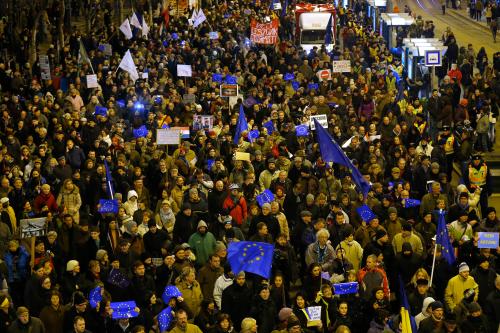
It isn’t just this administration, and may God be thanked for it.
 
It isn’t just this administration, and may God be thanked for it.
It amazes me that you think a policy of publicly alienating, insulting, berating and unceremoniously lambasting your main trading partner, including encouraging populist and separatist movements within it, is conducive to anyone’s interests.

Really, it’s just dumb, because it has the reflexive consequence of strengthening European attachment to our institutions when we feel them to be under “siege” from external forces and thus augmenting the “trade” agenda one so decries.

The EU is very unlikely to re-consider its trade policies, tariff regime or standards at the behest of a party that actively seeks to undermine and belittle it, whilst its population is unlikely to look quite so warmly upon such a partner. No change is going to come from that quarter.

Talk about counter-productiveness. If you want change, then your administration is going about it in exactly the wrong way.
 
Last edited:
Status
Not open for further replies.
Back
Top