You are exactly right - You are looking at forgiveness as restoration. It is not. Restoration can only occur by mutual forgiving.
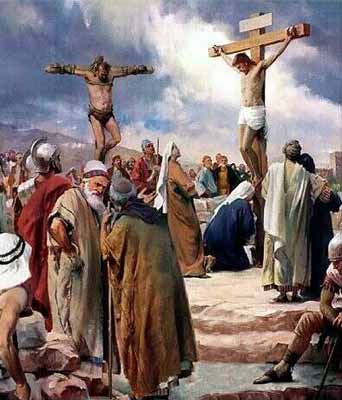
The best example I can think of is Christ on the Cross when He asked the Father to, “Forgive them for they no not what they do”. Was Christ’s forgiveness conditional on their acceptance?
We know that some, probably most, of those who Crucified Him did not repent, Do you think that Christ, or the Father, withdrew His forgiveness, or an offer of restoration because they failed to take advantage of it?
From “
Dictionary.com”, Forgive is thus defined:
- to grant pardon for or remission of (an offense, debt, etc.); absolve.
- to give up all claim on account of; remit (a debt, obligation, etc.).
- to grant pardon to (a person).
- to cease to feel resentment against: to forgive one’s enemies.
You will note in the above that action or inaction of another is not necessary for forgiveness. It does not matter what the other person does or does not do for me to forgive.
Peace
James
But please forgive me, James for being so rude as to ask another question of you before answering your question!

My answer is this: I believe you are correct that Christ was *not *asking His Father to forgive based on the condition of repentance. For a person to repent, he must first realize that what he has done is wrong. Jesus, from His words on the cross, indicate that the ones who should be forgiven in no way knew that what they were doing to Him was wrong, for He said:
“Father, forgive them, for they do not know what they are doing.”
(Luke 23:34)
They did not know what they were doing was wrong, so they would not know of their need to repent. They were soldiers executing who they believed to be a criminal and someone deserving of suffering and death for his crimes against the Empire. St. Paul appears to agree, for he wrote:
No, we speak of God’s secret wisdom, a wisdom that has been hidden and that God destined for our glory before time began. None of the rulers of this age understood it, for if they had, they would not have crucified the Lord of glory.
(1 Corinthians 2:7-8)
The question, then, is whether the forgiveness Christ asked the Father to grant was unconditional, or based on some condition. I believe it was based on some condition, that condition being ignorance. If a person is unaware of his sin, such lack of awareness may be grounds for forgiveness. Christ Himself teaches this, for He says in a conversation with His enemies:
Jesus said, “For judgment I have come into this world, so that the blind will see and those who see will become blind.”
Some Pharisees who were with him heard him say this and asked, “What? Are we blind too?”
Jesus said, “If you were blind, you would not be guilty of sin; but now that you claim you can see, your guilt remains.”
(John 9:39-41)
“If you were blind [to your sin], you would not be guilty,” Jesus told them. “But now that you claim you can see [the truth about your sin], your guilt remains.” Unlike the Roman guards who were ignorant of their sin, the Jewish religious authorities knew full well that God sent Jesus to be their Messiah. Thus, their guilt remained in rejecting Him and bringing about His suffering and death.
So, James, I would answer your question by saying this: Jesus’ word’s on the cross, “Father, forgive them, for they don’t know what they are doing [is wrong],” were intended for the Roman guards, but His words were not for the Jewish authorities who threatened the Roman governor Pilot to force him to give Jesus the death sentence. For these guilty men, the only hope of forgiveness would be to meet the requirement of repentance. However, as I mentioned, the forgiveness for the Roman executioners was not unconditional, either. It was based on the condition of being unaware of the existence and gravity of their own sin of crucifying the Lord of Glory.
So far, then, you and I have discovered that forgiveness (at least sometimes) is conditional, and based on a condition that the one forgiven must first meet. For sometimes the condition of repentance must be met, and other times the condition of ignorance must be met. But can you give me just one example of our Lord, or of one of His disciples, forgiving unconditionally?
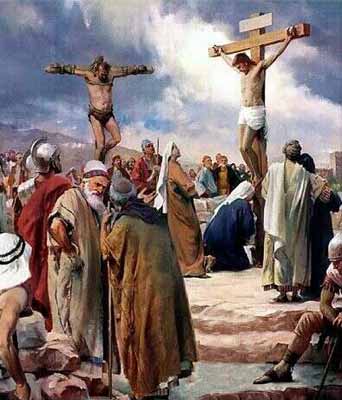 What conditions did those who were
responsible for Christ’s crucifixion
have to meet to be forgiven?