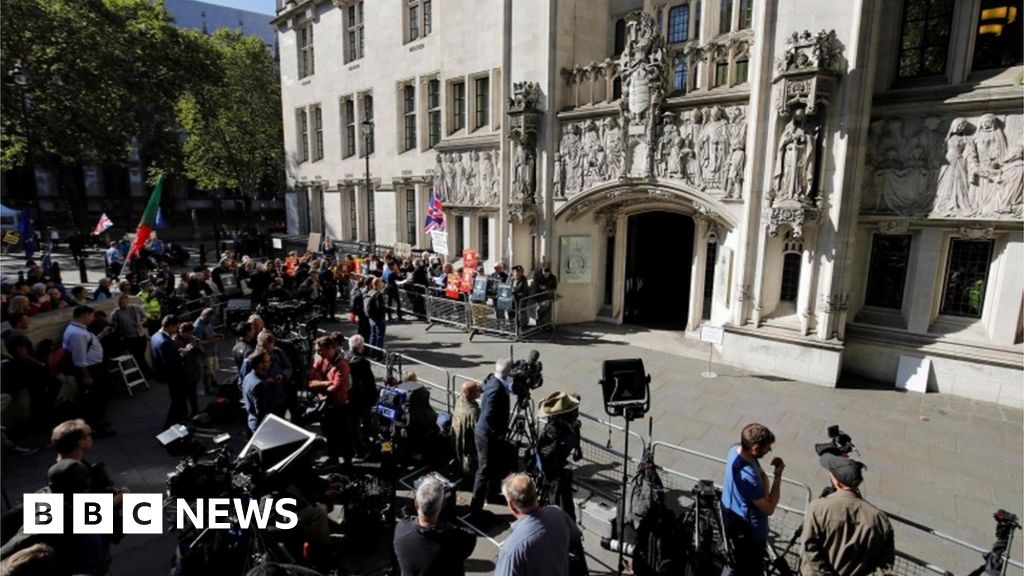
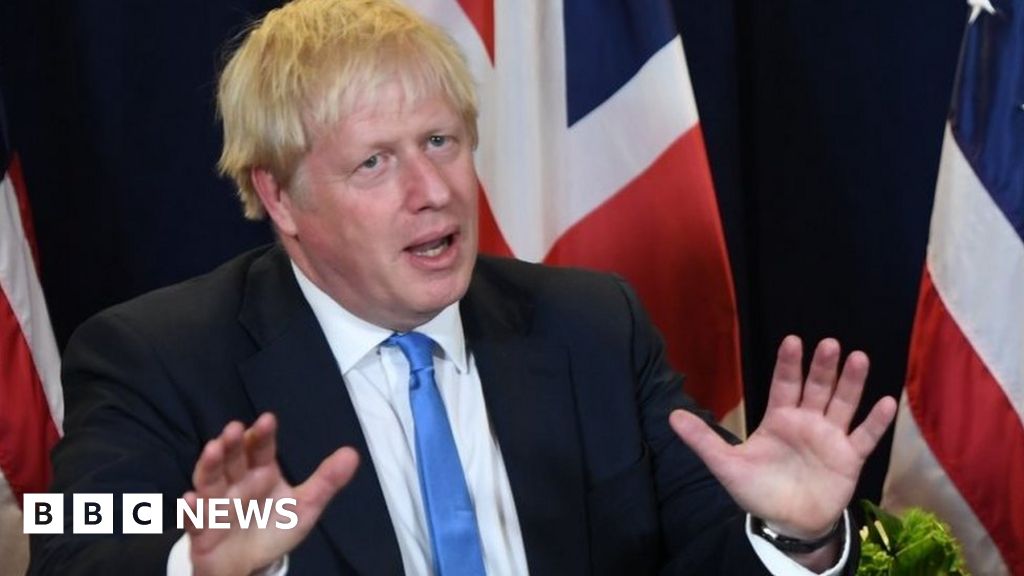
Supreme Court to give historic Parliament suspension ruling

Status
Not open for further replies.
So will they do their best to impeach him now?
 
Last edited:
The top judges in the UK have just confirmed that the prime minister openly misled the Queen, disobeyed the law & attempted to unlawfully shut down parliamentary democracy for five weeks to avoid scrutiny, declaring his acts null and void. Parliament was never legally prorogued, under law it is still sitting. That’s a constitutional earthquake.

And all eleven justices. Unanimous decision.

This is the UK constitution working as it should.
 
Last edited:
We’ve not impeached anyone for more than a hundred years. These days we get rid of prime ministers by a vote of no confidence. If these were anything like normal times established figures in the Conservative Party would be advising Mr Johnson to resign.

Very impressive unanimous judgement by the Supreme Court. No shilly-shallying, the prorogation was unlawful and therefore didn’t happen. In effect Parliament is still sitting and can get back to work immediately.
 
So will they do their best to impeach him now?
No Prime Minister in the UK has been impeached .

I don’t know whether a Prime Minister can be impeached .

Today’s judgement from the Supreme Court is unique .

No Prime Minister has been found before to have acted illegally on such an important matter .

We are in unchartered territory .

I would like to be a fly on the wall of Balmoral Castle .
 
To think, Johnson has only been in power for eight weeks.

Eight weeks.

And he very nearly dismantled the constitutional precedents that uphold our parliamentary democracy.
 
The top judges in the UK have just defined that the prime minister openly misled the Queen,
To be precise, that is the implication of the judgement. The court ruled that no satisfactory reason for the prorogation had been presented to the court.
No Prime Minister has been found before to have acted illegally on such an important matter .
Just to be picky, the prime minister’s action was unlawful rather than illegal, if you support the distinction. That is to say this was a civil, not a criminal, case.
 
To be precise, that is the implication of the judgement. The court ruled that no satisfactory reason for the prorogation had been presented to the court.
Ah yes, as I look at the judgment they didn’t look at motive (as in the Scots law court of Secession) but “effect”. Thanks!

No satisfactory reason was presented, so the decision to prorogue was unlawful, because it had the effect of preventing parliament from carrying out its proper constitutional function of holding the executive to account, without reasonable justification. Therefore, the PM’s counsel to the Queen has also been ruled “unlawful” (effectively a blank piece of paper, to quote Lady Hale in the judgment).

And so, by implication, Johnson misled the Queen because his expressed motive for requesting the prorogation (to hold a normal Queens speech) was not the case and this places him in political jeopardy in addition to unlawfulness as per the court decision.
 
Last edited:
The language used by the Supreme Court needs to be taken into account .

It is devastating for the UK Government .
 
Last edited:
The language used by the Supreme Court needs to be taken into account .

It is devastating for the UK Government .
Absolutely agree. A very forceful judgement. No itty-bitty technicalities, no “on the one hand, on the other”, just a firm condemnation of an unconstitutional action.
 
Looking over the judgment now, my favourite line is this one:

The effect on the fundamentals of our democracy was extreme. No justification has been put before the court.”

That’s what you call a whopper.

(unfortunately I missed the broadcast of this judgment live, how could I have missed watching live the most important judgment in, like, 300 years!?)
 
Last edited:
It’s interesting to me that while both the Court of Secession in Scotland and the Supreme Court of the UK both ruled (contrary to the English High Court ruling) that prorogation was justiciable and in this exceptional circumstance unlawful with the effect of styming parliament, a difference between the two legal systems in this case has been shown: Scots law took motive into account as part of its judgment (that Johnson had “improper purpose of stymieing parliament” contrary to what he told the Sovereign), whereas the UK constitutional law considered only the effect (to unlawfully shut down parliamentary democracy without reasonable justification).

The outcome is the same but the nuance here appears to signify a slightly distinct legal reasoning (if I’m looking at the two judgments rightly).

Still, the English High Court was clearly wrong in averring this was not justiciable, as the Supreme Court has now overruled and corrected.

So the (upheld) Scottish Court of Session ruling was that Boris Johnson misled (some say ‘lied to’) the Queen on his motive for shutting down parliament but the Supreme Court has avoided saying so itself by ruling on the effect of the prorogation but not the motive.

I’m a Scot, so I naturally still reason like a Scots lawyer. I must try and figure out why this distinction has emerged between our two judicial traditions 🧐
 
Last edited:
Status
Not open for further replies.
Back
Top