What did Jesus look like?

  • Thread starter Thread starter Niji
  • Start date Start date
Status
Not open for further replies.
Then why does Benedict XVI venerate it in Turin?

Bruce
Trickster
That really doesn’t tell us anything. After all, the pope’s veneration of a relic is not a dogmatic statement about its authenticity.
 
I know you lot aren’t the only ones who have said this out but I just wanted to repeat something another poster and I raised previously: there is no such thing as “Jewish” physiological features or traits.

Furthermore, keep in mind my point about superimposing modern racial concepts on the ancient world.
I quote from Martin Goodman’s Rome and Jerusalem: The Clash of Ancient Civilizations:

According to the Babylonian Talmud, it was a religious duty for all Jews, men as well as women, to wear special clothes on the Sabbath: “your Sabbath garments should not be like your weekday garments…” In general, however, expenditure on personal appearance was assumed by Jews to be a characteristic of women rather than men. Jewish clothing, apart from the uniforms of the priests and Levites, seems to have been the same as that of others in the eastern Mediterranean. It would be wrong to imagine the Jewish tallit as an identity marker similar to the distinctively Roman toga; tallit in Hebrew means simply “cloak” and the use of such a garment as a dedicated prayer shawl did not begin until after late antiquity. The biblical prohibition on wearing garments manufactured from wool and linen, stated simply as a general law in Deuteronomy, was explained by Josephus as a way to preserve the unique status of the priesthood: such raiment “is reserved for priests alone.” That priests did indeed wear clothes made from such materials is confirmed in the Mishnah. When the Pharisees chose to “make broad their phylacteries and enlarge the borders of their garments,” they did this in order “to be seen of men;” but such ostentation must have been unusual for it to be alleged that it attracted Jesus’ criticism, and it is probably significant that no gentile pagan source betrays any knowledge of this distinctive Jewish custom. The Jewish figures in the frescoes from the synagogue at Dura-Europus have fringes on the corners of some of their cloaks, but if this reflected standard male Jewish practice, the fringes must have generally been discreet. Jewish men did not specially cover their heads. The dress of Jewish women also seems to have been much the same as that of gentile contemporaries; the Christian Tertullian remarked in Carthage at the end of the second century CE that Jewish women could be recognized as Jews by the fact that they wore veils in public, but it seems likely that such veils, common in the eastern Mediterranean, marked them out less as specifically Jewish than as simply oriental in the Roman West, where women were generally unveiled. According to the Mishnah it was regarded as immodest and shaming for a woman to wear her hair loose. The Mishnah refers to types of jewellery that a woman should not carry on a Sabbath: “She may not go out…with forehead-band or head-bangles if they are not sewn, or with a hairnet…or a necklace or nose-rings…”

Too much pride by males in their long hair was dangerously immoral, as the story of Absalom showed: he gloried in his hair, so he was hanged by it. A few hairstyles were specially forbidden by the rabbis in the Tosefta on the grounds that they looked too gentile and therefore smacked of idolatry or magic: “What are the matters which constitute ‘the ways of the Amorites?’ He who trims the front of his hair, and he who makes his locks grow long, and he who makes a baldness in front for a particular star…” But these restrictions are the exception that prove the rule, that Jews generally looked like non-Jews. Romans often noted that foreign peoples looked different from themselves, but (apart from male circumcision) they never noticed this of the Jews. One passing remark by a Roman author does, however, suggest that some Romans thought Jews had a distinctive smell: the historian Ammianus Marcellinus recorded in the fourth century CE a comment of the philosopher Marcus Aurelius in the second century CE about the Jews as malodorous. This was not a standard form of abuse of other people in the Roman world. It may even have some basis in a real difference. If modesty requires more clothing, in a hot climate old sweaty clothes may become smelly. If everyone smells equally, no one notices, and the issue of body odour (except of tanners) fails to surface in the Jewish texts.
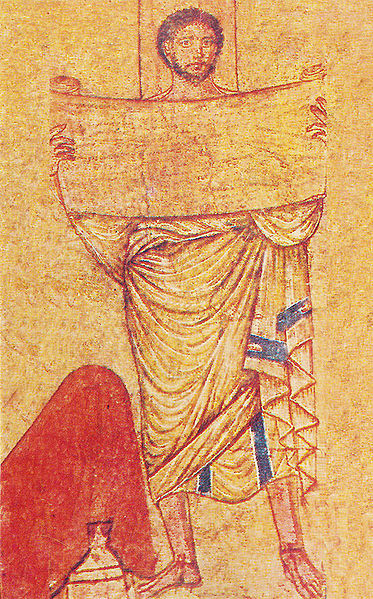

 
Just thought it was interesting that the only description of Jesus in the Bible has Him with white hair (Revelation 1:14 His head and hair were white like wool).

and

“Dr. Gilbert Lavoie in his Unlocking the Secrets of the Shroud presented another intriguing discovery. The negative image of the shroud as compared with the negative images of photography reveals that the man in question had either white or light blond hair.”

holyspiritinteractive.net/columns/williamsaunders/straightanswers/shroudofturin.asp

Just seems to match up.
Interesting to note that Caesar marveled at the oddity of the Celtic childrens’ hair. He remarked that their hair was 'white, like that of old men". Well, it wasn’t, of course. In my neck of the woods, a good half of children, perhaps more, have blonde hair when they’re young. (Scots-Irish, Irish, Germans, Poles) Just because that appeared ‘white" to Caesar who, presumably, was not used to seeing it, it doesn’t mean Jesus’ hair was really “white” let alone that He was albino.
 
See, I told you it was night, they wouldn’t have needed the lanterns and torches if it was daytime.
Well, duh. 😃
Even without the lanterns, it wouldn’t have been completely pitch-black dark, since the Passover season coincided with the full moon. Barring heavy cloud cover or bad weather, the moonlight would have been just bright enough.
 
Since no one recognized Him in His glorified Body, by either appearance or voice, until He revealed Himself to them, I will simply watch for His coming on the clouds of heaven.
 
Didn’t know that, do you mean that there was some way it was determined that there was a full moon during the Agony in the Garden?
Well, as I mentioned, it was the Passover season. Passover usually starts on the first full moon following the spring equinox.

Of course, this is supposing that (1) the moon is up in the sky during the night and that (2) there were not things like heavy cloud cover.
 
Well, as I mentioned, it was the Passover season. Passover usually starts on the first full moon following the spring equinox.

Of course, this is supposing that (1) the moon is up in the sky during the night and that (2) there were not things like heavy cloud cover.
Very interesting, this might make it possible to figure out the exact date of the Agony in the Garden.
 
Very interesting, this might make it possible to figure out the exact date of the Agony in the Garden.
Not really, no. If anything, we still don’t know the exact year when Jesus died. All we know was that it happened somewhere during the prefecture of Pontius Pilate (AD 26-36) and the high priesthood of Joseph Caiaphas (AD 18-36), which would give us the latest possible date of AD 36. Many scholars suggest a date between 29-33 based on the literary evidence, though a few would propose an earlier or later date.

The Jewish calendar, which was lunisolar, was based not on calculation as our modern calendar is today, but on observation. Since the months were reckoned strictly according to the phases of the moon (though the number of months were adjusted to bring the calendar into agreement with the solar year by inserting an extra ‘intercalary’ month every two or three years, otherwise the calendar would go out of wack), observers had to look for the first faintly glowing lunar crescent following conjunction with the sun - since after all you couldn’t really see a new moon. When ancient authorities fixed the date of Passover, they not only considered the visibility of the moon, but also the season as determined by temperature and the growth of crops: an extra month would have been intercalated if unseasonably cold temperatures meant that barley could not be offered during the festival.

If we calculate astronomically, the best candidate is April 3 (Nisan 14), AD 33, and indeed some people favor this date. But in fact, we cannot be sure that modern astronomical retrojection of the Jewish calendar agrees with the actual calculation of dates in the 1st century.
 
So Jesus was more or less an albino?? Why would Judas have had to specifically identify him if Jesus had been a freak of his time? “It’s the blonde guy, you KNOW, that guy!”

😉
The area had been invaded serially by a wide variety of people including the Caucasians and the Celts. There’s no reason to believe the Jews of Jesus’ time looked more like this guy

(Please Note: This uploaded content is no longer available.)

than like this guy:

http://media.thenewstribune.com/smedia/2011/12/23/22/49/1pEsyD.Hi.5.JPG
 
Not really, no. If anything, we still don’t know the exact year when Jesus died. All we know was that it happened somewhere during the prefecture of Pontius Pilate (AD 26-36) and the high priesthood of Joseph Caiaphas (AD 18-36), which would give us the latest possible date of AD 36. Many scholars suggest a date between 29-33 based on the literary evidence, though a few would propose an earlier or later date.

The Jewish calendar, which was lunisolar, was based not on calculation as our modern calendar is today, but on observation. Since the months were reckoned strictly according to the phases of the moon (though the number of months were adjusted to bring the calendar into agreement with the solar year by inserting an extra ‘intercalary’ month every two or three years, otherwise the calendar would go out of wack), observers had to look for the first faintly glowing lunar crescent following conjunction with the sun - since after all you couldn’t really see a new moon. When ancient authorities fixed the date of Passover, they not only considered the visibility of the moon, but also the season as determined by temperature and the growth of crops: an extra month would have been intercalated if unseasonably cold temperatures meant that barley could not be offered during the festival.

If we calculate astronomically, the best candidate is April 3 (Nisan 14), AD 33, and indeed some people favor this date. But in fact, we cannot be sure that modern astronomical retrojection of the Jewish calendar agrees with the actual calculation of dates in the 1st century.
Thanks, that was very informative.
 
The Bible Clearly says exactly what jesus looked like in Reveltations

Revelation 1:9

1 The Revelation of Jesus Christ, which God gave unto him, to shew unto his servants things which must shortly come to pass; and he sent and signified it by his angel unto his servant John:

2 Who bare record of the word of God, and of the testimony of Jesus Christ, and of all things that he saw.

Now we go down to verse 13-20

13 And in the midst of the seven candlesticks one like unto the Son of man, clothed with a garment down to the foot, and girt about the paps with a golden girdle.

14 His head and his hairs were white like wool, as white as snow; and his eyes were as a flame of fire;

15 And his feet like unto fine brass, as if they burned in a furnace; and his voice as the sound of many waters.

16 And he had in his right hand seven stars: and out of his mouth went a sharp twoedged sword: and his countenance was as the sun shineth in his strength.

17 And when I saw him, I fell at his feet as dead. And he laid his right hand upon me, saying unto me, Fear not; I am the first and the last:

18 I am he that liveth, and was dead; and, behold, I am alive for evermore, Amen; and have the keys of hell and of death.

19 Write the things which thou hast seen, and the things which are, and the things which shall be hereafter;

20 The mystery of the seven stars which thou sawest in my right hand, and the seven golden candlesticks. The seven stars are the angels of the seven churches: and the seven candlesticks which thou sawest are the seven churches.

Conclusion:
Jesus was a black man with white wooly hair. There is only one race with Wooly hair and that is so called African Americans. The true Israelites sent here on slave ships and scattered across the world.
 
The Bible Clearly says exactly what jesus looked like in Reveltations

Revelation 1:9

1 The Revelation of Jesus Christ, which God gave unto him, to shew unto his servants things which must shortly come to pass; and he sent and signified it by his angel unto his servant John:

2 Who bare record of the word of God, and of the testimony of Jesus Christ, and of all things that he saw.

Now we go down to verse 13-20

13 And in the midst of the seven candlesticks one like unto the Son of man, clothed with a garment down to the foot, and girt about the paps with a golden girdle.

14 His head and his hairs were white like wool, as white as snow; and his eyes were as a flame of fire;

15 And his feet like unto fine brass, as if they burned in a furnace; and his voice as the sound of many waters.

16 And he had in his right hand seven stars: and out of his mouth went a sharp twoedged sword: and his countenance was as the sun shineth in his strength.

17 And when I saw him, I fell at his feet as dead. And he laid his right hand upon me, saying unto me, Fear not; I am the first and the last:

18 I am he that liveth, and was dead; and, behold, I am alive for evermore, Amen; and have the keys of hell and of death.

19 Write the things which thou hast seen, and the things which are, and the things which shall be hereafter;

20 The mystery of the seven stars which thou sawest in my right hand, and the seven golden candlesticks. The seven stars are the angels of the seven churches: and the seven candlesticks which thou sawest are the seven churches.

Conclusion:
Jesus was a black man with white wooly hair. There is only one race with Wooly hair and that is so called African Americans. The true Israelites sent here on slave ships and scattered across the world.
yeah, but what about those flaming eyes and brass feet?
 
Jesus Drank Wine.

And his feet like unto fine brass, as if they burned in a furnace; and his voice as the sound of many waters.

His feet were the color of burnt brass. If you put anything in a furnace it turns black.
 
The Book of Revelations is the revealing of the so called Jesus Christ who’s real name is Yahawashi.

Revelations means to reveal. All the answers are in the bible, don’t rely on hoax’s and false prophets.
 
The Book of Revelations is the revealing of the so called Jesus Christ who’s real name is Yahawashi.

Revelations means to reveal. All the answers are in the bible, don’t rely on hoax’s and false prophets.
Where in the Bible does it say that Jesus’s real name was Yahawashi?

Revelation is a very symbolic book, so there is a lot of imagery in it that is rather dreamlike.

Jesus is God, so he has many many faces.
 
Status
Not open for further replies.
Back
Top