Woman on the altar

  • Thread starter Thread starter Woman1987
  • Start date Start date
Status
Not open for further replies.
You have got to be kidding me!

The alter is not a place for priests deacons and alter boys, it is a place for Jesus! We all go to mass to worship Jesus. The priest is not somehow so special that he is more worthy to stand on the alter than a woman! The miracle that occurs in mass does not occur because the priest wills it to be so, it occurs because Jesus wills it to be so!

We are Catholics, we venerate Mary as the best human that ever lived outside Jesus himself. She was there at the foot of the cross as Jesus died, she fed and cleaned him as he grew up. How do you guys come to the conclusion that somehow women are less worthy to be on that alter with Jesus, When Jesus himself has told us to venerate his mother so highly?
i think this is from the jewish understanding of the alter which was for the priest and ministers alone.
 
Is it actually in the rubrics of the OF that a layman must do these readings? Is it a stated norm that has to be followed?
Likewise, are EMHCs mandatory? I don’t think they are. They really detract from an atmosphere of sanctity.
The rubrics say that anyone can do the reading, preferably one who has been installed as lector. In Canon Law, the ministry of lector is a lay ministry. Obviously, if no one else steps up to do the reading, one of the clerics has to do it.

The Gospel is a whole other matter. The Gospel must be read by the deacon, if there is one present or the priest. Only an ordained minister can read the Gospel.

The only time that I have ever seen a layman read the Gospel is for a legally blind priest whom I know. I don’t think that Father reads Braille. He lost his sight gradually as a result of diabetes. Most people who read Braille are visually impaired since childhood or born that way. But he has the rest of the mass memorized…

If you read what I posted, the law says, “may” use EMHC. The law gives the presider the authority to make that judgment call. That’s in Canon Law.

Fraternally,

Br. JR, OSF 🙂
 
Which reading was she doing? Anyone can read either of the first two readings. The priest is not supposed to read them.

Distributing Holy Communion is not a priest’s role. In the Latin Church the canon is very clear that the Ordinary Ministers of Holy Communion are the deacon, priest and bishop. We have a hangup with it having to be a priest who distributes Holy Communion and forget what the canon says.

There is another canon that says that when the numbers of communicants are high enough to cause the mass to be extended, the presider may make use of EMHC.

What would be wrong would be if there are ordained men on the altar and the EMHC distributes while the deacon sits it out.

Fraternally,

Br. JR, OSF 🙂
wow! I thought the distribution of the eucharist is primarily for the clergy (i mean deacons and priests) and the emhc are extraordinary i.e products of circumstance, im i reading the wrong document? Beside i have attended masses where healthy priests are sitted and the laymen are distributing communion, prompting the bishop to ban every extraordinary activities and other diocese were extraordinary minister are used even when we have 2 communicants.
Ubenedictus
 
i think this is from the jewish understanding of the alter which was for the priest and ministers alone.
It’s still in Jewish law. Only the Rabbi and cantors can enter the sanctuary of the temple. The laity are allowed to go up to do a reading and return to their seats immediately. That’s how I grew up.

Fraternally,

Br. JR, OSF 🙂
 
wow! I thought the distribution of the eucharist is primarily for the clergy (i mean deacons and priests) and the emhc are extraordinary i.e products of circumstance, im i reading the wrong document? Beside i have attended masses where healthy priests are sitted and the laymen are distributing communion, prompting the bishop to ban every extraordinary activities and other diocese were extraordinary minister are used even when we have 2 communicants.
Ubenedictus
That’s what I said. The ordinary ministers of Holy Communion are the deacon, priest or bishop. The EMHC MAY be used, if necessary to avoid prolonging the mass. It’s a judgment call that is made at the parish level.

What is not allowed is for a cleric to sit it out unless there is a legitimate reason. Let’s say that his arthritis is flaring up. That would be a legitimate reason to sit it out and let the EMHC distribute. But those are exceptions.

What I was trying to address is the hangup that people have that ONLY the priest may distribute Holy Communion. That’s not true. The deacon is also an ordinary minister of Holy Communion.

It never ceases to amaze me that we have had permanent deacons in the Latin Church for more than 30 years and people are still saying that only priests should distribute Holy Communion.

Fraternally,

Br.JR, OSF 🙂
 
Whoah! If the sacristan is not a deacon, the law prohibits that he open the tabernacle or move the Blessed Sacrament at all. Opening and closing the tabernacle is reserved for the ordained.

In the case of necessity where an EMHC has to take the Eucharist to the sick, the pastor can grant him or her permission to open the tabernacle and get a consecrated host; but this may never be a matter of routine. Hence the term Extraordinary.

The Sacristan is the keeper of the sacristy (the sacred vessels and books).

Even in religious houses of men, the ordained brothers open and close the tabernacle. The other brothers may only do so to take communion to the sick. That’s not a daily situation.

This has nothing to do with gender. It has to do with identity. The identity of the deacon, priest and bishop carries with it certain duties and rights.

Fraternally,

Br. JR, OSF 🙂
Whoa is right. I was not aware of this.

-Tim-
 
That’s what I said. The ordinary ministers of Holy Communion are the deacon, priest or bishop. The EMHC MAY be used, if necessary to avoid prolonging the mass. It’s a judgment call that is made at the parish level.

What is not allowed is for a cleric to sit it out unless there is a legitimate reason. Let’s say that his arthritis is flaring up. That would be a legitimate reason to sit it out and let the EMHC distribute. But those are exceptions.

What I was trying to address is the hangup that people have that ONLY the priest may distribute Holy Communion. That’s not true. The deacon is also an ordinary minister of Holy Communion.

It never ceases to amaze me that we have had permanent deacons in the Latin Church for more than 30 years and people are still saying that only priests should distribute Holy Communion.

Fraternally,

Br.JR, OSF 🙂
That is a very helpful explanation. 🙂
 
i think this is from the jewish understanding of the alter which was for the priest and ministers alone.
It’s become a Catholic understanding of the altar as well, since Melchisedech, Abraham, and Abel are all mentioned in the Canon (or EP1).
 
Do those who object to the role of women in the liturgy extend that same objection to functions in and around the sanctuary and the priest outside of the ligurgy, specifically to the duties of sacristan?

I don’t see too many male sacristans, setting up the Roman Missal and Lectionary, lighting candles and replacing them as needed, filling the ciboria with hosts.

I think it is one of the most sacred liturgical ministries outside of the prieshood. The reason I say this is because the sacristan often has to open the tabernacle and look inside the ciboria to see how many hosts are consecrated. Sacristans also have to move Jesus from the tabernacle in the main Church to the chapel and have to handle the sacred vessels. Sure, it is outside of Mass, but I tremble sometimes when I have to go into the tabernacle.

Just curious, that’s all, as to how many men would feel comfortable setting up for mass and cleaning up afterward, dusting and cleaning up there if the Church suddenly said that females were not to enter the sanctuary ever.

-Tim-
Hi Tim,

In extrodinary form parishes NO ONE who did not have consecrated hands would EVER be allowed to touch the sacred species. The ONLY exception I have EVER seen is with acolytes and they must put on white gloves to handle even the chalices or ciboria.

The function of lighting the candles and making the church ready was traditionally the function of the porter, one of the minor orders. You will not see a real porter outside of an Extrodinary form community due to the minor orders being given to the laity. In my extrordinary form parish only the Altar servers (we have one ordained acolyte) light the candles. They do so before Mass, along with removing the protective linen on top of the three linens. (Not all church’s do this). The servers then place the missal with stand on the epistle side of the altar, prepare the credence table, put the hand missal on the ambo with page marker/bookmark on the correct page for the day.

Depending on the day there may be more or less to do. I.E. Requiem Mass they would put out the six candlesticks for the the casket and replace the candles with pure beeswax, replace any colored clothes on the antipendium with black (if an antipendium cloth is used), etc.

You see servers in the traditional Mass do a lot more than in the N.O. It is also one of the reasons, I believe, why we have so many servers. There is so much for them to do, at least at a High Mass. Solemn High Mass so of these duties are properly done by the sub-deacon and deacon.

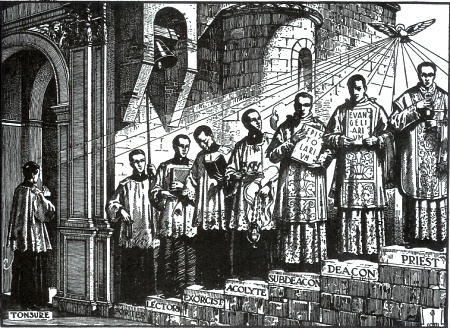
A scaristan is traditionally a male in the seminary who would preform these duties. Since the reforms of Vatican II and the elimination of minor orders, many of which were given in the home parish, has seen these duties transferred to the laity. It is an unfortunate change. It no longer allows the community to actively see and support those young men who are just begining their discernment. We are now relegated to pictures on a poster of the seminarians for the diocese.
 
…Since the reforms of Vatican II and the elimination of minor orders, many of which were given in the home parish, has seen these duties transferred to the laity. It is an unfortunate change. It no longer allows the community to actively see and support those young men who are just begining their discernment. We are now relegated to pictures on a poster of the seminarians for the diocese.
I am asking because I don’t know and I vaquely remember time before Vatican II. Was there something in Vatican II that said to do away with minor orders or did it just kind of happen along with all of the other falling away of religious orders?
 
My concern is how it looks. If it’s a sacred rite, having women in day clothes up there reading from the pulpit strikes a wrong note. I think Catholics confuse ‘may’ with ‘mandatory’: you must have lay people up there.

They take the legalist view: we can do it if it’s not forbidden. They take the view of the constant exception: if it can be done anywhere, we can do it all the time. They should think instead: ‘How can we glorify God, to the best of our ability?’

Making the Mass look like a recital is definitely not the way.

There’s also the factor of manic chasing after popular taste that occurred after the 60’s: we must get lay people involved or they might apostasise. I don’t think that’s effective.

Lay lectors, especially women and EMHCs just look ‘off’ and can look comical. What are they doing the the priest can’t do? They don’t use them at all in the TLM and there are no complaints.
 
In extrodinary form parishes NO ONE who did not have consecrated hands would EVER be allowed to touch the sacred species. The ONLY exception I have EVER seen is with acolytes and they must put on white gloves to handle even the chalices or ciboria.
So that would mean in EF parishes Deacons, who happen to be Ordinary Ministers of Communion, can’t even distribute the Eucharist?

(Although to be fair, I’ve seen some websites say “the Deacon is only the Ordinary Minister of the Chalice!!”, but these are from the “OF is not valid” crowd).
 
So that would mean in EF parishes Deacons, who happen to be Ordinary Ministers of Communion, can’t even distribute the Eucharist?
They are used in EF Masses and they use the pre-1964 formula. The all-EF parishes probably don’t have too many permanent deacons, however.
 
They are used in EF Masses and they use the pre-1964 formula. The all-EF parishes probably don’t have too many permanent deacons, however.
Permanent, no. Transitional though ? Most likely.

The fellow above was pretty adamant about “CONSECRATED HANDS REQUIRED” across the board in EF parishes, so I wanted to verify that was or wasn’t the case.
 
Permanent, no. Transitional though ? Most likely.

The fellow above was pretty adamant about “CONSECRATED HANDS REQUIRED” across the board in EF parishes, so I wanted to verify that was or wasn’t the case.
Most deacons would hold the paton during communion. The sub-deacon would stand with folded hands opposite the deacon (other side of the priest.) They can also distribute communion as well (They are a major order, but they would be considered extraordinary ministers). Sub-deacons and on very rare occasions Acolytes were also Extraodinary miniters.

In practical terms today in MOST EF parishes, especially those exclusive EF, deacons do not distribute communion unless there are huge crowds (I would estimate more than 500 people). A deacon has no role a low Mass other than as subbing for an Acolyte.

There were essentially NO permenant deacons before Vatican II. All were in transition to the priesthood so a permanent role for a deacon was not something that was envisioned.
 
I am asking because I don’t know and I vaquely remember time before Vatican II. Was there something in Vatican II that said to do away with minor orders or did it just kind of happen along with all of the other falling away of religious orders?
Hi Tim,

In extrodinary form parishes NO ONE who did not have consecrated hands would EVER be allowed to touch the sacred species. The ONLY exception I have EVER seen is with acolytes and they must put on white gloves to handle even the chalices or ciboria.
That’s because it’s their custom, not because it has ever been the law. The deacon has always been allowed to touch the host. Deacons do not have consecrated hands. This is why Thomas Aquinas’ proposal was never adopted as doctrine. Aquinas wrote in “consecrated hands”. In the Universal Church, East and West, the deacon does not have consecrated hands, but he is a cleric and can touch the host.

We can’t confuse custom with law.

Fraternally,

Br. JR, OSF 🙂
 
I am asking because I don’t know and I vaquely remember time before Vatican II. Was there something in Vatican II that said to do away with minor orders or did it just kind of happen along with all of the other falling away of religious orders?
The change was not a result of Vatican II. Religious orders of men never called them minor orders. The reason being that it would make everyone a cleric. In some religious orders, it is forbidden to have a surplus of clerics. They were instituted, instead of ordained, as ministries.

Bl. John Paul borrowed the custom from the religious men and wrote it into Canon Law in 1983, abrogating all of the minor orders and leaving acolyte and lector as lay ministries, to conform to the religious. His idea was to make the system the same for the entire Latin Church.

There was the confusion between dioceses ordaining secular men to minor orders and religious instituting consecrated men to lay ministries, but all were the same. It was a step to make uniform.

The ED communities are allowed to use the ordination rite for minor orders. No one else is allowed to do so.

Fraternally,

Br. JR, OSF 🙂
 
The change was not a result of Vatican II. Religious orders of men never called them minor orders. The reason being that it would make everyone a cleric. In some religious orders, it is forbidden to have a surplus of clerics. They were instituted, instead of ordained, as ministries.

Bl. John Paul borrowed the custom from the religious men and wrote it into Canon Law in 1983, abrogating all of the minor orders and leaving acolyte and lector as lay ministries, to conform to the religious. His idea was to make the system the same for the entire Latin Church.

There was the confusion between dioceses ordaining secular men to minor orders and religious instituting consecrated men to lay ministries, but all were the same. It was a step to make uniform.

The ED communities are allowed to use the ordination rite for minor orders. No one else is allowed to do so.

Fraternally,

Br. JR, OSF 🙂
The last statement is not entirely true. There are Bishops, who are not connected with an ED community, who have used the 1962 books to ordain Sub-deacons and up. The minor orders though were instituted as you say. It is such a shame that they were given over to the laity. It was a great loss to young men who were discerning the priesthood.

This picture has always captivated me, even as a young boy:
 
Status
Not open for further replies.
Back
Top