How to test the truth of a religion

  • Thread starter Thread starter hamba2han
  • Start date Start date
Status
Not open for further replies.
The Qur’an is NOT “inspired” by God… It is instead the literal Word of God and His Final Revelation to humankind.
Hmm … See, here’s sort of our deal on that:

To say that every word in Scripture is the very Word of God would suggest something quite absurd (or at least by my reasoning). By saying that this is so, it would be perfectly acceptable to take the Qur’an and rearrange all it’s words into any order, because since each word itself is divine, the order wouldn’t matter. Now, literally in the Greek text (speaking of which, you are familiar with the Qur’an in the original Arabic, no? Moslems like yourself were part of our [my discipleship teacher and I, that is] ispiration to memorize the New Testament in English and in the original Greek, though my Greek is still rusty, I admit) the phrase used translates literally as “God-breathed.” We have translated it as “inspired” because this term seems to carry the correct denotation of the original texts. The difference in our views of Scripture I think is this:

We uphold that the divine influence isn’t to be found in the individual words (though word-choice is infinitely important, mind you), but rather, it lies in the arrangement of the words, which reveals to us the Divine Will in a way that the words themselves otherwise could not … This seems to me what Paul was trying to get across to Timothy in his letter (where this is to be foud).
 
I just want to know why I should accept Mohamed as God’s prophet. Has God so much as even prepared us for Mohamed’s coming, and the arrival of the “third testament” (so to speak), the Qu’ran? I don’t know of any prophecy contained in Jewish and Christian Holy Writ pertaining to such things.

Though I’m sure you’re tired out having responded to everyone here a great deal, I’d very much like to read what you or someone you respect has to say about this. You may link me to one of your previous posts if you’d like.

Salaam.

In the name of G-d who is Trinity,
tony
 
It’s starting to sound like the same discussion we have with Protestants about the bible interpretation.

Who’s interpretation of the Quran should one use to give it the test of truth?
 
I just want to know why I should accept Mohamed as God’s prophet. Has God so much as even prepared us for Mohamed’s coming, and the arrival of the “third testament” (so to speak), the Qu’ran? I don’t know of any prophecy contained in Jewish and Christian Holy Writ pertaining to such things.

Though I’m sure you’re tired out having responded to everyone here a great deal, I’d very much like to read what you or someone you respect has to say about this. You may link me to one of your previous posts if you’d like.

Salaam.

In the name of G-d who is Trinity,
tony
On the contrary, there are indeed numerous prophecies to be found in both the Old and New Testaments that foretells the coming of Prophet Muhammad (pbuh).

These two links should provide a better understanding of these Biblical prophecies

The first article is a brief overview of some of these prophecies.

The second link offers a more detailed and comprehensive explanation of all the Biblical prophecies foretelling the coming of the awaited Last Prophet i.e. “the Himda (Ahmed) of all nations”.

"Certainly, you will find the strongest among men in enmity to the believers (Muslims) the Jews and those who are Pagans, and you will find the nearest in love to the Believers (Muslims) those who say: “We are Christians.” That is because amongst them are priests (Men devoted to learning) and monks (men who have renounced the world), and because they do not behave proudly. And when they listen to what has been sent down to the Messenger (Muhammad), you see their eyes overflowing with tears, for they recognize the truth. They say: “Our Lord! We believe; so write us down among the witnesses. And why should we not believe in Allah and in that which has come to us of the truth (Islamic Monotheism) and we wish that our Lord will admit us (in Paradise on the Day of Resurrection) along with the righteous people?” So because of what they said, Allah rewarded them Gardens under which rivers flow (in Paradise), they will abide therein forever. Such is the reward of good-doers. But those who disbelieved and denied Our signs, they shall be the dwellers of the Hell-Fire."… (Holy Qur’an 5:82-86)
 
I think with all these threads about muslims and christianity we can agree on one thing.
Muslims and Christians will never agree.
This argument can take forever.
I think we should just let it take its course and end it.
Ive asked several ants on their opinion, they agree… :rolleyes:
 
Who’s interpretation of the Quran should one use to give it the test of truth?
In Islam, there is only one interpretation of the Qur’an that is acceptable i.e that of the Prophet Muhammad (pbuh).

Think of the Qur’an as the map to guide us in our journey through life in order for us to safely reach our intended destination in the Hereafter and think of the Sunnah of the Prophet Muhammad (pbuh) as the legend by which to correctly read this map.
**
“I leave behind me two things, the Qur’an and my example, the Sunnah, and if you follow these you will never go astray”. **… the Prophet (peace and blessings be upon him) reminded the faithful of this in the sermon that he delivered on the 9 Dhul-Hijjah 10 a.h. in the valley of Mount `Arafat, during his final Hajj, known as the Farewell Hajj.
 
I think with all these threads about muslims and christianity we can agree on one thing.
Muslims and Christians will never agree.
This argument can take forever.
I think we should just let it take its course and end it.
Ive asked several ants on their opinion, they agree… :rolleyes:
👍 :rotfl:
 
In Islam, there is only one interpretation of the Qur’an that is acceptable i.e that of the Prophet Muhammad (pbuh)
err, ham, I hate to be the bringer of bad news but the man who called himself “Muhammad” isn’t with us now. Do you intend to hold a seance to find out his interpretation?
 
How mulsims have viewed and interpeted QU’ran had changed and continues to change over time.
 
It’s starting to sound like the same discussion we have with Protestants about the bible interpretation.

Who’s interpretation of the Quran should one use to give it the test of truth?
I forgot to add that in the whole world, there is only one version of the Qur’an that is available for testing it’s truth… and that is the word for word and syllable for syllable exact copy of the original Qur’an that was authenticated by the Prophet Muhammad (pbuh) himself shortly before his demise and which has remained 100% pure and free from any additions or revisions since.
 
well we know that’s not true, ham
just spouting Muslim propaganda that runs contrary in some cases to known historical fact is getting a bit tedious
 
The Qur’an on Human Embryonic Development:

In the Holy Qur’an, God speaks about the stages of man’s embryonic development:

We created man from an extract of clay. Then We made him as a drop in a place of settlement, firmly fixed. Then We made the drop into an alaqah (leech, suspended thing, and blood clot), then We made the alaqah into a mudghah (chewed substance)… (Qur’an, 23:12-14)

Literally, the Arabic word alaqah has three meanings: (1) leech, (2) suspended thing, and (3) blood clot.

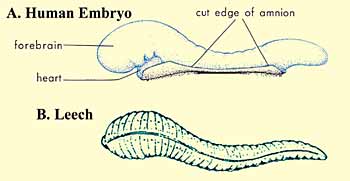
In comparing a leech to an embryo in the alaqah stage, we find similarity between the two as we can see in figure 1. Also, the embryo at this stage obtains nourishment from the blood of the mother, similar to the leech, which feeds on the blood of others.
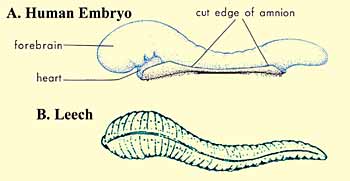

Figure 1: Drawings illustrating the similarities in appearance between a leech and a human embryo at the alaqah stage. (Leech drawing from Human Development as Described in the Quran and Sunnah, Moore and others, p. 37, modified from Integrated Principles of Zoology, Hickman and others. Embryo drawing from The Developing Human, Moore and Persaud, 5th ed., p. 73.)

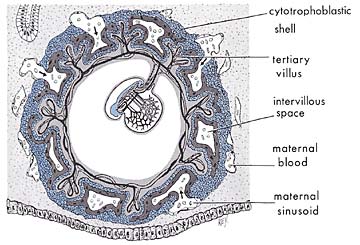
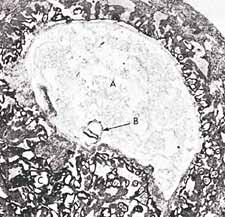
The second meaning of the word alaqah is “suspended thing.” This is what we can see in figures 2 and 3, the suspension of the embryo, during the alaqah stage, in the womb of the mother.


Figure 2: We can see in this diagram the suspension of an embryo during the alaqah stage in the womb (uterus) of the mother. (The Developing Human, Moore and Persaud, 5th ed., p. 66.)


Figure 3: In this photomicrograph, we can see the suspension of an embryo (marked B) during the alaqah stage (about 15 days old) in the womb of the mother. The actual size of the embryo is about 0.6 mm. (The Developing Human, Moore, 3rd ed., p. 66, from Histology, Leeson and Leeson.)

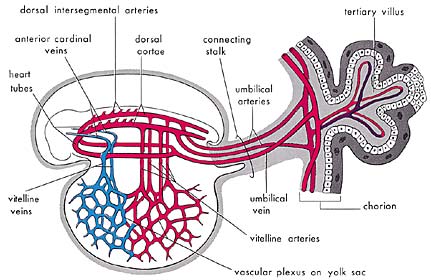
The third meaning of the word alaqah is “blood clot.” We find that the external appearance of the embryo and its sacs during the alaqah stage is similar to that of a blood clot. This is due to the presence of relatively large amounts of blood present in the embryo during this stage (see figure 4). Also during this stage, the blood in the embryo does not circulate until the end of the third week. Thus, the embryo at this stage is like a clot of blood.


Figure 4: Diagram of the primitive cardiovascular system in an embryo during the alaqah stage. The external appearance of the embryo and its sacs is similar to that of a blood clot, due to the presence of relatively large amounts of blood present in the embryo. (The Developing Human, Moore, 5th ed., p. 65.)

So the three meanings of the word alaqah correspond accurately to the descriptions of the embryo at the alaqah stage.

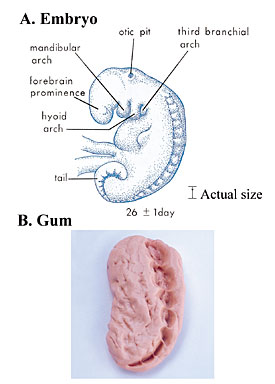
The next stage mentioned in the verse is the mudghah stage. The Arabic word mudghah means “chewed substance.” If one were to take a piece of gum and chew it in his or her mouth and then compare it with an embryo at the mudghah stage, we would conclude that the embryo at the mudghah stage acquires the appearance of a chewed substance. This is because of the somites at the back of the embryo that “somewhat resemble teethmarks in a chewed substance.” (see figures 5 and 6).


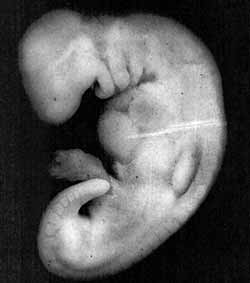
Figure 5: Photograph of an embryo at the mudghah stage (28 days old). The embryo at this stage acquires the appearance of a chewed substance, because the somites at the back of the embryo somewhat resemble teeth marks in a chewed substance. The actual size of the embryo is 4 mm. (The Developing Human, Moore and Persaud, 5th ed., p. 82, from Professor Hideo Nishimura, Kyoto University, Kyoto, Japan.)

To be continued…

 
… cont:


Figure 6: When comparing the appearance of an embryo at the mudghah stage with a piece of gum that has been chewed, we find similarity between the two.
A) Drawing of an embryo at the mudghah stage. We can see here the somites at the back of the embryo that look like teeth marks. (The Developing Human, Moore and Persaud, 5th ed., p. 79.)
B) Photograph of a piece of gum that has been chewed.

How could Muhammad (pbuh) have possibly known all this 1400 years ago, when scientists have only recently discovered this using advanced equipment and powerful microscopes which did not exist at that time? Hamm and Leeuwenhoek were the first scientists to observe human sperm cells (spermatozoa) using an improved microscope in 1677 (more than 1000 years after Muhammad (pbuh)). They mistakenly thought that the sperm cell contained a miniature preformed human being that grew when it was deposited in the female genital tract.

Professor Emeritus Keith L. Moore is one of the world’s most prominent scientists in the fields of anatomy and embryology and is the author of the book entitled The Developing Human, which has been translated into eight languages. This book is a scientific reference work and was chosen by a special committee in the United States as the best book authored by one person. Dr. Keith Moore is Professor Emeritus of Anatomy and Cell Biology at the University of Toronto, Toronto, Canada. There, he was Associate Dean of Basic Sciences at the Faculty of Medicine and for 8 years was the Chairman of the Department of Anatomy. In 1984, he received the most distinguished award presented in the field of anatomy in Canada, the J.C.B. Grant Award from the Canadian Association of Anatomists. He has directed many international associations, such as the Canadian and American Association of Anatomists and the Council of the Union of Biological Sciences.

In 1981, during the Seventh Medical Conference in Dammam, Saudi Arabia, Professor Moore said: “It has been a great pleasure for me to help clarify statements in the Qur’an about human development. It is clear to me that these statements must have come to Muhammad from God, because almost all of this knowledge was not discovered until many centuries later. This proves to me that Muhammad must have been a messenger of God.”

Consequently, Professor Moore was asked the following question: “Does this mean that you believe that the Qur’an is the word of God?” He replied: “I find no difficulty in accepting this.”

During one conference, Professor Moore stated: “…Because the staging of human embryos is complex, owing to the continuous process of change during development, it is proposed that a new system of classification could be developed using the terms mentioned in the Qur’an and Sunnah (what Muhammad said, did, or approved of). The proposed system is simple, comprehensive, and conforms with present embryological knowledge. The intensive studies of the Qur’an and hadeeth (reliably transmitted reports by the Prophet Muhammad’s companions of what he said, did, or approved of) in the last four years have revealed a system for classifying human embryos that is amazing since it was recorded in the seventh century A.D. Although Aristotle, the founder of the science of embryology, realized that chick embryos developed in stages from his studies of hen’s eggs in the fourth century B.C., he did not give any details about these stages. As far as it is known from the history of embryology, little was known about the staging and classification of human embryos until the twentieth century. For this reason, the descriptions of the human embryo in the Qur’an cannot be based on scientific knowledge in the seventh century. The only reasonable conclusion is: these descriptions were revealed to Muhammad from God. He could not have known such details because he was an illiterate man with absolutely no scientific training.”
 
ask any (non-Muslim) doctor whether the embryology in the Koran is correct - and I know what answer you’ll get
this topic has been debated on a doctor’s website I frequent called DNUK and the overwhelming reaction was “codswallop”!
Moore of course got plenty of money for his book on Muslim embryology - not used by non-Muslims of course
Moore for all his petrodollar-induced praise did not however become a Muslim - which tells us that the phenomenon is not that explicable
 
The Qur’an on Human Embryonic Development:

In the Holy Quran, God speaks about the stages of man’s embryonic development:

We created man from an extract of clay.
Who is “we”? And what scientific evidence is there for creating man out of clay?
 
ask any (non-Muslim) doctor whether the embryology in the Koran is correct - and I know what answer you’ll get
this topic has been debated on a doctor’s website I frequent called DNUK and the overwhelming reaction was “codswallop”!
Moore of course got plenty of money for his book on Muslim embryology - not used by non-Muslims of course
Moore for all his petrodollar-induced praise did not however become a Muslim - which tells us that the phenomenon is not that explicable
inexplicable I mean!
 
CREATION FROM CLAY

In the Qur’an, Allah reveals that the creation of the human is a miracle. The first human being was created by Allah shaping clay into human form and breathing a soul into it:
Code:
**Your Lord said to the angels, "I am going to create a human being out of clay. When I have formed him and breathed My Spirit into him, fall down in prostration to him!"** (Qur'an, 38:71-72)

**Then inquire of them: Is it they who are stronger in structure or other things We have created? We created them from sticky clay.** (Qur'an, 37:11)
When the human body is examined today, it may be discovered that many elements present on the earth are also to be found in the body. Living tissues contain 95% carbon, hydrogen, oxygen, nitrogen, phosphorus and sulphur, with a total of 26 different elements. In another verse of the Qur’an we are told:
Code:
**We created man from an extract of clay.** (Qur'an, 23:12)
The Arabic word “sulala,” translated as “extract” in the verse, means “representative example, essence.” As we have seen, the information revealed in the Qur’an 1,400 years ago confirms what modern science tells us-the fact that the same elements are employed in human creation as those found in the soil.
 
Status
Not open for further replies.
Back
Top