
You are using an out of date browser. It may not display this or other websites correctly.
You should upgrade or use an alternative browser.
You should upgrade or use an alternative browser.
- Status
- Not open for further replies.
H
hamba2han
Guest
From the other thread:
A book entitled Earth is a basic reference textbook in many universities around the world. One of its two authors is Professor Emeritus Frank Press. He was the Science Advisor to former US President Jimmy Carter and for 12 years was the President of the National Academy of Sciences, Washington, DC. His book says that mountains have underlying roots. These roots are deeply embedded in the ground, thus, mountains have a shape like a peg.
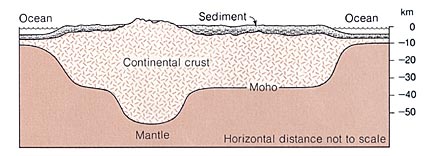
Figure 1: Mountains have deep roots under the surface of the ground. (Earth, Press and Siever, P. 413
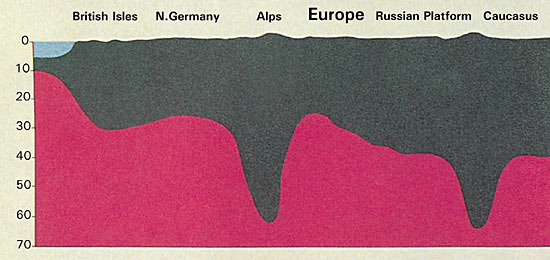
Figure 2: Schematic section. The mountains, like pegs, have deep roots embedded in the ground.
(Anatomy of the Earth, Cailleux, p. 220.)
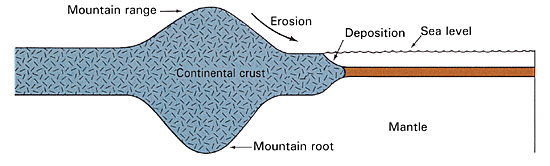
Figure 3: Another illustration shows how the mountains are peg-like in shape, due to their deep roots.
(Earth Science, Tarbuck and Lutgens, p. 158.)
This is how the Qur’an has described mountains. God has said in the Qur’an:
Have We not made the earth as a bed, and the mountains as pegs? (Qur’an, 78:6-7)
Modern earth sciences have proven that mountains have deep roots under the surface of the ground and that these roots can reach several times their elevations above the surface of the ground. So the most suitable word to describe mountains on the basis of this information is the word ‘peg,’ since most of a properly set peg is hidden under the surface of the ground. The history of science tells us that the theory of mountains having deep roots was introduced only in the latter half of the nineteenth century.
Mountains also play an important role in stabilizing the crust of the earth. They hinder the shaking of the earth. God has said in the Qur’an:
And He has set firm mountains in the earth so that it would not shake with you… (Qur’an, 16:15)
Likewise, the modern theory of plate tectonics holds that mountains work as stabilizers for the earth. This knowledge about the role of mountains as stabilizers for the earth has just begun to be understood in the framework of plate tectonics since the late 1960’s.
Could anyone during the time of the Prophet Muhammad (pbuh) have known of the true shape of mountains? Could anyone imagine that the solid massive mountain which he sees before him actually extends deep into the earth and has a root, as scientists assert? A large number of books of geology, when discussing mountains, only describe that part which is above the surface of the earth. This is because these books were not written by specialists in geology. However, modern geology has confirmed the truth of the Qur’anic verses.
The Qur’an on Mountains:Valke2 said:The Quran says regarding mountains, among other things, that they are placed like stakes in the ground to keep the earth from shaking. (78:6) Where does modern science weigh in on this?
Mountains were thrown down like:
tent pegs
like an anchor to hold a ship in place
to limit earthquakes (16:15)
Where does modern science weigh in on this.
A book entitled Earth is a basic reference textbook in many universities around the world. One of its two authors is Professor Emeritus Frank Press. He was the Science Advisor to former US President Jimmy Carter and for 12 years was the President of the National Academy of Sciences, Washington, DC. His book says that mountains have underlying roots. These roots are deeply embedded in the ground, thus, mountains have a shape like a peg.
Figure 1: Mountains have deep roots under the surface of the ground. (Earth, Press and Siever, P. 413
Figure 2: Schematic section. The mountains, like pegs, have deep roots embedded in the ground.
(Anatomy of the Earth, Cailleux, p. 220.)
Figure 3: Another illustration shows how the mountains are peg-like in shape, due to their deep roots.
(Earth Science, Tarbuck and Lutgens, p. 158.)
This is how the Qur’an has described mountains. God has said in the Qur’an:
Have We not made the earth as a bed, and the mountains as pegs? (Qur’an, 78:6-7)
Modern earth sciences have proven that mountains have deep roots under the surface of the ground and that these roots can reach several times their elevations above the surface of the ground. So the most suitable word to describe mountains on the basis of this information is the word ‘peg,’ since most of a properly set peg is hidden under the surface of the ground. The history of science tells us that the theory of mountains having deep roots was introduced only in the latter half of the nineteenth century.
Mountains also play an important role in stabilizing the crust of the earth. They hinder the shaking of the earth. God has said in the Qur’an:
And He has set firm mountains in the earth so that it would not shake with you… (Qur’an, 16:15)
Likewise, the modern theory of plate tectonics holds that mountains work as stabilizers for the earth. This knowledge about the role of mountains as stabilizers for the earth has just begun to be understood in the framework of plate tectonics since the late 1960’s.
Could anyone during the time of the Prophet Muhammad (pbuh) have known of the true shape of mountains? Could anyone imagine that the solid massive mountain which he sees before him actually extends deep into the earth and has a root, as scientists assert? A large number of books of geology, when discussing mountains, only describe that part which is above the surface of the earth. This is because these books were not written by specialists in geology. However, modern geology has confirmed the truth of the Qur’anic verses.
B
Booklover
Guest
“(Yea, the same that) has made for you the earth (like a carpet) spread out, and has made for you roads (and channels) therein, in order that ye may find guidance (on the way); (The Noble Quran, 43:10)”
Spread out like a carpet?? That sounds like FLAT to me! How can you deduce that the earth is round from that? :whacky:
You’re using the same quotes like the link I posted, except that their explanation makes sense and yours does not.
Vickie
V
Valke2
Guest
I don’t know where you learned your geology. This is getting a little silly, even for me.
K
Keikiolu
Guest
More like, “The koran on Crack”.The Qur’an on Clouds:
…{snip}…
Mahalo ke Akua…!
E pili mau na pomaika
i ia oe. Aloha nui.
H
hamba2han
Guest
The Qur’an does not state that Prophet Solomon (pbuh) talked to the ants but that he merely overheard their ‘conversation’.Valke2 said:In Sura 27:18, Solomon listens to a conversation of ants. Where does modern science weigh in on this.
At length, when they came to a (lowly) valley of ants, one of the ants said:
"O ye ants, get into your habitations, lest Solomon and his hosts crush you (under foot) without knowing it." … (Al-Qur’an, 27:18-19)
And do ants talk to one another?
Scientific research into ants has revealed that these tiny animals have very organised social lives and that, as a requirement of that organisation, they also have a very complex communication network. For example, National Geographic reports that:
Huge and tiny, an ant carries in her head multiple sensory organs to pick up chemical and visual signals vital to colonies that may contain a million or more workers, all of which are female. The brain contains half a million nerve cells; eyes are compound; antennae act as nose and fingertips. Projections below the mouth sense taste; hairs respond to touch.
Even if we are not aware of it, ants use a variety of methods to communicate, thanks to their very sensitive sensory organs. They use these organs at all times, from finding prey to following one another, and from building their nests to waging war. With 500,000 nerve cells squeezed into their 2-3 mm bodies, they possess a communications system that astonishes human beings.
The reactions in their communications have been divided into several specific categories: alarm, recruitment, grooming, exchange of oral and anal liquid, group effect, recognition, caste determination… Ants, which establish an ordered society by means of these reactions, live a life based on the mutual exchange of information. To bring about this exchange, they sometimes exhibit more flawless communication in areas that human beings often cannot resolve through speech, such as coming together, sharing, cleaning and defence.
Ants mainly communicate on the chemical level. These semiochemicals, known as pheromones, are chemical compounds that are perceived by smell and secreted by internal glands. In addition, they play the most important role in organising ant societies. When an ant secretes a pheromone, the other ants receive it by means of smell or taste and duly respond. Research into ant pheromones has revealed that all signals are emitted according to the needs of the colony. Moreover, the intensity of the pheromone emitted also varies according to the urgency of the situation at hand.
As we have seen, ants require a profound knowledge of chemistry to do what they do. The fact that the Qur’an emphasized this fact 1,400 years ago, a time when there was no such knowledge about ants, is another one of its scientific miracles.
Another interesting article is:
sciencenews.org/articles/20000205/bob12.asp
My opinion here is that this is one of the many verses found in the Qur’an that we humans still do not have adequate knowledge of.The stars are in the lower of the 7 heavens according to the Quran (Surah 67). Where does modern science weigh in on this?
And so, I would say that this is one instance where our knowledge in modern science has still to catch up with the Qur’an and while I know the cynics here will scoff at this answer, nevertheless this would be my honest opinion with regard to this particular verse and also other similar verses in the Qur’an.
J
jack_hawkins
Guest
which completely undermines the argument you have been making thus far!!!And so, I would say that this is one instance where our knowledge in modern science has still to catch up with the Qur’an

C
cestusdei
Guest
hamba, I went outside after reading this and found some ants. I began a conversation with them. However I was very frustrated. They didn’t talk back. Is it only middle eastern ants who can talk?
H
hamba2han
Guest
You really do need to read this article in order to discover the answer.Is it only middle eastern ants who can talk?
B
Booklover
Guest
This is getting sillier by the minute! :hypno: You must be desperate!The Qur’an does not state that Prophet Solomon (pbuh) talked to the ants but that he merely overheard their ‘conversation’.
At length, when they came to a (lowly) valley of ants, one of the ants said:
"O ye ants, get into your habitations, lest Solomon and his hosts crush you (under foot) without knowing it." … (Al-Qur’an, 27:18-19)
And do ants talk to one another?
Scientific research into ants has revealed that these tiny animals have very organised social lives and that, as a requirement of that organisation, they also have a very complex communication network. For example, National Geographic reports that:
Huge and tiny, an ant carries in her head multiple sensory organs to pick up chemical and visual signals vital to colonies that may contain a million or more workers, all of which are female. The brain contains half a million nerve cells; eyes are compound; antennae act as nose and fingertips. Projections below the mouth sense taste; hairs respond to touch.
Even if we are not aware of it, ants use a variety of methods to communicate, thanks to their very sensitive sensory organs. They use these organs at all times, from finding prey to following one another, and from building their nests to waging war. With 500,000 nerve cells squeezed into their 2-3 mm bodies, they possess a communications system that astonishes human beings.
The reactions in their communications have been divided into several specific categories: alarm, recruitment, grooming, exchange of oral and anal liquid, group effect, recognition, caste determination… Ants, which establish an ordered society by means of these reactions, live a life based on the mutual exchange of information. To bring about this exchange, they sometimes exhibit more flawless communication in areas that human beings often cannot resolve through speech, such as coming together, sharing, cleaning and defence.
Ants mainly communicate on the chemical level. These semiochemicals, known as pheromones, are chemical compounds that are perceived by smell and secreted by internal glands. In addition, they play the most important role in organising ant societies. When an ant secretes a pheromone, the other ants receive it by means of smell or taste and duly respond. Research into ant pheromones has revealed that all signals are emitted according to the needs of the colony. Moreover, the intensity of the pheromone emitted also varies according to the urgency of the situation at hand.
As we have seen, ants require a profound knowledge of chemistry to do what they do. The fact that the Qur’an emphasized this fact 1,400 years ago, a time when there was no such knowledge about ants, is another one of its scientific miracles.
Another interesting article is:
sciencenews.org/articles/20000205/bob12.asp
My opinion here is that this is one of the many verses found in the Qur’an that we humans still do not have adequate knowledge of.
And so, I would say that this is one instance where our knowledge in modern science has still to catch up with the Qur’an and while I know the cynics here will scoff at this answer, nevertheless this would be my honest opinion with regard to this particular verse and also other similar verses in the Qur’an.

Vickie
C
cestusdei
Guest
It says “talk”. I am taking the quran at its word. It must be these American ants. Maybe they only speak Arabic!
K
Keikiolu
Guest
Moslem ants are just as responsive as moslem people, in that you have to “word” things “JUST RIGHT”, or they get “offended” and infest your abode.hamba, I went outside after reading this and found some ants. I began a conversation with them. However I was very frustrated. They didn’t talk back. Is it only middle eastern ants who can talk?
You were expecting WHAT, exactly…!?
SENSE!? Dude,…! Get real…
Mahalo ke Akua…!
E pili mau na pomaika
i ia oe. Aloha nui.
T
The_Truthinator
Guest
You seem to claim that because Mohammed decided to construct the Qur’an with a challenge attached, that proves its authenticity, correct? Obviously, none but a fool would put such a bold statement in unless it were true …  HOWEVER,
In the Scriptures, it is written:
“Test everything that is said. Hold on to what is good.”
And,
“All Scripture is inspired by God and is useful to teach us what is true…”
Finally, I think it’s important to point out that the Qur’an doesn’t advertise a God of justice, but rather, a god who will excuse violation of his laws so long as good deeds out-weigh bad deeds. The God of the Bible is just and gracious. The Jews have no means of forgiveness without sacrifices, because to say God will simply pardon their sins without payment is to say he is unjust. To say he would abolish the sacrificial system without providing a means of forgiveness is to say he is ungracious. Only Christianity covers both these attributes: God, in his grace–in his unending love–sent us a means of forgiveness, one who would pay the price for all our misdeeds … Thus his wrath was appeased, his Grace made flesh!
Beyond that is the fact that the Qur’an was composed solely by Mohammed, in Arabic, while the Christian Bible was written by shepherds, kings, scribes, fishermen, an ex-Pharisee, a tax collector, on three continents, in Hebrew, Aramaic, and Greek, and yet has an undescribable flow and unity to it.
“If a fragment of stone were found in Italy, another in Asia Minor, another in Greece, another in Egypt, and on and on until sixty-six fragments had been found, and if when put together they fitted perfectly together, making a perfect statue of Venus de Milo, there is not an artist or scientist but would arrive immediately at the conclusion that there was originally a sculptor who conceived and carved the statue. The very lines and perfections would probably determine which of the great ancient artists carved the statue. Not only the unity of the Scriptures, but their lines of perfection, suggest One far above any human as the real author. That could be no one but God.” --C.J. Sharp
HOWEVER,In the Scriptures, it is written:
“Test everything that is said. Hold on to what is good.”
And,
“All Scripture is inspired by God and is useful to teach us what is true…”
Finally, I think it’s important to point out that the Qur’an doesn’t advertise a God of justice, but rather, a god who will excuse violation of his laws so long as good deeds out-weigh bad deeds. The God of the Bible is just and gracious. The Jews have no means of forgiveness without sacrifices, because to say God will simply pardon their sins without payment is to say he is unjust. To say he would abolish the sacrificial system without providing a means of forgiveness is to say he is ungracious. Only Christianity covers both these attributes: God, in his grace–in his unending love–sent us a means of forgiveness, one who would pay the price for all our misdeeds … Thus his wrath was appeased, his Grace made flesh!
Beyond that is the fact that the Qur’an was composed solely by Mohammed, in Arabic, while the Christian Bible was written by shepherds, kings, scribes, fishermen, an ex-Pharisee, a tax collector, on three continents, in Hebrew, Aramaic, and Greek, and yet has an undescribable flow and unity to it.
“If a fragment of stone were found in Italy, another in Asia Minor, another in Greece, another in Egypt, and on and on until sixty-six fragments had been found, and if when put together they fitted perfectly together, making a perfect statue of Venus de Milo, there is not an artist or scientist but would arrive immediately at the conclusion that there was originally a sculptor who conceived and carved the statue. The very lines and perfections would probably determine which of the great ancient artists carved the statue. Not only the unity of the Scriptures, but their lines of perfection, suggest One far above any human as the real author. That could be no one but God.” --C.J. Sharp
H
hamba2han
Guest
The Qur’an is NOT “inspired” by God… It is instead the literal Word of God and His Final Revelation to humankind.In the Scriptures, it is written:
“Test everything that is said. Hold on to what is good.”
And,
“All Scripture is inspired by God and is useful to teach us what is true…”
Allah (swt) will not excuse violations of His laws, but rather He will forgive these violations according to His Grace and His Mercy for He is the Most Gracious and the Most Merciful… but this too will be tempered by His sense of justice for He is also the Most Just.I think it’s important to point out that the Qur’an doesn’t advertise a God of justice, but rather, a god who will excuse violation of his laws so long as good deeds out-weigh bad deeds.
What this means is that wrongdoers and evildoers in this world cannot expect the same level of forgiveness from their Creator in the Hereafter as that which He will bestow on the good and faithful of His creations on the Day of Judgment because that would not be doing justice to those of His creations who had faithfully followed His commands and made many acts of worship and sacrifices in this world for the sake of their Creator.
The Qur’an was NOT composed by Prophet Muhammad (pbuh) for he could neither read nor write but he was indeed solely responsible for everything that is found within it, not just the actual text but also the arrangement of all of the verses and chapters of the Qur’an as well as I have explained in my previous posts on this thread.Beyond that is the fact that the Qur’an was composed solely by Mohammed, in Arabic, while the Christian Bible was written by shepherds, kings, scribes, fishermen, an ex-Pharisee, a tax collector, on three continents, in Hebrew, Aramaic, and Greek, and yet has an undescribable flow and unity to it.
M
Montalban
Guest
You miss the difference between ‘communicating’ and talking.You really do need to read this article in order to discover the answer.
When my dog growls, it is communicating. Ants communicate, not talk.
I’ve yet to hear ants conversant in topics. This is much different from Solomon listening to a ‘conversation’. To converse is not something ants do.
And that’s what the Koran says of ants…
Surah An-Naml
27:18
Till, when they came to the valley of the ants, one of the ants said: “O ants! Enter your dwellings, lest Sulaiman (Solomon) and his hosts crush you, while they perceive not.”
quraan.com/index.aspx?tabindex=1&tabid=27&bid=27
Note well, that your own article doesn’t use the word ‘talk’ at all, nor ‘speak’.
M
Montalban
Guest
How did your god speak these words?The Qur’an is NOT “inspired” by God… It is instead the literal Word of God and His Final Revelation to humankind.
J
jack_hawkins
Guest
right - ever heard of a non sequiturThe Qur’an was NOT composed by Prophet Muhammad (pbuh) for he could neither read nor write
you may be right of course, it may be someone else other than “Muhammad” that wrote the Koran - he had a learned companion didn’t he, can’t remember his name…
large sections are plagiarised anyway
since “Muhammad” couldn’t read or write, how do we know that the Koran has been written down as “Allah” dictated it? why didn’t “Allah” dictate it to someone who could read and write?
M
Montalban
Guest
In Islam we have a god who’s beyond knowing passing on his thoughts to Muhammed who can’t read or write!right - ever heard of a non sequitur
you may be right of course, it may be someone else other than “Muhammad” that wrote the Koran - he had a learned companion didn’t he, can’t remember his name…
large sections are plagiarised anyway
since “Muhammad” couldn’t read or write, how do we know that the Koran has been written down as “Allah” dictated it? why didn’t “Allah” dictate it to someone who could read and write?
Muhammed composes a Koran that’s supposed to have nothing in it, but the word of this god. Yet several verses have Muhammed speaking in first person.
It’s supposed to be without errors, and yet several verses ‘abrogate’ others.
It seems to be the only work in world history that it’s impossible to translate from - as all Moslems seem to think we’ve all missed the meaning of the words.
H
hamba2han
Guest
How did God speak the words of the Qur’an?
Through the Archangel Gabriel (as) who taught the verses to the Prophet Muhammad (pbuh) over a 23-year period up till shortly before his demise.
Apart from mountains, pegs, clouds, seas and rivers etc., the Qur’an also mentions something about ladders:
And if their turning away is hard on you, then if you can seek an opening (to go down) into the earth or a ladder (to ascend up) to heaven so that you should bring them a sign and if Allah had pleased He would certainly have gathered them all on guidance, therefore be not of the ignorant … Al-Qur’an, 006:035
In other words, it does not matter what signs are shown to them, those who choose to not believe will never be satisfied by the truth of the Qur’an.
Correct guidance is only given to those who choose to believe and have Taqwa i.e. fear of Allah:
Had We sent this as a Qur’an (in the language) other than Arabic, they would have said: “Why are not its verses explained in detail? What! (a Book) not in Arabic and (a Messenger an Arab?” Say: “It is a Guide and a Healing to those who believe; and for those who believe not, there is a deafness in their ears, and it is blindness in their (eyes): They are (as it were) being called from a place far distant!” … Al-Qur’an, 041:044
Through the Archangel Gabriel (as) who taught the verses to the Prophet Muhammad (pbuh) over a 23-year period up till shortly before his demise.
Apart from mountains, pegs, clouds, seas and rivers etc., the Qur’an also mentions something about ladders:
And if their turning away is hard on you, then if you can seek an opening (to go down) into the earth or a ladder (to ascend up) to heaven so that you should bring them a sign and if Allah had pleased He would certainly have gathered them all on guidance, therefore be not of the ignorant … Al-Qur’an, 006:035
In other words, it does not matter what signs are shown to them, those who choose to not believe will never be satisfied by the truth of the Qur’an.
Correct guidance is only given to those who choose to believe and have Taqwa i.e. fear of Allah:
Had We sent this as a Qur’an (in the language) other than Arabic, they would have said: “Why are not its verses explained in detail? What! (a Book) not in Arabic and (a Messenger an Arab?” Say: “It is a Guide and a Healing to those who believe; and for those who believe not, there is a deafness in their ears, and it is blindness in their (eyes): They are (as it were) being called from a place far distant!” … Al-Qur’an, 041:044
J
jack_hawkins
Guest
another of your by now famous circular argumentsIn other words, it does not matter what signs are shown to them, those who choose to not believe will never be satisfied by the truth of the Qur’an
how can someone choose not to believe???
explain that one ham - it is completely illogical

- Status
- Not open for further replies.